


1. Setting the stage
This July, I Said What I Said, one of Africa’s most popular podcasts, hosted by Jola Ayeye and Feyikemi “FK” Abudu, will begin its largest international tour yet. The show will make stops in 12 cities across the United States, the United Kingdom, Canada, Nigeria, Ghana and Kenya. Seven new cities have been added to the tour, up from the five it visited last year.
The expansion offers a glimpse into what I Said What I Said has become. Launched in 2017, the podcast began as a series of candid conversations about life, relationships and popular culture. It has since grown into one of Nigeria’s most recognisable talk shows, with an audience that stretches beyond the country and a business that now extends beyond recorded episodes.
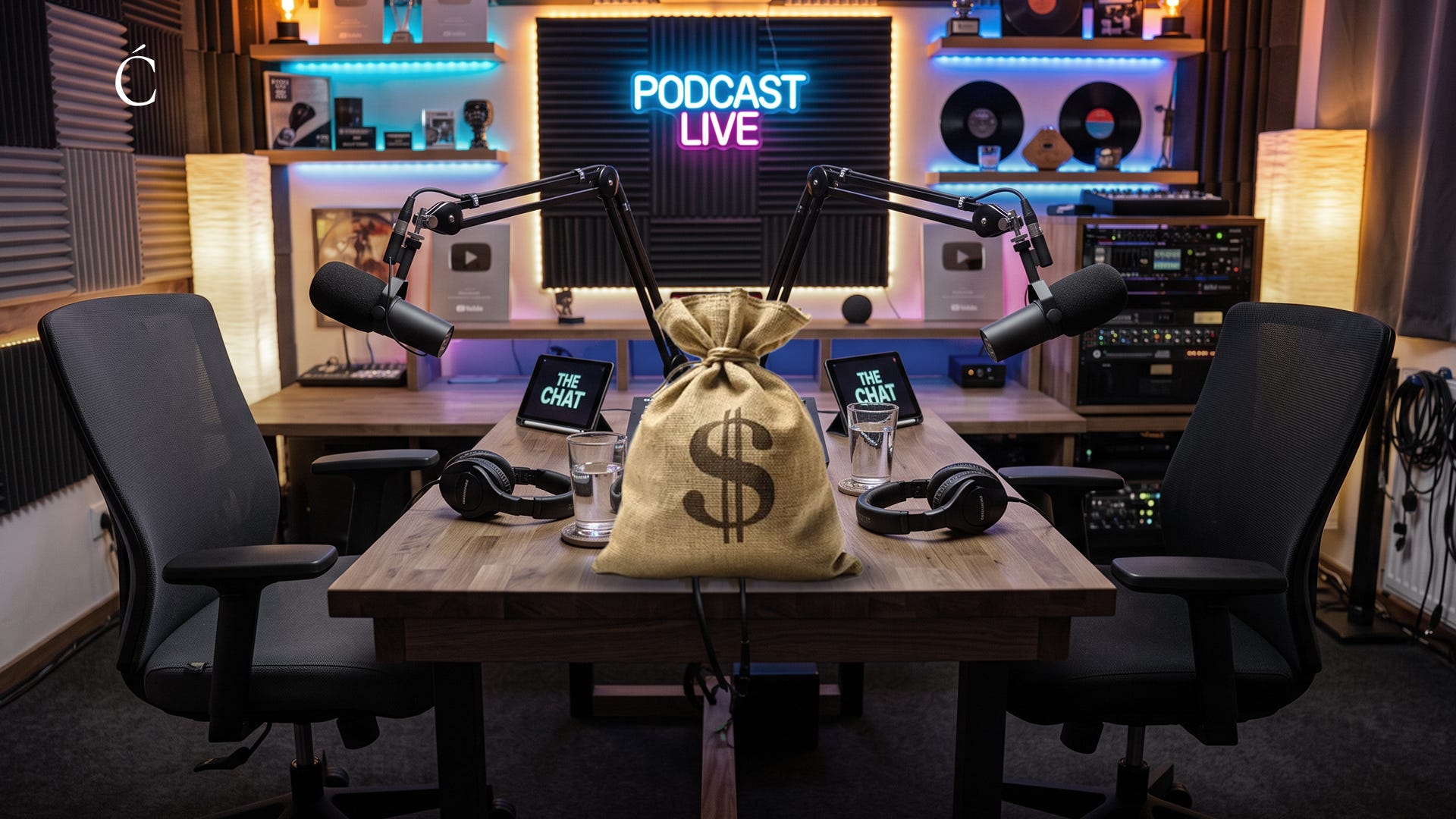
I Said What I Said is not alone. Across Nigeria, successful podcasts are beginning to operate as multimedia businesses rather than standalone audio programmes. They publish full video episodes on YouTube, cut recordings into clips for social media, work with advertisers, and organise ticketed events. But each new format also introduces new costs. A podcast that once required microphones, a producer, and a sound engineer may now need a studio, cameras, lighting, video editors, social media producers, and an events team. Touring adds venues, travel, accommodation, technical production, and marketing to the bill.
As Nigerian podcasts evolve into full multimedia businesses, how much does it actually cost to produce one? And what does it take to build a sustainable business around a podcast?
You’re reading Communiqué because someone in the Inner Circle paid for it. Pay it forward.
2. Counting the cost
Not everyone will achieve success on the scale of I Said What I Said. Podcasting still has an unusually low barrier to entry. Anyone with a smartphone and a quiet room can record a conversation, publish it online, and call it a podcast without spending anything. That simplicity has produced an abundance of shows. Spotify now hosts about 100,000 African podcasts.
Most podcasts begin as audio-only productions and, despite the growth of video, audio remains the format’s foundation. Media companies also continue to invest in it. Last year, Culture Custodian launched Carnivores, a narrative podcast about the rivalries and public disputes that have shaped Nigerian popular culture. Earlier this month, technology newsletter Notadeepdive launched Africa Built, which traces the development of some of Africa’s most important technology companies.
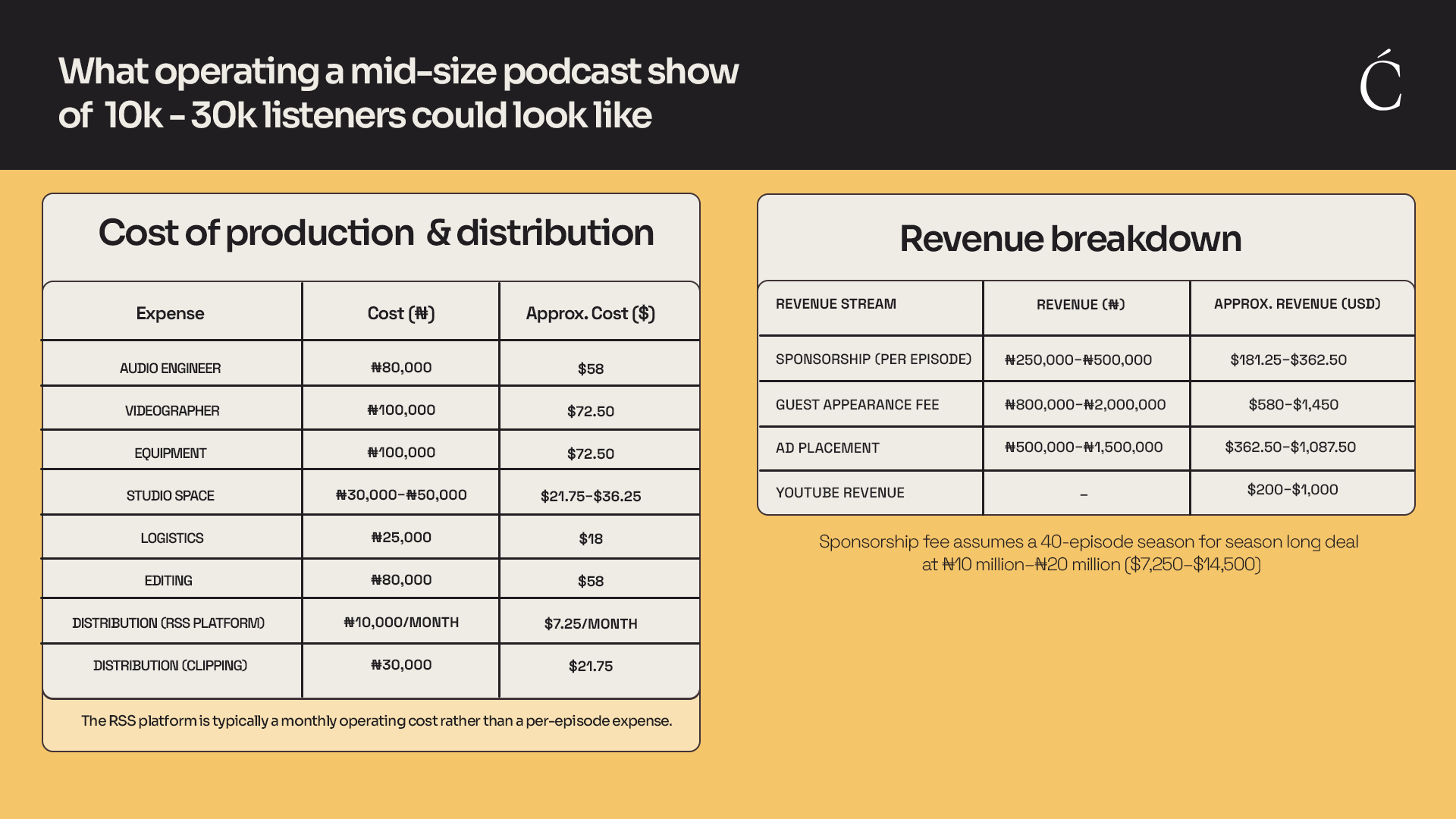
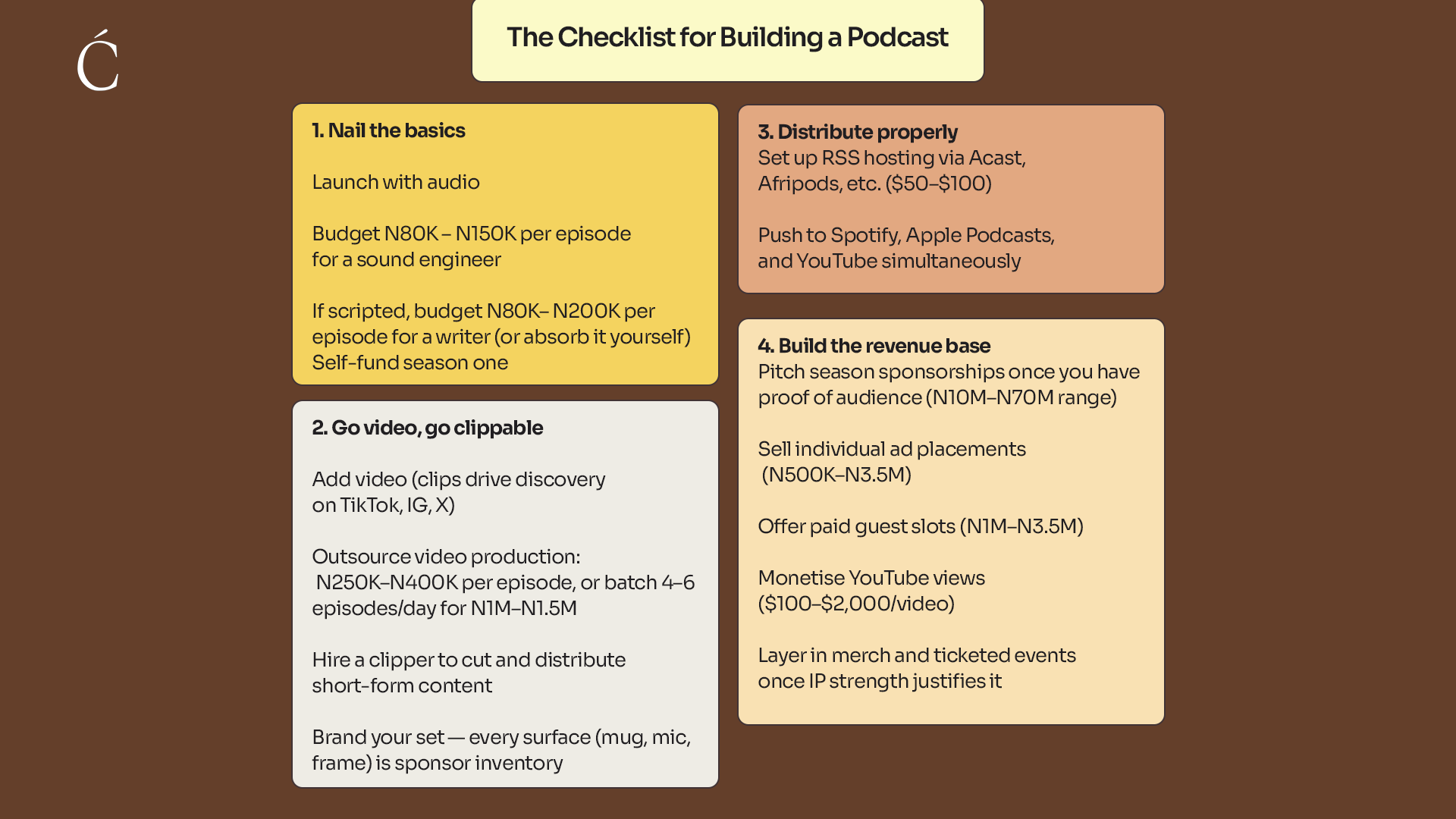
But the moment a producer decides to professionalise a podcast, the costs begin to accumulate. For a one-hour audio episode, a sound engineer can charge between ₦80,000 ($58) and ₦150,000 ($109), depending on experience and production complexity. That work can include supervising the recording, cleaning the audio, mixing voices, and adding music or effects. A heavily produced narrative show will usually cost more than a loose conversation between two hosts.
A scripted programme also needs a writer. An experienced podcast scriptwriter can charge between ₦80,000 ($58) and ₦200,000 ($158) per episode. Finding one is not always easy. Nigeria has a large pool of screenwriters and journalists, but relatively few writers have been trained to write for the ear, where pacing, transitions, and sound must carry the story. “Scripting podcasts in Nigeria is so difficult because people are not used to scripted podcasts. There’s this idea that to make a podcast, you just need to get behind the mic and discuss the topic of the day,” Adetoun Samiat, Culture Custodian’s head of storytelling, told Communiqué. Consequently, many scripted podcast productions absorb the cost of writing, with the host and producer taking on the work themselves.
Increasingly, however, audio is only the starting point. The reasoning is commercial. Audiences and platforms have shifted towards watching rather than just listening, and YouTube is now one of the largest homes for podcasts. A camera also turns one recording into several products: a full episode for YouTube, and short clips that travel across Instagram, TikTok and X. Those clips have become the main way new listeners find news shows, which makes video the cheapest marketing tool for podcasting.
Video pays in another way, too. It gives advertisers something to buy that audio cannot. “Video podcasts attract more investors because now there are visuals,” Ayo Lawal, former creative director at Eggcorn Digital, told Communiqué. “You can brand the cup, brand the mic, you can brand the picture frame hanging on the wall.” Every surface in the shot becomes inventory a sponsor can pay to occupy.
This does not mean audio-only podcasts cannot make money. Video may widen the commercial opportunity, but a distinctive audience can still make audio pay. In 2022, I Like Girls, a narrative audio podcast that entered the top 10 documentary podcasts in Africa, secured a combined ₦10 million ($22,831; at a 2022 exchange rate of ₦438.1 to $1) in sponsorship from PiggyVest and Paystack. The funding allowed the production to break even, with a significant portion used to stage a listening event.
With video, the trade-off is cost. A show that once needed only microphones, a producer, and a sound engineer now needs a studio, cameras, lighting, video editors, and social media producers. A podcast company can bring video production in-house by building its own studio. This requires a significant upfront investment in cameras, microphones, lighting, furniture, editing equipment and power. But the studio can eventually become a profit centre if it is leased to other podcasters and creators when not in use. For a fuller breakdown of those economics, read Communiqué 108.
Most podcasts, however, outsource production. Recording and editing a one-hour video episode typically costs between ₦250,000 ($181) and ₦400,000 ($290). Producers can lower the average cost by recording several episodes in one day. A full-day booking, during which four to six one-hour episodes are filmed, costs between ₦1 million ($725) and ₦1.5 million ($1,087.5). This spreads the cost of production across more episodes.
3. The long road to profitability
Once an episode is finished, it must be distributed. Hosting services such as Acast and Afripods provide the RSS feed through which an audio show reaches Spotify and Apple Podcasts. Hosting and distribution can add roughly $10 to $30 per month to costs, depending on the service and plan.
Distribution alone does not guarantee discovery. Producers increasingly pay clippers to extract moments from an episode and publish them on TikTok, Instagram, X and YouTube Shorts. These clips are designed to travel further than the full episode and direct viewers back to it.
Your contribution funds: Original reporting, data licensing, and a small editorial team that actually answers your replies. No ads, no paywalls.
After accumulating these costs, producers need to recoup their investment. Most do not. A polished set and clean footage may make a podcast look successful long before it becomes commercially viable. Typically, the first season is self-financed by the producer as a proof of concept: evidence that the format works, that the hosts are compelling, and that there is an audience for the podcast. Producers can then take those results to advertisers before commissioning a second season. The exceptions that secure sponsorship in their debut season are shows whose hosts already have large online followings; those existing audiences are what brands are actually trying to reach. Brands back them immediately because the podcast’s audience already exists.
For podcasts that do scale, revenue comes from several sources. Industry estimates gathered by Communiqué suggest that a season sponsorship can range from ₦10 million ($7,250) to ₦70 million ($50,750), depending on the number of episodes, audience size, and engagement. Individual advertising placements can bring in ₦500,000 to ₦3.5 million, while paid guest appearances can cost between ₦1 million and ₦3.5 million. These figures are not fixed. Prices depend on the advertiser’s budget, its relationship with the podcast and what the package includes.
YouTube adds another layer. Revenue can range from about $100 to $2,000 per video, depending on views and viewers’ locations. Ticketed live shows and merchandise also provide revenue.
By the time a podcast reaches this stage, it is no longer really a podcast. It is a media business, and like any business, it survives by not depending on a single source of income. The recorded episode sits at the centre, but the revenue radiates outwards into video, sponsorship, merchandise and live shows.
“The podcast becomes the central IP for everything that you do, and depending on the strength of the IP, it communicates immense value to brands to sponsor your production. In that way, podcasts make more money,” Samiat told Communiqué.
That is the logic behind I Said What I Said’s 12-city tour. The episodes built the audience, and a business was built on top of that audience. The tour is just the latest thing the business can sell.
A Note From the Editor

From today, July 21, until September 1, 2026, we will be going on a publishing break. During this time, we will not be publishing new Flagship essays or Offscript profiles. Instead, we’ll take this time to rest and recharge, improve our content formats, and strengthen the publication for the busy second half of the year.

While we are away from your inbox, feel free to explore our archives and catch up on the essays and Offscript profiles (there have been very incredible ones like this one and this) you might have missed this year. You can also reach out to us to share what you want to understand about Africa’s media and creative industries.

Thank you for your continued support. See you soon!
Excellent story..
Oh damn lmao. No words really.