


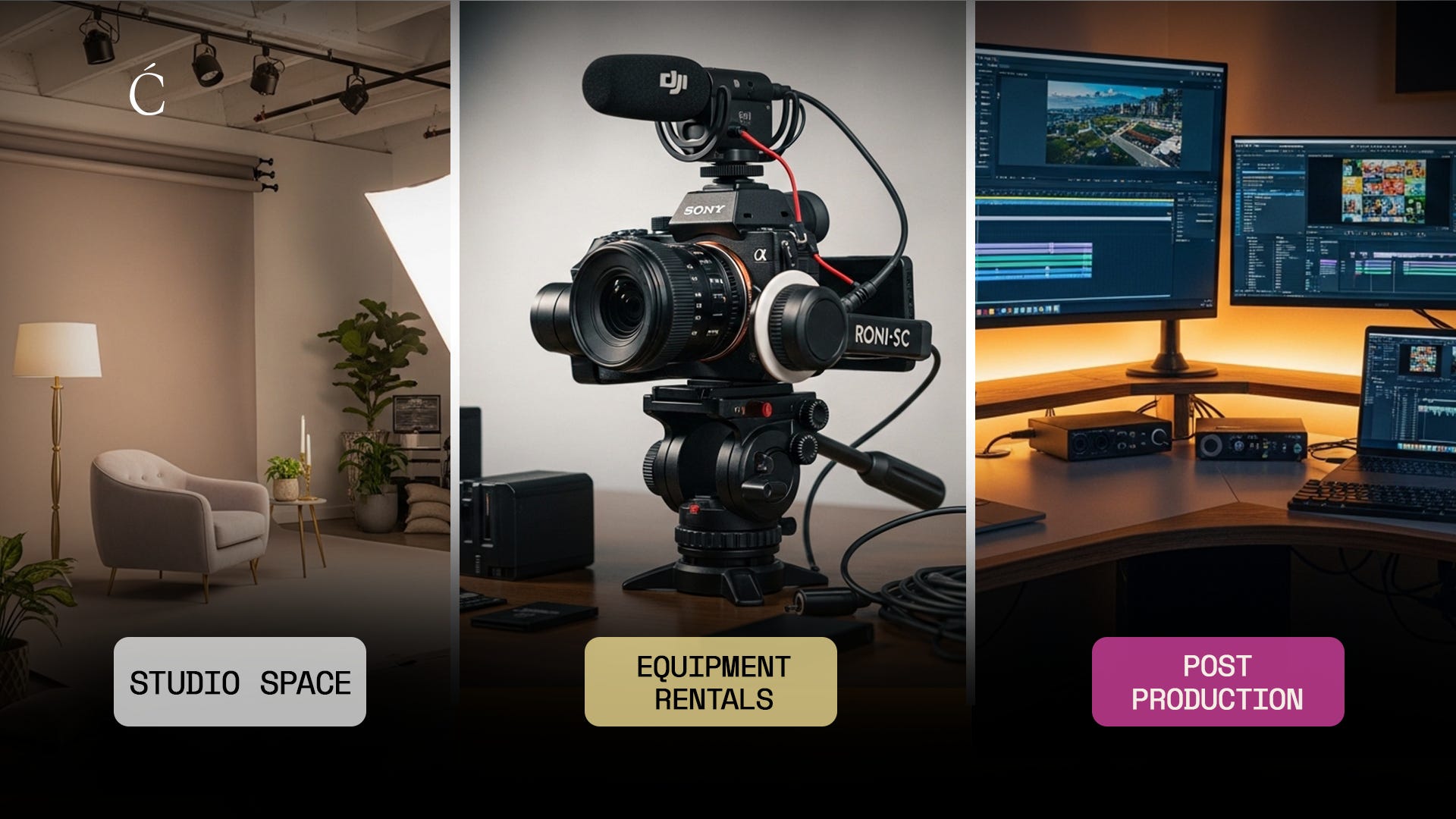
1. The creator studio gold rush
In November 2025, creative entrepreneur Ibidunni Oladayo opened The Content Lab, a 500-square-metre production facility designed for digital creators. Located in Ikeja, Lagos, the studio space includes three production studios, editing suites, a make-up studio, and other supporting facilities designed to streamline the production of professional digital content.
Oladayo is not the only one building infrastructure for creators. In February last year, documentary photographer and filmmaker Damilola Onafuwa opened Aroba Hub, a content studio and creative co-working space designed to serve photographers, filmmakers, and digital creators looking for a dedicated production environment.
Across Nigeria, similar facilities are appearing in major cities. From Lagos to Abuja, Port Harcourt, and Benin City, creator studios are quietly springing up, offering production spaces, equipment, and support services to a fast-growing population of digital creators. For YouTubers, podcasters, influencers, photographers, and filmmakers, these studios promise something that has historically been scarce in the creator economy: reliable places to produce high-quality content.
Demand for these creator studios is rising so quickly that some operators are beginning to specialise in only one part of the production process rather than building full-service facilities.
In October last year, Bright Eyes Editing Studio opened in Lekki, Lagos. Unlike broader studios that offer shooting spaces and production services, Bright Eyes focuses almost entirely on the final stages of the content pipeline—editing, colour grading, and finishing services for filmmakers, YouTubers, and digital media producers.
The emergence of specialised facilities like this is a sign of how quickly the creator economy is maturing. As more creators move from casual production to professional output, different parts of the value chain, from filming to editing to distribution, are beginning to support their own dedicated businesses.
What is emerging is an ecosystem of creator infrastructure providers: studios to shoot in, editing houses to finish content, and collaborative spaces where creators can work, meet, and experiment. Together, they form the early outlines of a physical production layer for Nigeria’s growing creator economy.
2. Counting the cost of creation
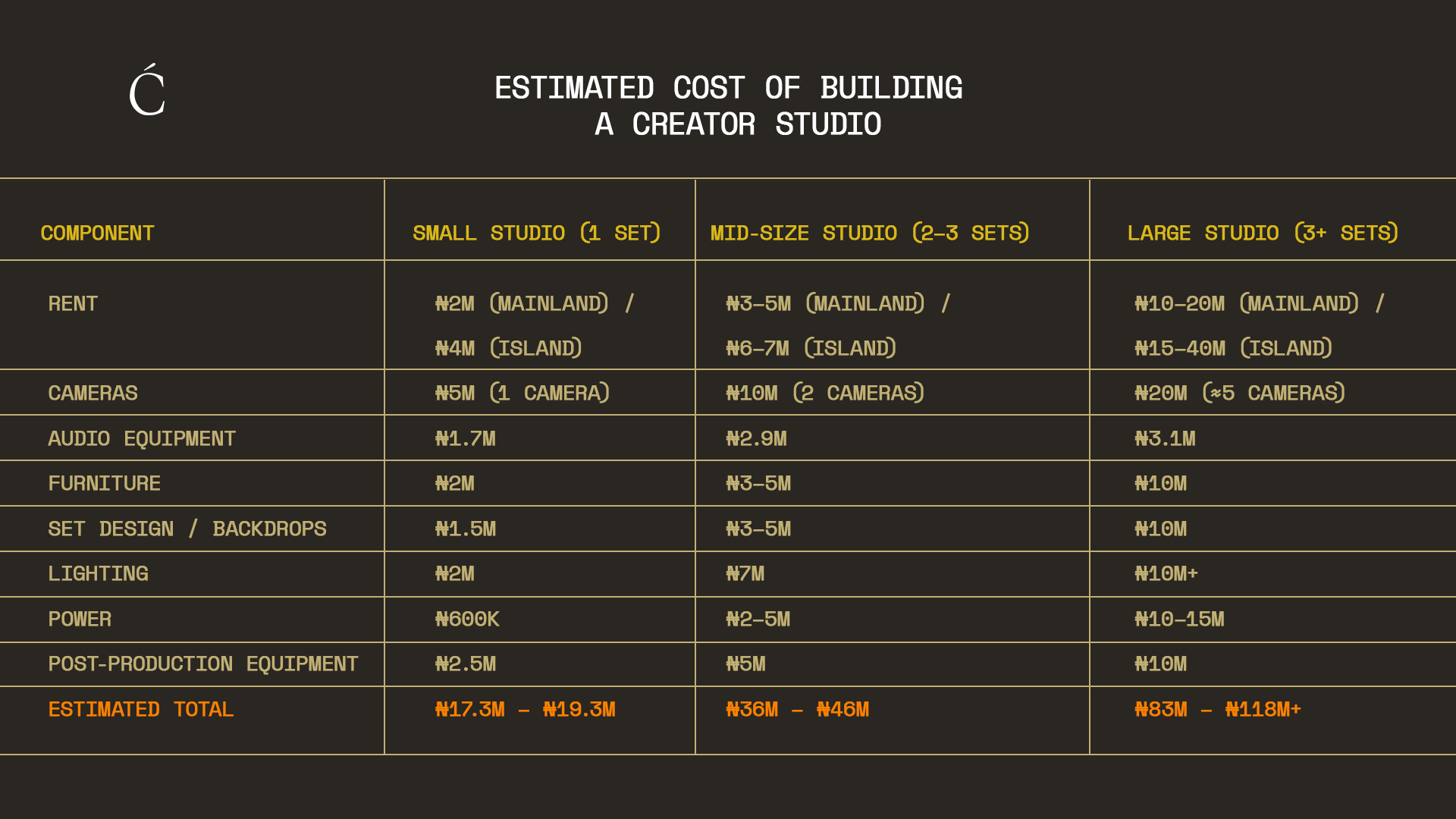
To be a part of the growing ecosystem of creator studios, you must first determine how big you want to go. The size you choose affects everything—rent, budget, and the kinds of clients and creators you can serve.
You can build a small creator studio inside a studio apartment. It will have only one set, for example, a podcast table, an interview corner, or a simple YouTube setup. Because the space is small, the equipment requirements are limited. One camera, basic lighting, microphones, and simple furniture are enough to get started.
The camera is where things get interesting. The most popular video camera used in content studios today is the Sony FX3, which sells for about ₦5 million ($3,570). “The FX3 is the cheapest Netflix-approved camera, making it attractive for creators who want high-quality video at a low price,” Tito Nwachokor, creative director at Mastermind Studios, told Communiqué.
For operators seeking slightly better camera quality, the Sony FX6 is another option, priced at around ₦9 million ($6,440). Lenses are another cost to consider. Basic lenses may cost between ₦500,000 and ₦1 million, while higher-end lenses like Sony’s G Master can cost as much as ₦3 million.
Audio equipment is equally important. A typical setup includes podcast microphones, wireless microphones for interviews, and an audio mixer. A Rode PodMic can cost around ₦300,000 ($214), while higher-end microphones like the Shure podcast mic can reach ₦700,000 ($500). Many studios also use the Rodecaster Duo mixer, which sells for about ₦1 million. Wireless microphones used for vox pops or mobile recording can cost as little as ₦200,000.
As studios grow, the highest costs tend to shift towards lighting, furniture, and set design. A mid-size studio, usually located in a two- or three-bedroom apartment, can support two or three sets. This allows creators to shoot different formats in the same facility: for example, a podcast set, a talk-show set, and a photography backdrop. Larger studios operate at a completely different scale. Instead of apartments, many operators rent whole buildings or warehouses and build multiple sets inside them. This strategy allows several productions to run simultaneously.
Power is another major consideration in Nigeria. Small studios may rely on a small petrol generator, which can cost around ₦600,000. Larger facilities often need multiple solutions, including solar and inverter systems, and diesel generators. Combined, these can cost between ₦10 million ($7,150) and ₦15 million ($10,730) upfront.
Post-production equipment is also necessary. Laptops, editing software, and hard drives are essential. Many studios rely on MacBooks, editing systems, and external storage drives. A single 4-terabyte hard drive can cost as much as ₦450,000 for a small studio, while a 20-terabyte hard drive setup can cost ₦2–3 million if the studio needs large storage capacity for video files. The numbers above represent the cost of buying brand-new equipment. In practice, many studio owners buy fairly used equipment to reduce their start-up costs. Prices are also heavily influenced by exchange rates, since most cameras, lights, and audio gear are imported.
3. The creator studio revenue playbook
Given the massive capital investment required to launch, studios must generate revenue immediately. This revenue comes from a mix of sources, including photography shoots, videography shoots, and podcast recording sessions. Studios also earn money by renting out cameras, lighting kits, and microphones. Some studios host small, intimate events such as private screenings, workshops, masterclasses, creator meet-ups, and training sessions. Over time, these multiple revenue streams allow the operators to keep their spaces busy throughout the week.
The size—and to some extent the location—are the primary determinants of the cost of renting these studios. A small studio with one set might charge around ₦20,000 per hour for studio time. A mid-size studio, with two or three sets, can charge between ₦30,000 and ₦65,000 per hour. Larger studios, especially those built inside warehouses with multiple sets, command higher prices. These facilities typically charge between ₦70,000 and ₦100,000 per hour, especially for commercial productions, brand shoots, or music video shoots.
Beyond hourly rentals, some studio operators are experimenting with membership models. For instance, Eko Creative Hub, with four locations in Lagos, has introduced a two-tiered creator membership programme for frequent users of the space. These memberships allow creators to pay a recurring monthly fee in exchange for discounted studio access, priority booking slots, and a set number of recording hours each month. In some cases, members also gain access to editing suites, community events, training sessions, and collaboration opportunities with other creators using the facility.
For creators, the membership model reduces the cost of repeatedly booking studio time. For studio operators, it creates predictable, recurring revenue, which can be difficult to achieve in a business built around hourly rentals.
4. The economics of creator infrastructure
What is happening with the trend of new creator studios emerging is not unique. Economists have spent decades trying to explain how industries grow from scattered individual activity into organised, self-sustaining ecosystems. The story of Nigeria’s creator economy fits their models closely enough to be instructive.
The starting point is the Linkage Theory developed by the economist Albert Hirschman in the 1950s. Hirschman argued that certain investments do not just support economic activity; they induce it. When infrastructure is in place, previously unviable activities suddenly become possible. A creator who cannot afford to own professional equipment can now rent studio time. A filmmaker who lacked post-production facilities can now outsource the process. The infrastructure does not follow the industry; it calls it into existence. In Hirschman’s language, every studio that opens in Lagos creates forward linkages: it enables the next layer of creative output that would not otherwise occur.
But infrastructure alone does not explain what comes next. As the creator economy has grown, something more interesting has begun to happen: the production process is splitting into distinct stages. What was once a single, messy, do-it-yourself chain—shoot, edit, grade, distribute—now begins to split into distinct, specialised businesses. Studios focused only on shooting, editing houses focused only on finishing, and equipment rental outfits supplying cameras, lights and other production gear.. This kind of decomposition has a name in business theory: modularity. The economists Carliss Baldwin and Kim Clark showed that as industries mature, they tend to break into interoperable components, each of which can be optimised independently. The emergence of a place like Bright Eyes Editing Studio in Lekki, focused entirely on editing and colour grading, is a sign that the Nigerian creator economy has crossed a threshold. It is mature enough to support specialisation.
And finally, there is the question of geography. These studios are not appearing randomly across Nigeria. They are concentrating in particular corridors across major cities, where creators, clients, and collaborators increasingly find each other. The economist Alfred Marshall, writing over a century ago, noticed that industries tend to cluster in specific places and that the clustering itself becomes an advantage. Skilled workers concentrate there. Knowledge moves between firms. Suppliers set up nearby. The cluster becomes more productive than the sum of its parts. What Marshall described in Victorian England’s manufacturing towns, you can now see taking shape in Lagos and other major cities across Nigeria: a geographic centre of gravity for content production, still forming but already pulling people and money towards it.
Taken together, these three dynamics— activity, specialisation deepening the production chain, and geography concentrating talent—suggest that the creator economy is not simply getting bigger but also becoming more structured. And that structural maturity tends to be self-reinforcing: the more developed the ecosystem, the easier it becomes for new creators to enter, which drives more demand for infrastructure, which attracts more investment, which deepens the specialisation further.
Once it starts, the cycle is hard to stop.
If you like what you just read and find it useful, consider supporting Communiqué with a donation.
This is a great read. I started to notice the shift in content across Nigeria in 2020 . Around Covid, the intro of Hype Squad, Cruise and skits showed me that the creator economy is truly alive in Nigeria.
I have been looking for ways to invest into this economy. This article has been able to perform a proper market analysis on how to get started