


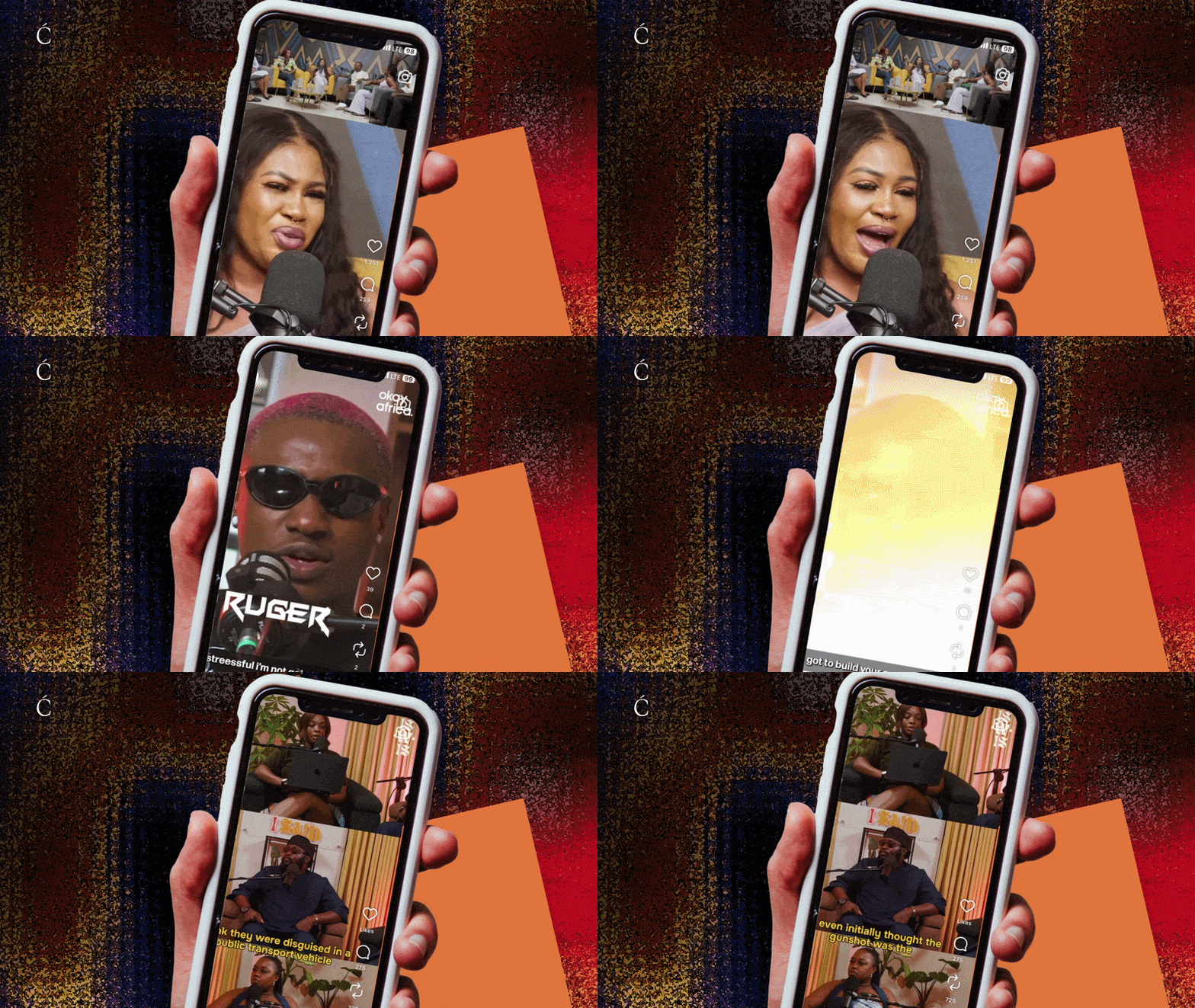
1. Welcome to the clipping economy
You’ve probably become familiar with the format by now. You open X and the first thing you see is a short video from your favourite podcast. Maybe it is I Said What I Said with Jola Ayeye and FK Abudu mid-laugh about a dilemma sent in by one of their listeners. Maybe it is The Honest Bunch, with a presidential candidate explaining his policy initiatives. It might even be Afrobeats Intelligence, with Joey Akan dissecting the finer details of a label deal involving your favourite artist. Or maybe the clip is not from a podcast at all. Maybe it is from a church service, a concert, or the morning segment of a TV show.
Whatever it is, you almost certainly did not go looking for it. The account that posted is not one you follow, and is run by a person you cannot name. Congratulations. You have just experienced the clipping industry.
Clippers are largely anonymous social media accounts whose sole purpose is to rack up views. They take a piece of long-form content — an hour-long livestream, a podcast, a sermon, a press conference — and pull out the most exciting, controversial, or emotionally charged moments. Some are dedicated operations. Others are existing media or entertainment pages that creators and companies quietly recruit to help push their content. The clippers themselves can be based anywhere in the world: a teenager in Ibadan, a 9–5 worker in Nairobi, a university student in Accra. Geography is irrelevant. The only thing that matters is that the clip travels.
And increasingly, this is how most people now experience content on the internet: not as complete works consumed intentionally, but as fragments engineered by strangers to drive engagement. Globally, an industry has begun to form around this behaviour. In Nigeria, however, it is still in its early stages.
2. Meet Nigeria’s most famous clipper
No one has come to exemplify the clipping industry in Nigeria quite like OneJoblessBoy. If you spend enough time on social media, particularly X, you will run into the account sooner or later. It is one of the clearest examples of how clipping in Nigeria has grown from casual posting into a real part of the media ecosystem.
Like many similar operations, OneJoblessBoy did not begin as a clipping account. It was the social media page for Onejoblessboy.com, a kind of online diary where the founder and his circle of friends published everyday stories, observations, and commentary in both English and Pidgin. The problem was that almost nobody was paying attention.
To drive engagement, they started posting things people already cared about: memes, concert recaps, throwback videos, football clips, anything people were already interested in. The plan was to build an audience first and then use that audience to drive their own distribution needs. “The idea is that things are shareable on social media, so we find things that people find interesting. Like a throwback video of Wizkid dancing, for example, and we bring it back, and we use that to build distribution, which we can now use for our articles,” the operator behind the OneJoblessBoy accounts, who spoke on the condition of anonymity, told Communiqué.
As the accounts grew, brands, artists, and podcasters began to reach out for promotion. Some asked OneJoblessBoy to pick the best moments from long videos. Others came with clips and talking points already prepared. About 60% of what they now post comes from clients. The other 40% is content that the team finds on their own. OneJoblessBoy is now run by two full-time employees, with several unpaid contributors. According to the team’s spokesperson, what makes content go viral is usually emotional tension. Topics like marriage, migration, money, and politics tend to perform because they connect directly to the lives of young Nigerians.
There is no flat rate for any of this. Pricing is negotiation-based and shifts depending on who is asking. The most the account has charged for a single post is around ₦100,000 ($73). Across the broader market, clippers tend to charge between ₦30,000 and ₦200,000 per post. The real money, though, sits in bulk deals. When a brand wants a clipper to post a series of videos, those campaigns are negotiated as packages, often with content calendars worked out jointly with the clipper. But these rates apply to established clipping operations. Smaller clippers are paid in kind with concert tickets, hotel stays, etc. Clippers who are monetised also rely on platform payouts as part of their income.
3. Worldwide clippers
In contrast to Nigeria, a dedicated clipping industry has already begun to develop globally into a structured creator economy segment. In March 2025, social commerce platform Whop launched dedicated clipping products designed to formalise the practice and make it easier for creators and advertisers to coordinate clip distribution campaigns. Around the same period, platforms like CLIPPING also emerged, turning clipping into a performance-based marketplace where creators and brands can pay armies of clippers to flood TikTok, Instagram, YouTube, and X with short-form content. One campaign on CLIPPING offered clippers $150 for every 100,000 views generated. According to the company’s founder, more than 62,000 clippers now use the platform, earning an average of roughly $3,000 per month.
In October 2025, YouTuber MrBeast launched Vyro, a clipping marketplace under his Viewstats company. Vyro pays roughly $3 per 1,000 views, with payouts capped at $1,000 per post, depending on the campaign.
If Communiqué has shaped how you see the industry, return the favour. Every contribution keeps us accountable to you.
4. Who owns the viral moment?
If the clipping industry looks more organised abroad, what exists in Nigeria is still haphazard and in its early stages. There are no rules of engagement to guide the practice. For the most part, clippers use whatever videos they can find, cut out whatever moments seem most likely to drive engagement, and post them as quickly as possible.
According to OneJoblessboy’s spokesperson, the point of clipping is not to replace the original work but to send people back to it. The idea is to find the part of a long video that generates enough curiosity, tension, or excitement to make viewers want to watch the full thing. “Clipping should be able to extend the shelf life of a video, not shorten it,” he told Communiqué. But that logic has often clashed with the people who make the original content.
Many creators believe clipping does the opposite of what it claims to do. Instead of driving viewers to the full episode, they argue, it gives audiences just enough of the good parts that they no longer feel the need to watch the longer version. In a media environment where views, ad revenue, and direct audience attention are already hard to win, that can feel less like promotion and more like extraction.
This tension came into public view in January, when YouTuber Korty EO complained about the practice, “I know you guys are trying to eat. But if you bring my entire video to post here, what will I eat? I don’t need you to credit me. All I ask is that you don’t post 7 clips from one video.” Her frustration captured the central copyright and ownership problem inside Nigeria’s clipping economy: creators may appreciate visibility, but that does not mean they want strangers slicing up their work without permission or limits.
That is the contradiction at the heart of clipping in Nigeria. Clippers often present themselves as growth partners. Many creators experience them as unauthorised middlemen. And because the industry is still so informal, there is very little in place to resolve those tensions. There are no clear standards on consent, takedowns, licensing, or fair use in practice.
The clipping industry raises difficult questions, even as it becomes harder to ignore. If the only thing that matters is producing more clips that travel, then the clip itself becomes more important than the work it was supposed to promote. The most emotionally charged 90 seconds begin to matter more than the full context of the interview. Over time, this has distorted how content gets made. Some creators now shape their work around what can be clipped, rather than what they actually want to say.
There is also the risk that audiences begin to lose interest in content that feels organic or slow. If everything is engineered for virality, the rougher, less optimised work that once made the internet feel human will gradually disappear. Indie artists are a good example. Part of what makes them interesting is that they are still developing in public, outside the pressure of mass appeal. But a system that rewards only the most instantly shareable moments leaves less room for that kind of gradual growth. This phenomenon is seeping into podcasts, interviews, comedy, politics, and even journalism. Clips flatten nuance, reward outrage over substance, and strip conversations of context.
Furthermore, because clippers operate with almost no oversight, the same systems that reward virality can also reward misinformation, manipulated edits, deepfakes, and politically motivated disinformation, especially during elections or moments of heightened public tension.
The market urgently needs structure. Clear takedown policies that creators can actually enforce, standardised pricing that does not leave smaller clippers paid in concert tickets, stronger copyright enforcement, and formal partnership frameworks between clippers and the creators whose work they redistribute.
None of this requires regulation. Whop, Vyro, and CLIPPING all exist because someone decided to build infrastructure around an emerging trend. We are now approaching the same inflection point in Nigeria’s creator ecosystem.
I get the dreadul feeling that this is another of those great social media 'scams' where people convince themselves they're helping others to grow when all that's happening is that they're mining the already existing 'micro-attention' of users. Oh, there's nothing wrong with that I hear you say but you can see where it ends....
This is a great piece. OneJoblessBoy has tried with clipping.
However, I am still strongly of the opinion that clipping has to be curbed.
These days, contoversy to attain virality is now what many do, thereby rendering the effort of the original creator almost useless.