



1. In Dreamland
On April 28, 2024, Nigerian YouTube creator and filmmaker Eniola Olanrewaju — popularly known as Korty EO — staged an event called “Dreamland” in Lagos. It was her first live show, and the premise was straightforward: take the formats her audience already loved on YouTube and bring them to life in a physical location.
Over the course of the evening, attendees watched a live rendition of Flow with Korty featuring comedian Isaac Olayiwola (Layi Wasabi) as a guest, followed by a Love or Lies segment that kept the energy up. There was a spoken-word performance by a poet, a sneak peek at a never-released interview with Afrobeats star Davido, a raffle with lucky attendees taking home $500, and an after-party with sets from a roster of musicians. By most accounts, people had a good time.
Dreamland was not the first time a Nigerian creator had tried to extend an online format into a live experience. But it was a useful demonstration of something that does not happen often enough in this ecosystem: the deliberate recognition that a format built for one medium can retain its value in another, that the audience relationship that sustains a YouTube channel is transferable, and that transferability has a price people will pay.
Olanrewaju hasn’t reenacted Dreamland, but she has since moved in another structurally interesting direction. She founded Any Production, a film & TV network, which suggests she is beginning to think less like a creator and more like a company—that shift, whether by instinct or design, is the subject of this essay.
2. A familiar problem, a familiar argument
Four years ago, in Communiqué 33, I made the case that more journalists needed to apply product thinking to their work. The argument was this: too many media companies had confused content as their only product, and that confusion had cost them dearly — because it meant editorial decisions were disconnected from the economic logic of the businesses they were trying to build. The forward-thinking ones — Stears (still a media company at the time), The New York Times, Daily Maverick — had figured out that product thinking begins with understanding the user’s problem and designing around it, not publishing stories and hoping for the best.
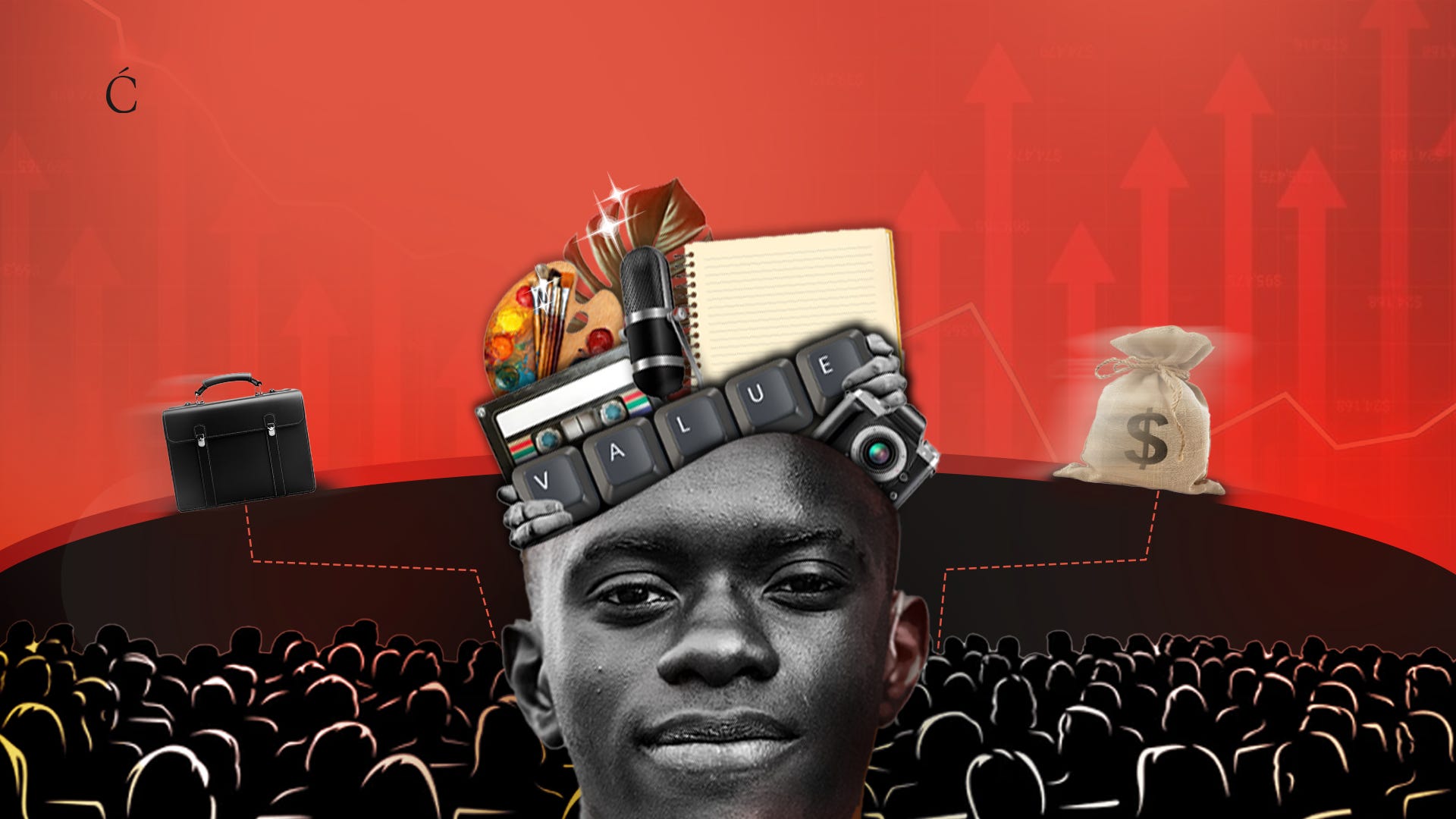
We can make the same argument for the African creator economy, and perhaps even more urgently. At the heart of any business is a value exchange. You offer something; someone pays for it; you keep the margin. For creators, this exchange has always been structurally awkward. The audience’s side is legible enough: they receive entertainment, information, and a sense of community. But how do creators extract economic value in return?
There are broadly two answers. The first involves a third party as the paying customer: brand partnerships, sponsorships, and platform revenue-sharing. The second involves the audience directly: merchandise, ticketed events, licensed IP, and direct-to-consumer products. Most African creators live almost entirely in the first category, a structural dependency that the Africa Creator Economy Report 2.0 documents in detail. The problem with relying on the first category alone is not just that it limits revenue; it also relinquishes economic control over creative work to someone else’s decisions. A brand’s budget gets cut, a platform changes its algorithm, and the income disappears.
Product thinking is, at its core, the practice of designing one’s way out of that dependency.
3. Content is just the beginning
Product thinking begins with a question most creators never ask seriously: who, exactly, is my audience, and what problem am I solving for them?
They skip the question because their content still gets views without it. But skipping it forecloses the entire conversation about what else the audience relationship could be worth.
Olanrewaju’s audience, for instance, is not simply “people who like interviews.” It is, more precisely, young Nigerians who want honest, unguarded conversations about identity, relationships, and modern life, delivered in a format that feels less like a produced show and more like eavesdropping on people they wish they knew. That level of specificity matters. It is the difference between knowing which extensions of the format will work and which will not. Dreamland worked because the intimacy of the online format translates to a physical conversation. A documentary commission, as Olanrewaju proved with Victoria’s Secret, works for the same reason. A fashion line probably does not, at least not without a different kind of rigour to prove otherwise.
This is what it means to treat content as a foundation rather than an endpoint. A video with 300,000 views is evidence of a real relationship between a creator and an audience. But the video is one expression of that relationship. Product thinking forces the question: what are the others?
The clearest (and most famous) illustration of how seriously we can answer that question is Disney. What began as cartoon characters became films, then franchises, then theme parks, merch lines, Broadway productions, and a media empire. Walt Disney was not in the cartoon business. He was in the business of building emotional attachment at scale, and he spent his life finding every form that attachment could take. The content was never the end product. It was the soil for planting seeds.
A film producer who thinks only about cinema revenue is possibly leaving much of their harvest to rot in the field. If 50,000 people can move to watch a movie, there is a high chance that 2,000 of them will buy merchandise. Immersia by Anthill Studios is making a case for this.
In the same way, a creator who has built 300,000 loyal subscribers has done the hardest part of any business: establishing trust at scale. The question is what to build on top of it.
4. What do products actually look like?
I know that arguing for creators to think in terms of products is easy. The harder question is: what products, exactly?
The answer depends on the creator, the audience, and the resources available. But the landscape is clearer than most people realise, and it is worth mapping carefully. There are broadly three categories, defined not by product type but by what it takes to build one.
I. Products a creator can build alone: Not all creators need teams or partners. Sometimes they have enough going on to build alone, which often requires the least capital and infrastructure.
Paid content subscriptions are the most obvious — a Substack, a Patreon, or a private community where subscribers pay for access to more of what they already follow for free. The model works when the creator has earned enough trust that a segment of their audience wants more. When done well, this strategy converts passive attention into recurring revenue with no middleman. But it also requires the audience to have significant purchasing power.
Digital products follow a similar logic. A creator known for a particular expertise — cooking, photography, finance, fitness, fashion — can productise that knowledge as templates, presets, guides, courses, or e-books. The content is already proof that the audience trusts the creator’s judgment. The product crystallises that trust into something they can own and use. Here, product functionality and the strength of emotional attachment to the creator matter most.
Merchandise is a different kind of signal: it tests whether people identify with a creator strongly enough to carry a piece of their brand into the world. The smarter approach for creators without capital to stockpile inventory is to print on demand, which eliminates risk while still testing whether the demand exists.
II. Products built in partnership with brands, agencies, or investors: Some creators grow to a certain scale where they become attractive commercial partners. Then the question shifts from how to monetise directly to how to structure that monetisation so it reflects rather than erodes the trust that made them attractive in the first place.
Co-created product lines are one version of this. The creator brings the audience and the credibility; the brand or partner brings the supply chain and distribution. When the partnership is genuine, the product can work for both sides. The risk is alignment: a creator whose audience trusts their aesthetic judgment needs a co-branded product that reflects that trust, not just a product that carries a name.
Exclusive content and format licensing deals are another path. A creator who has developed a recognisable format — a documentary style, an interview approach, a show concept — can license that format to a platform, a brand, or a production company. Olanrewaju’s Victoria’s Secret documentary is an example of a brand paying for access to a specific creative sensibility, not just a distribution channel. That is a different and more durable commercial relationship than a standard sponsorship.
There is also a more structural opportunity here — one that local and international operators have not yet seriously explored in Africa. Globally, companies like Jellysmack and Spotter have built significant businesses by acquiring or licensing rights to creators’ content and running the monetisation on their behalf. Jellysmack, backed by SoftBank’s Vision Fund and valued at over $3 billion at its peak, works with creators like MrBeast and The Try Guys by re-optimising their existing content for distribution across multiple platforms and managing brand deals and revenue strategy. Spotter takes a different approach: it buys the rights to creators’ back catalogues for a set period, pays creators upfront — in some cases up to $100 million — and then runs the content promotion strategy, taking the AdSense revenue in exchange. The company has paid out over $600 million to creators. Electrify Video Partners, a UK-based private equity-backed fund, has gone further still, raising $85 million specifically to acquire YouTube channels outright, particularly those with long-form educational content.
The pattern across all three is the same: identifying creators with proven audiences and strong content IP, and building the commercial architecture around them — often bearing the operational and financial risk that the creator alone could not absorb. None of this exists in any meaningful form in Africa. For a local operator, agency, or investor with the right analytical framework, the opportunity to do for African creators what these companies have done in their markets is significant and largely unclaimed. The model does not even require working with a single creator at a time. A portfolio approach, which involves identifying five to ten creators across different niches with strong audience relationships and buildable IP, spreads the risk considerably while compounding the upside.
III. Products built with a team: The most valuable creator businesses are not built solo. They require operators — people who can manage logistics, build infrastructure, and turn a creative asset into something commercially durable.
Ticketed live experiences are the clearest example. Korty’s Dreamland worked because she had people to manage the venue, production, ticketing, talent, and experience design. The creator is the draw; the team makes it possible. Done consistently, with the intention of building a recurring event rather than a one-off, live shows create a revenue stream that no algorithm can interrupt.
Crea8torium, which is positioning itself as a school for African creators, is another example. While the show, hosted by Salem King and Adaora Mbelu, is the most visible part of the vehicle, there’s a team of operators, including two other co-founders, Mofe Ade and Karishma Daryani-Chugani, in the backend building the engine and designing other products, including a paid membership offering.
And this brings us to our final point.
Communiqué is a trade publication for leaders and professionals in the African media and creative economy. We are also a research and intelligence partner for large institutions and individual operators who want to tell better stories, reach the right rooms, and earn the coverage that matters.
5. The operator gap
There are creators in Africa who have already arrived at some version of this — by design or accident.
Fisayo Fosudo started in 2016 as a solo operator, filming tech reviews on basic equipment in Lagos. What he runs today looks nothing like that. With over 780,000 YouTube subscribers and more than 145 million lifetime video views, Fosudo now operates across multiple content verticals simultaneously — tech reviews, the Finance Friday series, in-depth economic explainers, interviews with figures ranging from former US Secretary of State Antony Blinken to Don Jazzy and the Deputy Governor of the CBN — all while running, by his own account, eight parallel projects at once. He has a full team, a suite of professional equipment (including a robotic camera arm used in production), and brand partnerships with Samsung, Google, LG, and major Nigerian fintech companies. He built all of this from Lagos, without being on a global platform’s payroll, and without compromising the specificity of what his audience came for: clear, rigorous, Africa-first analysis of technology and money.
Fosudo treats his audience as a viable commercial asset capable of taking many forms. His income does not depend on any single platform or sponsor. He is closer to a media company with a face than he is to a content creator with a channel.
There is also the I Said What I Said podcast team and what they’ve done with their live events and Owambe parties. There is creator Tomike Adeoye’s Party with Olori-Ebi event, which began as a smaller idea in 2023 and has now evolved into something bigger. What unites them is the move from content to cultural product — something people do not just consume passively but show up for, pay for, and return to.
But one implication of this argument is that the creator economy cannot grow on creators alone.
Oritsejolomi Otomewo made this point in Communiqué 103, writing that the creator economy would not reach the scale any of us want for it without the formation of a creator middle class, one where value is stored in companies, formats, and intellectual property, not only in personalities and follower counts. He also argued that a functioning middle class would pull a second economy into existence around it: editors, writers, producers, designers, and strategists, working not as side hustlers orbiting fame but as professionals inside creator-led companies.
The other half of that picture is the operator, and it is the part most conspicuously missing in Africa’s creator economy.
Not every creator can do all of this, nor should they have to. The most durable creator businesses internationally are partnerships between creative talent and operational infrastructure. Fosudo’s output today — the volume, the polish, the diversification across verticals — is not possible without a team. The trust he built is one thing; the architecture that monetises it is another, and the two require different skills.
The more ambitious version of this model is Steven Bartlett’s steven.com, which closed an eight-figure investment round in October 2025 at a $425 million valuation, with the stated ambition of building “the Disney of the creator economy.” The premise is clear: the creator is the IP, and the company is the institutionalised product-thinking entity.
In Africa, this is a real and largely unclaimed opportunity. An entrepreneur who can look at a creator with 300,000 loyal followers and ask the right questions about who that audience is, what they value, and what forms that value could take is not just helping a creator. That entrepreneur is identifying a business that the creator alone may not have the bandwidth or the operational skill to build.
The operator layer of the creator economy is as legitimate and potentially as lucrative as the creative layer itself. It does not require being on camera. It requires a willingness to apply rigorous thinking to assets that most people still regard as content.
The point is not that every creator should become a product manager, or that they should squeeze every piece of content for commercial yield. Over-commercialisation is its own trap, and audiences sense it faster than we think. The argument is more precise than that: creators who take seriously the question of what value they are generating — and who are honest about the many forms that value could take — are more likely to build businesses that last. Africa’s creator economy has generated more than enough attention. What it needs now is the thinking to match.
This article is spot on and hits on a global topic, not just an African one, for all Creators; How to turn Content and Community into Commerce.
Spot on. Spot on. Spot on.
This logic can be applied to culture, music and everything the attention economy has captured. There is a current of business opportunities that needs to be realized beyond the fame and content catalogue.
We need operators for this.