


1. Point of correction
Osahon Akpata began our conversation by correcting a misconception.
I had asked him to explain how CANEX Creations Inc, for which he is CEO, differs from “the larger CANEX fund.” It was a reasonable question, one many in the ecosystem have but rarely voice. But it was built on a false premise. “First of all,” he said, “there’s no larger fund.”
For a long time, that misconception has shaped how several players within Africa’s creative economy understand the available capital. CANEX, or the Creative Africa Nexus programme, and much of the language surrounding it has suggested it was a fund of sorts. For instance, a 2024 press release announced that “Afreximbank will increase its funding to the Creative Africa Nexus (CANEX) programme from $1 billion to $2 billion for the next three years.” The same release added, “With the newly increased $2 billion fund, Afreximbank aims to fulfil these verticals’ growing needs by providing infrastructure, financing, and other resources that will help Africa’s creative industries flourish on a global scale.”
So, part of that misconception has been fuelled by the bank’s own language, making it hard not to think of the CANEX programme as a “$2 billion fund.” But this gap between what people imagine CANEX to be and what it actually is is a story in itself.
So let me lay out the architecture, because the rest of this essay, and, dare I say, the future of this industry, depends on getting it right.
2. To be or not to be
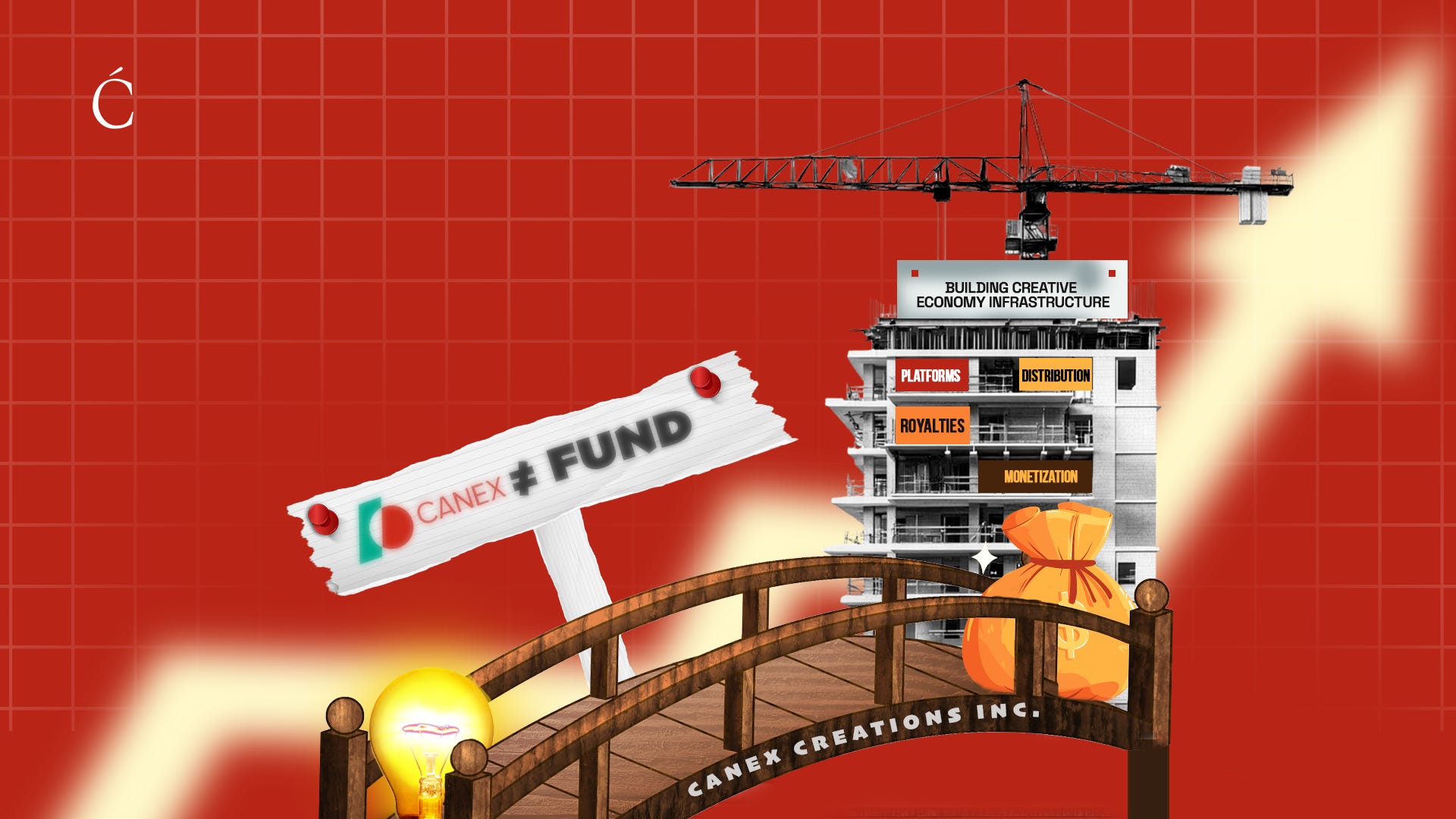
To be clear, CANEX is not a fund. It is a programme, the embodiment of the African Export-Import Bank’s strategy for developing the continent’s creative and cultural industries. The bank moved into the sector for two reasons: its potential to create jobs at the scale the continent’s young population needs, and its hunger for the development and expansion capital it has long been denied. That programme, launched in 2021, sits atop several pillars. Financing is one of them; the others are capacity building, export promotion, policy advocacy, partnerships, and digitisation. This is the CANEX most people know. Its scope is broad, but it doesn’t include writing equity cheques.
CANEX Creations Inc, or CCInc, is a different machine entirely. It is a subsidiary of FEDA, the Fund for Export Development in Africa, Afreximbank’s equity investment arm, which was registered at the end of March 2024. The bank does not engage in equity or venture investing on its own balance sheet; FEDA does, and CCInc is the vehicle it created to take such positions in intellectual property.
Akpata was hired weeks after CCInc was registered to operationalise it, and he spent the better part of a year setting up governance structures, drafting policies and a business plan, and conducting a market assessment before the board appointed him CEO. Only after that did the company begin making investments.
So, CCInc has been investing for barely a year. This distinction matters, because the weight the ecosystem already places on it tells you something about how starved the sector is for this kind of capital.
But it’s also necessary to lay out the actual strategy at play here, given that CANEX Creations Inc doesn’t exist to do everything and solve every problem.
Communiqué has an Inner Circle now. It’s the group of readers who decide that independent reporting and analysis of Africa’s creative economy is worth paying for.
3. The anatomy of an investment strategy
CCInc won’t back just any creative venture. Its focus is on intellectual property and the companies that build the infrastructure around it. Film and music, the sectors it’s most known for, are entry points, not the whole picture.
Its mandate tracks the seven sectors the CANEX programme covers — film and television, music, sports, fashion, literature, food, and visual arts — and then goes further, into industries where IP sits at the centre of the business: technology, life sciences, etc. Anywhere intellectual property is the core asset, CCInc can take a position. That this isn’t just talk is clear from the portfolio, which already reaches past film and music into literary IP, including Riding the Storm, the bank-commissioned account of Africa’s COVID-19 response, and Instances of Exceptional Moments of Hunger, a 2024 anthology from a CANEX writing workshop.
But it’s the other half of CCInc’s interest — not the IP itself, but the IP-rich technology companies that help creators make, sell, and keep it — that could bring the venture returns and long-term leverage it’s after. A quick clarification matters here: CCInc is an IP investor, not a builder of hard infrastructure. It isn’t looking to fund studios or venues; it’s looking for software and rights businesses where intellectual property is the asset. With that distinction in mind, three categories are worth evaluating closely.
The first is creator monetisation: platforms like Selar, Mainstack, Nestuge, Selfany, and Makerverse, which give African creators the means to sell their work and keep ownership rather than surrender it. These are the businesses that turn scattered audiences into recurring income, and ownership into something a creator can actually hold on to.
The second is film production and distribution infrastructure — the operational layer of the screen business. Here you have ventures like Fusion Intelligence, whose software already runs more than half of West Africa’s cinemas and whose newer tools push real-time box office and royalty data to producers.
The third is music rights infrastructure, the least mature of the three. African music is now a real export — by Spotify’s own reporting, the platform paid out more than $38 million in royalties to Nigerian artists recently, most of it earned abroad. But streaming is only one income stream. Across performance, broadcast, and mechanical royalties, the continent’s collection infrastructure underperforms, and much of what creators are owed is neither tracked nor paid.
The technology in all three categories tends to be fluid. A tool built for filmmakers can find a second life in music or fashion, making a single solution relevant across industries. If CCInc is serious about African ownership, this is the layer that enables it at scale, and it is also where more African entrepreneurs should be building their businesses.
Already, CCInc has three public investments, and together they tell you more than any of them can alone.
The first was Muganga, a film about Dr Denis Mukwege, the Congolese physician and Nobel Peace laureate. The French-Belgian production had been fully financed through the French system before costs overran in post-production, leaving equity as the only route to completion. That’s where CCInc came in. With Angelina Jolie credited as an executive producer, the film opened theatrically in France last September, drew more than 300,000 admissions, posted the highest audience rating of any film since its release, and stayed in cinemas for over twenty-four weeks — rare for any film, rarer for an independent one. Akpata keeps a framed poster of it above his desk.
The second was Clarissa, which premiered at Cannes some weeks ago and is distributed by NEON, with Sophie Okonedo, Ayo Edebiri, David Oyelowo, and others in the cast. The third is the publishing catalogue of about 230 songs administered by Sony Music Publishing, composed or produced by Africans and the diaspora.
Muganga is the deal CCInc talks about most, but it’s perhaps the one that least resembles what the company says it wants to be. CCInc came in at the end, as the investor that rescued a film someone else had already made. Clarissa shows the thesis more clearly: a Nigerian story, co-financed with other institutional investors, with CCInc on the cap table early enough to shape the deal rather than salvage it. That is the model Akpata returns to when he describes what the company wants to be — the cheque that pulls other investors in, on African IP, with African ownership intact. It does not want to come in at the finish line to bail out post-production, even if it sometimes must. It does not want to be the only name on the cap table. There must be other partners in the room.
So, is CCInc’s breadth — seven sectors, plus life sciences, plus all that infrastructure beneath it — substantial or unfocused? The deals give a provisional answer. Substantial, but building its core in real time, and still learning which of its own stories to tell.
Your contribution funds: Original reporting, data licensing, and a small editorial team that actually answers your replies. No ads, no paywalls.
4. No free lunches
There is a default mindset in the industry that Akpata mentioned without me prompting him. “Sometimes people think about a DFI, and they think it’s non-commercial grants and CSR,” he said. CANEX Creations is neither. It is commercial. It has to return capital to its shareholders, not just the principal, but a premium on top of it, enough to justify the cost of the money deployed.
This sounds like accounting, but it’s really a correction to the posture that has shaped African creative financing for some time. Too much of the capital that reached the sector arrived as gifts from donors, foundations, development agencies, and cultural budgets. Those gifts came with reporting requirements, but rarely with the one demand that forces commercial discipline and viability. So an entire ecosystem learned to ask how to receive money, and rarely how to return it. That is the systemic gap. Many people who take capital haven’t been required to think about where the return comes from, so they don’t.
This is the gap CCInc stands in, and why its commercial posture matters more than the size of any deal. By insisting on a return, the company rejects the narrative that creative capital is charity, betting instead that impact and commercial success can be the same.
This is why CCInc can’t fix the industry on its own. When you have to return your investors’ money with profit on top, you can’t bet on promises and goodwill — only on a plan that shows a path to profitability. CCInc isn’t a seed investor; it doesn’t back ideas or pre-revenue companies. It wants a track record — released films, operating businesses, revenue that already exists. So, if much of the sector is still venture-stage and institutional money won’t engage until you’re past that, the gap between the two is wider than capital alone can close.
5. The hard thing about hard things
I asked Akpata what was actually hard about his job, and his response rested on two points that sound familiar to anyone who’s been paying attention.
The first is packaging. “You might look at a thousand proposals,” he said, “and there could be fifty that you would do, and then you end up doing twenty-five.” But what kills most of them is that they never show how the money comes back. As he put it, there’s limited understanding in the industry of how to put a package together for a financier — “how they’re going to get their money back.”
Entrepreneur and adviser Marie Lora-Mungai echoes this point in her book, Creative Cash Flow:
“I believe that we have solved the demand side of the equation: investors are now ready and willing to deploy capital in the African creative industries. But while we were busy advocating for creatives to be taken seriously, we forgot to make sure that these same creatives were ready to access and digest this funding. Today, there’s more capital waiting to move into this sector than there are investment-ready businesses to receive it.”
That is the point. Shortage of capital, as CCInc is proving, is no longer the biggest problem. It’s the fact that there aren’t enough businesses in the ecosystem to absorb it.
We at Communiqué are also doing our bit to help solve this problem, primarily through our publication and partnerships — a case in point being our recent partnership with TM Global’s Technology Media Foundation for the first cohort of the Creative Investment Readiness Program. This is the kind of work the industry needs more of — accelerators and venture-building programmes that turn promising creators into investment-ready businesses CCInc can actually back.
The second challenge is structural. The continent’s distribution and monetisation infrastructure constrains how much any piece of IP can earn. Akpata used music to illustrate: a well-known musician once told him that a million streams pays roughly £4,000 in the UK, about $4,000 in the US, and around $300 in Nigeria. The gap isn’t mysterious — a Nigerian streaming subscription might cost a dollar and some change compared to $15 in the US, and the advertising pool behind the free tier is a fraction of the size of the US pool. The same logic bleeds into film: too few cinemas, limited internet connectivity, thin box-office windows. The content can be excellent and still hit a ceiling imposed by the market itself.
If you’ve read Communiqué 60, you know why I find this the most important part of the conversation. I have argued that African media will keep stuttering until it stops treating commercial sustainability as someone else’s problem, that the sector needs more product thinking, not charity, and businesses built to earn rather than to be funded. Akpata describes the same issue from the investor’s perspective. The packaging problem is a product-thinking conundrum. The distribution problem is the reason even good products struggle to move the needle. CCInc’s capital alone won’t fix either problem, and Akpata, to his credit, doesn’t pretend it will.
6. What does success look like?
So I asked Akpata the long question: five to ten years out, what will success look like for CCInc? His answer came in three parts.
First, creators should be able to monetise their IP in many ways. He used a Nigerian filmmaker as an example: someone who can recoup a meaningful share of a film’s cost from theatrical release at home and across several African markets, then stack streaming and broadcast deals, and more streaming windows after that, earning for years from a single film. For that to work, the domestic market has to be strong enough to carry the film; the international push should supplement it, not be its lifeline. This is why pullbacks, exits, and the shuttering of major streaming platforms have hurt the ecosystem and will continue to do so.
Second, more African ownership of African IP. Far too many African creators (including some of the legends we cherish, even their estates) do not own their intellectual properties. They’ve either pawned them off or surrendered control due to ignorance or a lack of leverage. Akpata hopes that the work his company is doing will help turn the tide.
Third, more institutional players in the room. This is the Clarissa logic again: CCInc as an enabler, not sole funder, building toward a coalition of other local and international investors on terms that keep ownership at home.
The vision is coherent and generous, but it also relies heavily on several other actors to play their roles. For creators to earn from their IP again and again, distribution channels must exist, and the ecosystem is still struggling to build them. For Africans to retain ownership of their work, creators need the bargaining power that financing brings, which the sector is still assembling. And for more investors to join in, they need to see real returns first — numbers that prove the bets pay off.
The vision is appealing. But it is also a chain, and Africa’s most ambitious creative economy investor holds only some of the links.
Editor’s note: The essay has an updated list of investable ecosystem assets.
What do you want to understand about Africa’s creative industry? Send us your questions, observations, or topics you think deserve deeper reporting.
I really enjoyed this.