


1. The new face of news
On May 15, gunmen attacked schools in Oyo State, South-West Nigeria, abducting dozens of children and teachers. By the time fuller reports emerged, 39 students and seven teachers had been taken from a secondary school and two primary schools, with some of the children as young as two.
The incident shocked the country not only because of the age of the victims, but because of where it happened. For much of the last decade, mass school abductions had been treated as a horror associated mostly with the North East and parts of the North West, where Boko Haram, ISWAP and armed groups had turned classrooms into targets. Oyo forced a different kind of reckoning. The fear that had long shaped conversations about education and insecurity in northern Nigeria had travelled down South. As outrage mounted, millions of Nigerians tried to make sense of what had happened.
One of the people helping them do that was the Arise News journalist Adesuwa Giwa-Osagie. But this time, not from the grounds of the National Assembly, where she covers the parliamentary beat or from behind her Arise News desk, but on her own social media channels. In one Instagram reel, Giwa-Osagie identified JAS (Jama’atu Ahlis-Sunna Lidda’Awati Wal-Jihad), a faction of the Boko Haram terrorist group, as the group believed to be behind the attack. In another video, she explained how terrorism is funded in Nigeria. Together, both videos have been watched more than 450,000 times. Many of those viewers were encountering the explanation of the tragedy not through a television segment or a newspaper report, but through a journalist speaking directly to them in the language and rhythm of social media. This is the growing power of the news creator.
According to the Pew Research Centre, a news creator or influencer is someone who regularly posts about current events and civic issues on social media and has at least 100,000 followers on Facebook, Instagram, TikTok, X, or YouTube. They may be trained journalists, subject-matter experts, commentators, satirists, or social-first personalities. What defines them is not the title they carry but the role they have come to play: making sense of events for an audience often overwhelmed by the speed and noise of the news cycle.
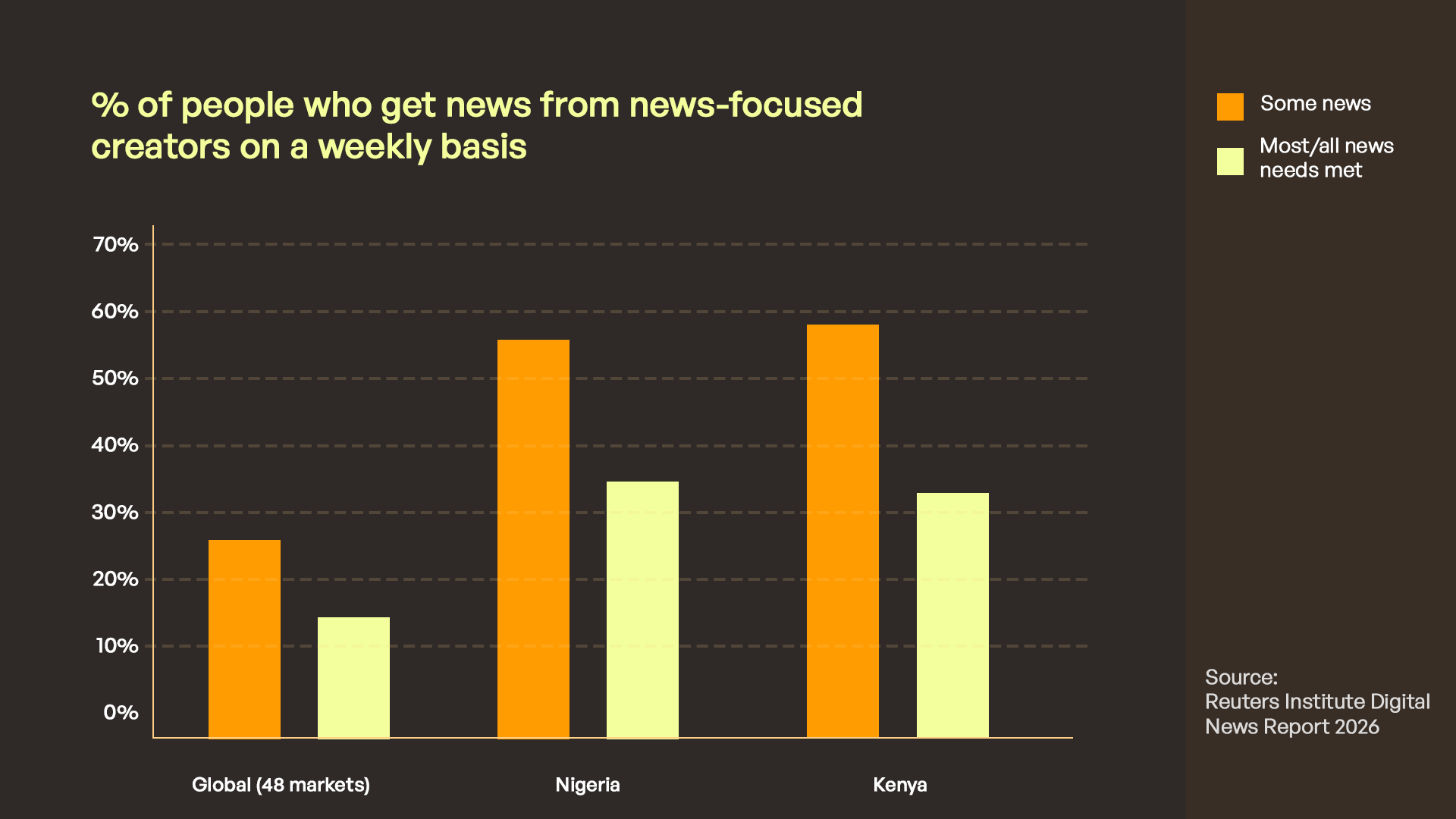
Globally, news creators are becoming an important part of the average individual’s media diet. According to the 2026 Reuters Institute Digital News Report, 27% of respondents across 48 markets say they consume some news from news-focused creators every week, while 13% say most or all of their news needs are met by these creators. But in Africa, the figures are significantly higher. In Nigeria, 34% of respondents say most or all of their news needs are met by news creators, while 57% consume some news from them weekly. In Kenya, 33% say most or all of their news needs are met by news creators, while 58% consume some news from them every week.
The phenomenon is not limited to hard news. Across various sectors, Nigerians are increasingly relying on individuals, not only institutions, to follow the news. In the tech industry, for instance, a growing number of people first hear about fundraising, layoffs, product launches and ecosystem shifts from creators like Abayomi Semudara, who translate startup news into accessible commentary. In sports, creators like Sulaiman Pooja Adebayo have become part of the way fans follow transfers, football federation politics, and the daily drama around Nigerian football. In health, business, politics, entertainment and culture, the same pattern is becoming clearer: the person explaining the news is becoming almost as important as the organisation that reported it.
Communiqué has an Inner Circle now. It’s the group of readers who decide that independent reporting and analysis of Africa’s creative economy are worth paying for.
2. Who owns the news value chain?
Traditional media organisations once controlled most of the news value chain. Beyond publishing information, they managed almost every stage through which an event became public knowledge. A reporter discovered what had happened. An editor or producer tested that information against documents, sources, and context to determine its veracity. The newsroom then interpreted the event, deciding what it meant, why it mattered, and how to frame it for the public. After that, the organisation distributed the story through print, radio, television, websites, newsletters, or social channels. It also conferred legitimacy, deciding which events deserved attention and which did not. Finally, it preserved memory, keeping the story in an archive so that it could be returned to, cited or built upon later.
For much of modern media history, these functions sat inside the same institution, whether a newspaper, TV or radio station, or digital newsroom. But increasingly, news creators are taking over two of the most valuable parts of the chain: distribution and interpretation. They help the news travel and help audiences decide what it means. This shift has become even more significant as trust in news declines globally. According to the 2026 Reuters Institute Digital News Report, global trust in news stands at 37%, down from 48% in 2021. In Nigeria, however, trust in news remains comparatively high, rising from 58% in 2021 to 68% in 2026.
The question, then, is not whether news creators are replacing Nigerian media. It is what their rise means for Nigerian media organisations and how those organisations must adapt to a changing landscape.
3. A brave new world
The first major implication is trust. A viewer watches Channels Television because the station has covered Nigerian politics for decades. In the same vein, the reader opens The Punch or Premium Times because they recognise the masthead. The institution produces trust: its editorial process, its record of accuracy, its access to power, and its sources.
Creator trust works differently. It is built around voice, consistency, relatability, courage, anger, humour, or expertise. This means media companies will have to stop hiding completely behind the brand. People may respect Arise News for its reputation for credible political coverage, but many also tune in to hear anchor Rufai Oseni’s commentary or his banter with colleague Reuben Abati.
In this brave new world that the Reuters Institute’s report spotlights, the journalist is not just a member of the newsroom but a key part of its distribution engine. This has implications for the relationship between media companies and their talent. The most in-demand journalists are now those with large, loyal audiences of their own. Alongside reporting skills, they bring reach and trust. Globally, media companies are having to think about journalist contracts less as ordinary employment agreements and more as talent contracts, and to consider factors such as revenue sharing, IP ownership, non-competes, and appearance rights.
Newsrooms have also become training grounds for future creators. For example, Eniola Olanrewaju, better known as Korty, joined Big Cabal Media after graduating from university, learned the ropes of production, and later left to build her own career as a creator. More journalists and producers will follow that path: learn inside an institution, acquire taste and discipline, then leave to build independently.
This has already happened in other media markets. For example, Mehdi Hasan left MSNBC and launched Zeteo, his own independent media company. In Nigeria, this has mostly happened with writers leaving traditional media to start Substack newsletters. But the same shift could extend to broadcast journalists. There are already early signs. In 2022, Channels TV broadcaster Seun Okinbaloye launched his Mic On Podcast, while Adesuwa Giwa-Osagie launched her YouTube show Untold Stories a year later. Neither has fully gone independent yet, but the direction is clear.
Your contribution funds: Original reporting, data licensing, and a small editorial team that actually answers your replies. No ads, no paywalls.
Advertising will also follow this shift. Advertisers will increasingly move towards news media organisations that can combine credibility with creator-led loyalty. Large reach will still matter, but smaller media organisations built around trusted personalities with direct audience relationships will become more attractive to advertisers than traditional platforms with bigger but weaker audience relationships.
But this shift also has limits. If the tools are now available to everyone, why is the news-creator ecosystem in Africa still less developed than in the West? The answer is that publishing tools are not the same as media infrastructure.
A journalist may leave a newsroom with credibility, experience, and a loyal audience, but that does not automatically translate into a sustainable independent media business. The same economic, political, and cultural pressures that weaken traditional media organisations will follow the journalist outside the newsroom. For instance, the political pressure a journalist will face in a traditional media organisation will not disappear just because he now publishes on YouTube or Substack. If anything, the independent journalists may be more exposed because they no longer have the institutional cover of a newsroom, legal department, editor or corporate owner.
This means there is not yet a clear pathway from journalist to successful independent news creator across Africa. A journalist can build visibility, but visibility is not the same as a business model. To become durable, they need production support, research help, editing, distribution, sales, and legal advice. In more mature creator markets, these functions increasingly exist around successful creator-journalists. On the continent, that support system is still thin.
There is also the question of advertising. News creators may have trust and direct relationships with audiences, but large-scale marketing spend still tends to favour established media organisations. Advertisers understand how to buy space on television, radio, newspapers, websites and big media platforms. They are more cautious when the product is a single independent journalist whose work may involve politics, controversy, or criticism of power. The exception is entertainment, where skitmakers, lifestyle vloggers, and pop culture creators have shown that media buyers are willing to spend heavily when the content is safer and more lighthearted.
News creators may not be burdened by the slow processes and institutional caution of traditional media, but they still operate within the same weak media economy. This is why the African news creator ecosystem may produce influential individuals before it produces any durable creator-led news institutions.
What do you want to understand about Africa’s media and creative industries? Send us your questions, observations, or topics you think deserve deeper reporting.