



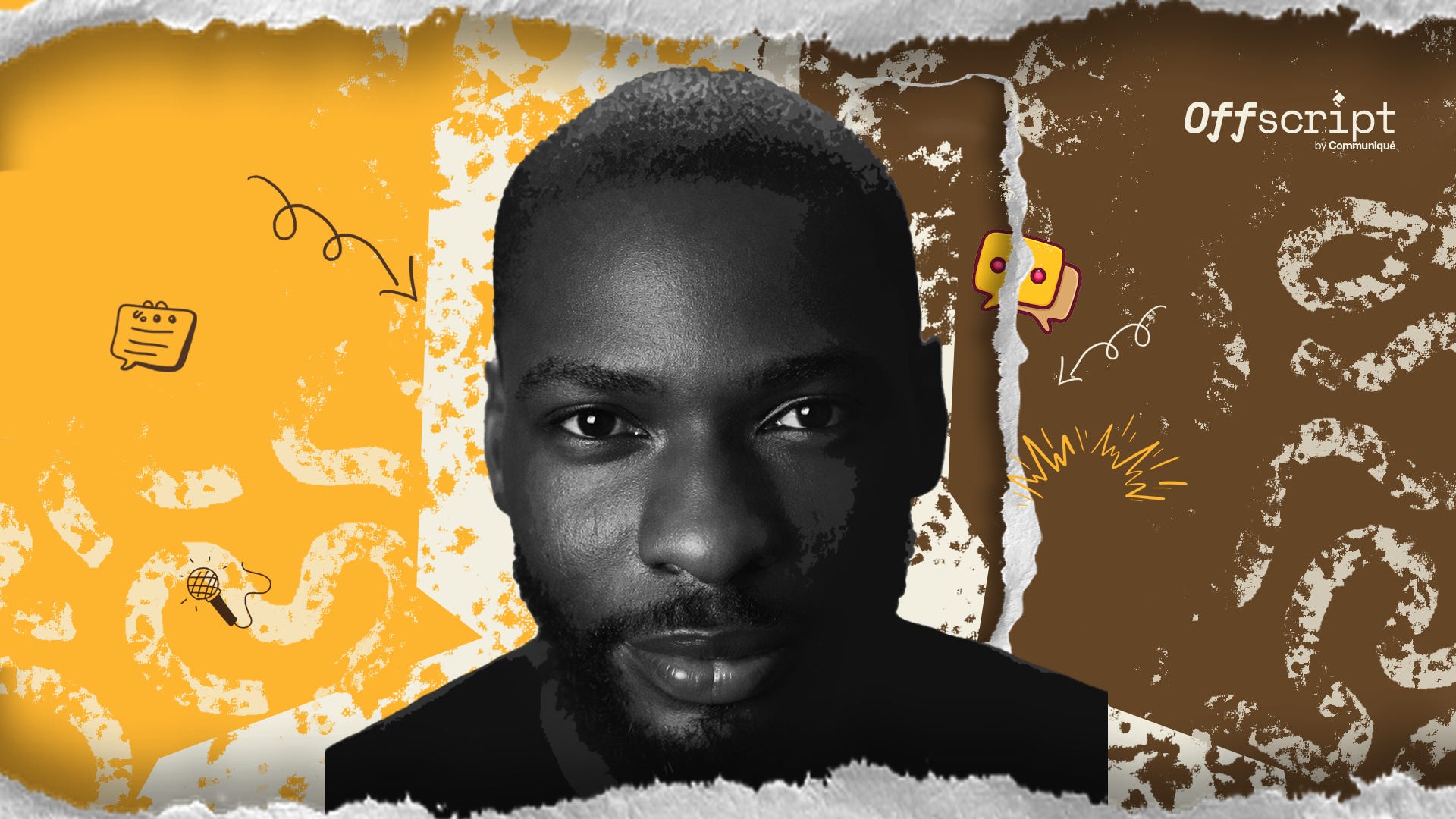
“I promised myself that any money I’m going to make has to be with my biro or with my brain.”
You might know Abayomi Semudara, “Bayomi,” from his videos breaking down tech industry news, or his game show Byte or Bail, or his Baraza events bringing together founders across African cities. For someone who started creating content out of boredom, that is an impressive portfolio. But impressive is what Bayomi does. His entire trajectory has been powered by a dogged refusal to settle for mediocrity.
Bayomi grew up on the outskirts of Lagos. Born to a primary school teacher and a trader. They didn’t have all the luxury things, but they had the necessities: food on the table and the means to attend school. And quite early, he realised that he could not follow the script that people around him did. After secondary school, most got married, learned tailoring, or took up carpentry. “I didn’t want that kind of life for myself,” he says.
His unlikely inspiration was Lex Luthor from Smallville, not the villainy, but the proof that intelligence and effort could unlock a different life. However, getting himself to that point wasn’t as straightforward as he would have liked.
He was smart. At his secondary school in Eti-Osa, the academic results had been dismal for years. Teachers told him after his WAEC results: in the past five years, not a single student had passed with five credits, including English and mathematics. Bayomi did it. A1 in commerce, B3 in financial accounts, and credits across the board. He was the first in half a decade to clear that bar.
“I considered myself one of the smartest in school,” he says plainly. “I just didn’t like being mediocre. The people writing this exam in other schools were passing. They didn’t have five heads. It’s the same exam. It just depends on how well you studied.”
After secondary school, he took a job as a motor-boy, loading 25-litre oil cans across Lagos markets. He lasted two days. His body was not built for physical labour. That is when he made his promise: any money would come from his pen or his brain. He cycled through other jobs while studying for JAMB, the entrance test for prospective higher-ed students in Nigeria: a pump attendant, a hotel front-desk assistant, and a cleaner at a Chevron Estate. Each job helped him stack up savings for his tertiary education.
He got admission to Yaba College of Technology, Lagos, in 2013, two years after he graduated from secondary school but when an eight-month strike stalled his education, he applied to the University of Lagos. This time he chose to study Educational Management, hoping to fix the rot in the system. He arrived at the University of Lagos as one of the top five in his cohort. But by the second year, his course work was no longer challenging. “I saw those things as something that if I woke up in the middle of the night before my exam and read, I’d still get a B or C.” He stopped prioritising the degree and started teaching himself design. First motion design, but his laptop could not handle the software, so he pivoted to brand design. Logos for classmates, then clients beyond campus. Before long, he told his family to stop sending pocket money.
In 2021, after his compulsory national service year, Bayomi made a public pitch on LinkedIn to Gradely, an edtech company he admired. They never responded. But Honey Ogundeyi, founder of Edukoya, saw his pitch and reached out. He was one of the earliest employees and spent a year and a half doing more than design: branding, user interface, marketing, and video production. His title resisted definition: lead designer and head of experimentation. When Edukoya raised $3.5 million, he designed the pitch decks.
Eventually, he got tired. He resigned, retrained in product design, freelanced for Recital Finance and Front Edge, and now leads design at a Ghanaian fintech helping global companies collect payments from Africa. He prefers not to name them. “They don’t make noise.” For a long time, neither did he.
Posting online content, as he is known for now, started without a plan. He started doing it when he was freelancing because he was bored, had some time on his hands, and wanted to share his observations. His first video was inspired by a tweet about a $30 million raise. He recorded a reaction and posted it. But since then, he hasn’t stopped. “I just kept doing it.”
His formula was simple: find interesting tech news, share his opinion. He trawled TechCabal, Techpoint, TechCrunch, and Twitter. “I find things I find interesting,” he explains. “If it interests me, I share it. If not, I don’t.” When one Sunday of posting three videos produced floods of views, he took note. Three videos daily for eight months straight.
One Sunday, he posted three videos and saw a surge in engagement. The pattern was clear. He increased his output and began posting three videos a day for months. The consistency built an audience.
Even then, he did not immediately see it as a business. He considered himself a designer first. Content was something he did at night, when his primary work was done. The shift in mindset came towards the end of 2025. He read an article about new media and the creative economy. It reframed what he was doing. He realised that he had become one of the more recognisable voices discussing tech in Nigeria. That influence could be structured.
Since then, he has begun thinking in formats. He plans more long-form content and documentaries. He has paid attention to positioning and narrative. He has registered the business, set up proper accounts and assembled a small team. Four people handle events. Two work with him directly.
Some of his experiments have matured into defined products. Byte or Bail is a tech game show that blends trivia with interviews. Founders and operators answer questions as they share their journeys. The show has accumulated over 100,000 views on YouTube. It is not mainstream television, but within its niche, it has found an audience.
Baraza extends his presence offline. It is a series of pop-up events across African cities that bring together founders, venture capitalists, and ecosystem operators. The first edition took place in Kigali. Lagos followed. Abuja, Nairobi, and Accra are part of the roadmap. The ambition is to create a networked community that connects operators across markets. There is also a shorter format in which founders present what they are building in one minute. Over the past year, dozens of startups have been spotlighted through this format.
The through-line in all of this is not a grand strategy. It is curiosity, applied consistently. He tends to follow what interests him, then build around it.
When asked about the larger direction, he does not outline a five-year plan. He returns to something simpler: he pursues what he finds interesting and lets that pursuit shape the outcome. And for now, his focus is on building one of Africa’s leading creator-led media brands.
Bayomi is such an amazing person. I often wonder how he births these ideas.
Such an interesting Personality!