


1. Breaking records
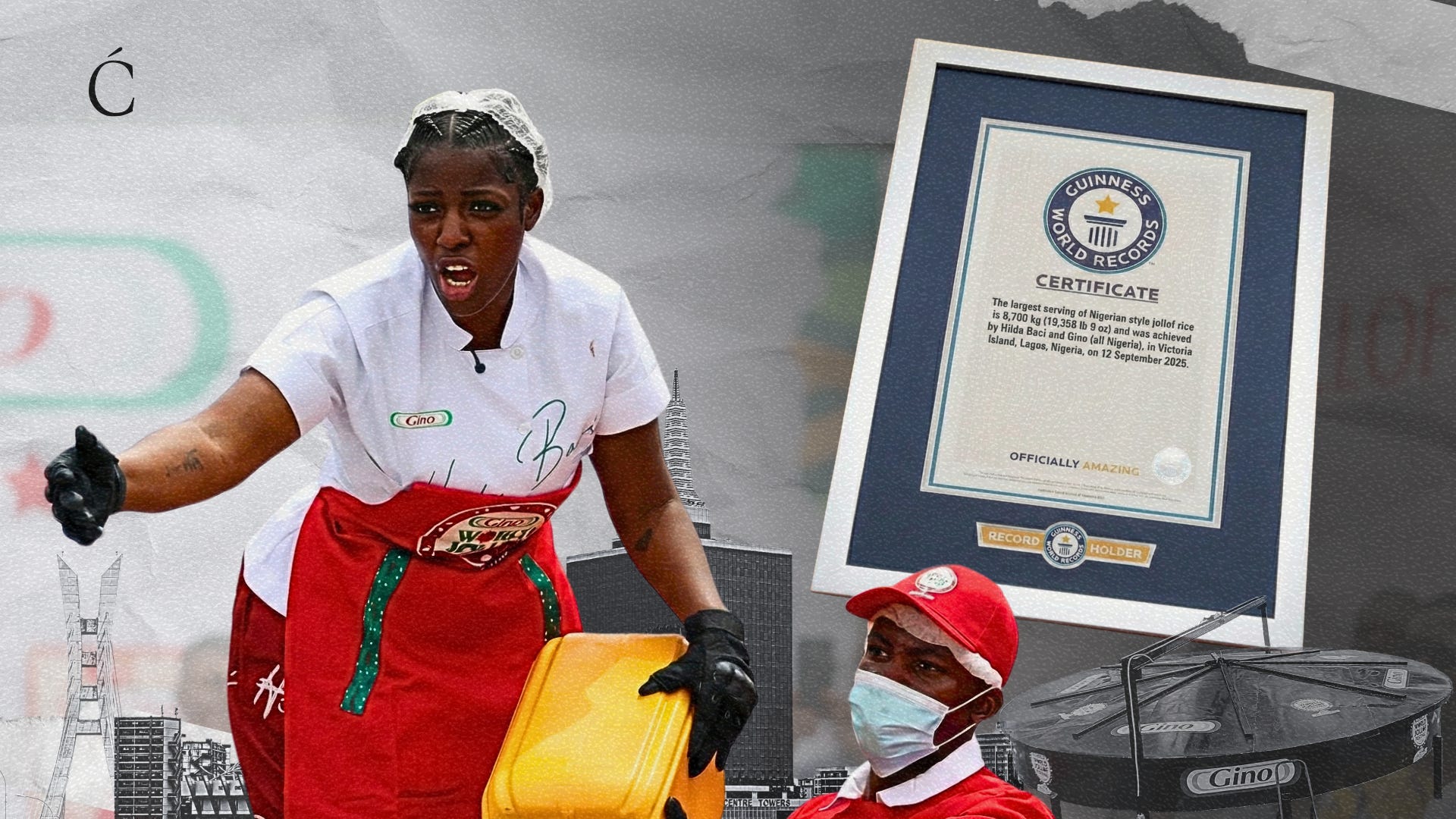
Hilda Effiong Bassey did not come into 2025 planning to break another Guinness World Record. The 30-year-old celebrity chef and culinary entrepreneur had been there, done that.
In May 2023, she shattered the record for the longest cooking marathon, with 93 hours and 11 minutes (the record has since been broken twice). The events surrounding and following the attempt brought her the fame and access she could only have dreamed of in the years before. It also sparked a wave of copycat attempts across West Africa. Within a year, Guinness World Records received nearly 2,000 applications from Nigeria and Ghana alone. For Bassey (better known online as Hilda Baci), however, one record-breaking effort, especially the type that took almost four sleepless days to complete, was exhausting enough. She had no plan to try it again.
But in September 2025, all that changed. History repeated itself as she, this time, set the record for cooking the largest serving of jollof rice. Together with Gino, one of West Africa’s largest food brands, for whom she is a brand ambassador, and a team of over 300 people, she cooked 8,780 kilograms of jollof rice—the equivalent weight of six cars or three adult elephants.
Cooking the jollof rice was only half of the job. For the record to stand, the food had to be distributed for people to eat—every last grain. But even before that could happen, there were storms to weather, codes to crack, and mountains to move.
2. Moving mountains
First, the team had to design and build a pot large enough to hold 4,000 kilograms of rice, about 720 litres of oil, 800 kilograms of specialised tomato paste, 220 kilograms of seasoning cubes, 300 kilograms of cooking paste, and 164 kilograms of goat meat, among many other things.
The pot also had to be designed to allow heat from the giant burner to spread evenly, so parts of the food did not cook faster than others. This entire fabrication process would take about two months.
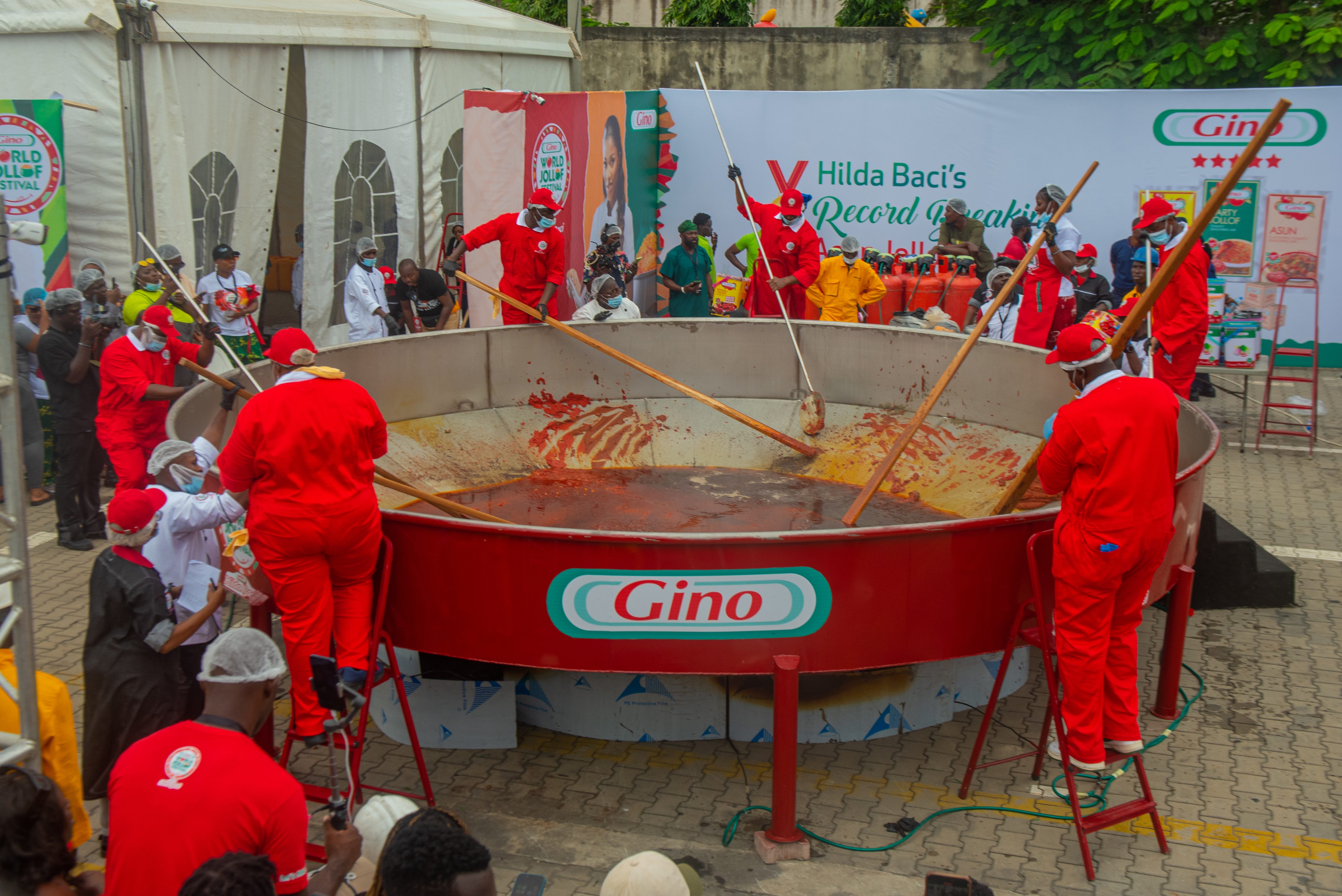
Then there was the science required for apportioning the ingredients. Each item going into the pot required extensive calculations and precise scale referencing. The quantity of rice had to be perfectly proportional to the amount of seasoning, tomato paste, blended mixes, oil, and cooking gas required. And all this had to happen on paper. There was no room for practice, at least not at scale. “It’s such an expensive activity; it is not something that we can test run before the day,” Bassey told Communiqué. “So, there is no way to know that it is absolutely correct until the day that it happens.” To achieve this balance, Bassey worked with culinary strategist Gbolabo Adebakin.
Beyond worrying about the food, the team also had to figure out how to move the pot from its point of creation to the final destination for use. For that to happen, the Lagos State Traffic Management Authority needed to approve the transportation of such an item. For safety reasons, the transportation had to take place when roads were less busy.
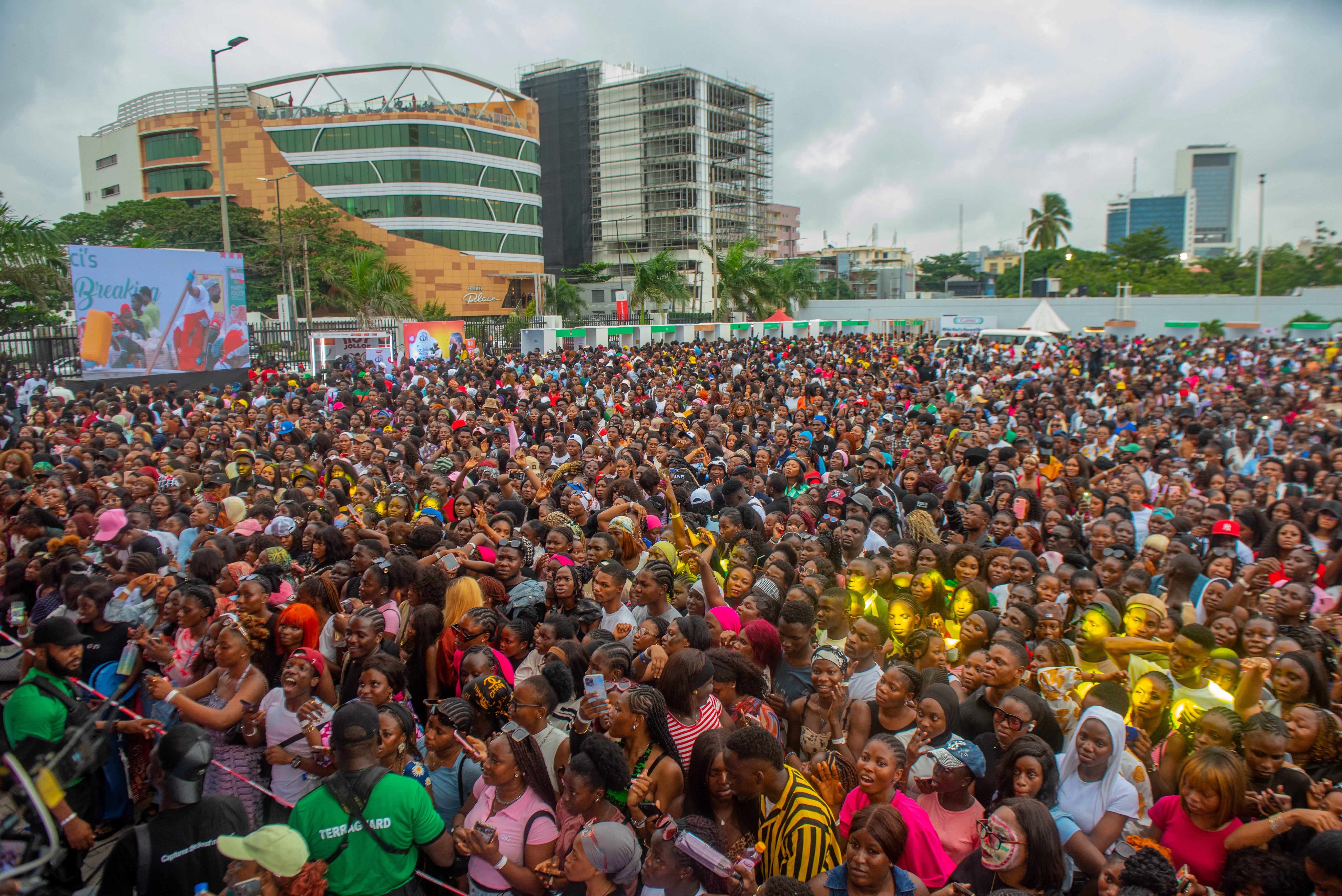
There was also the small matter of securing a venue, as this attempt was meant to commemorate World Jollof Day. They expected a crowd. The initial confirmed location was Muri Okunola Park in Victoria Island, Lagos. A few days after the Gino team announced this and opened a registration portal, it was clear the venue would be too small. More than 20,000 people had registered—15,000 more than initially planned.
“Our target was just 5,000,” says Michael Nwughala, digital marketing manager at GBFoods, Gino’s parent company. “Before the day of the event, we had 23,000 registered people. So we knew Muri Okunola, which was an 8,000-capacity ground, could not take even half of the audience that we were expecting.”
So, two days to the actual date, a race against time and a search for a bigger location were afoot. After hours of negotiations and long conversations, the decision was made to use the parking lot at Eko Hotel, a famed venue for concerts and conferences in Lagos.
Since this was an outdoor event, the weather had to be perfect. But this was September, the rainy season. And if there’s anything to know about Lagos, it’s that it has a toxic relationship with rain. It doesn’t just “rain” in Lagos; the heavens rip open and empty water tanks on the city. So the odds that it would rain on the day of the attempt were high—98%, according to AccuWeather.
When Friday, September 12, arrived, many parts of Lagos were flooded. “Surulere was flooded, Lekki was flooded. Everywhere was flooded except that venue,” Nwughala said. For him and his teammates, this was “the Hand of God.” “We turned into prayer warriors,” added Bright Mgbemele, category manager for tomato cooking bases at GBFoods. Mgbemele also served as project lead.
Pulling this project off bordered on the impossible. Every moving part—from fabricating a never-before-seen pot to calculating ingredients without the luxury of a trial run, from negotiating last-minute venue changes to praying against a 98% chance of rain—stacked the odds firmly against the team. Yet, somehow, it all held together long enough for history to be made.
But this was not always the plan—this shot at another world record. Long before the culinary and engineering miracles, something else came first.
3. From India, with love
The idea to cook a massive pot of rice didn’t arrive as a grand strategic plan. It floated in quietly, first as a video Bassey had watched multiple times. In it, worshippers at a Sikh temple in India brought grains, vegetables, spices—anything they could offer—and volunteers emptied everything into massive pots for Langar, the centuries-old tradition of cooking and serving free meals to all, regardless of belief or social status.
At the Golden Temple in Punjab, the most famous of these temple kitchens, the pots rarely go cold; more than 80,000 people eat there each day.
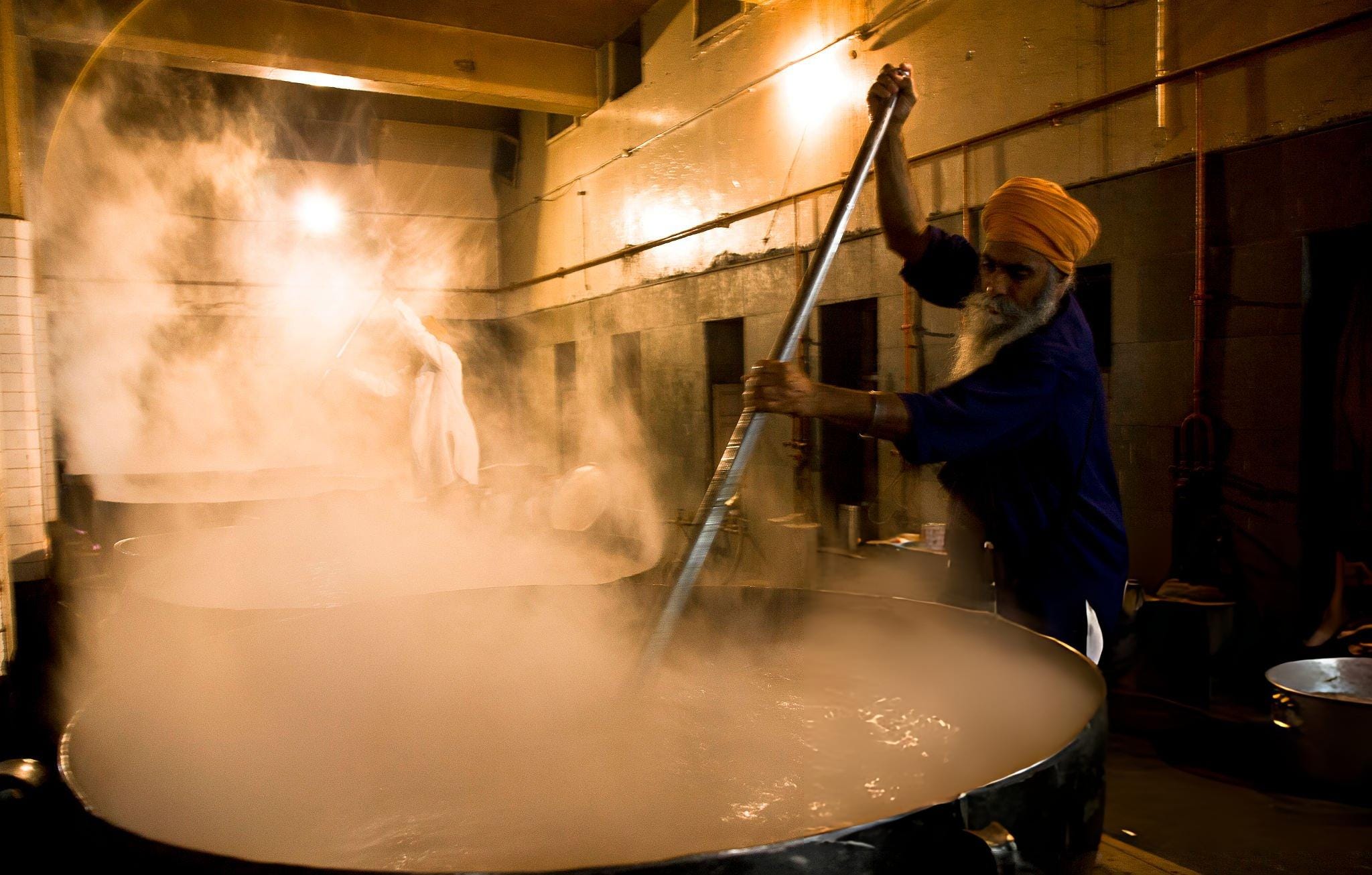
Something about that scale gripped Bassey. “Just imagine jollof rice being inside that pot,” she said. The thought stuck. Soon she found herself in her office, looking around and measuring the space with her eyes. What if a pot were as big as this room? What if it were filled with jollof rice? What would that even look like?
She kept turning the idea over in her mind like a puzzle she wasn’t yet sure how to solve. Then came the nudge.
One day, Oreoluwa Atinmo, the marketing director at GBFoods, asked her what they might do for World Jollof Day. The question landed on a concept already sitting somewhere in her subconscious, and suddenly the pieces began to click.
When Atinmo asked again weeks later, Bassey finally said it out loud: I want to make a massive pot of jollof rice.
Once she gave the idea voice, it grew legs. “When you start spitballing, you keep going,” she said. A festival, food for thousands, an experience people could gather around. She had never cooked anything close to that scale. But she wanted to try.
To her relief, the Gino team didn’t flinch. They saw what she saw—or at least believed in her vision enough to follow it. And so the conversations continued.
What the idea wasn’t, at that point, was a Guinness World Record attempt. Bassey was adamant about that. She had already been through the heat of global scrutiny; she didn’t want to turn this into another high-stakes contest. She didn’t want the pressure of rules, guidelines, auditors, and the fear of failure looming over her shoulder. “My God is not in the business of failure,” she said, but she also knew how taxing a record attempt could be. She wanted an adventure, not another headline.
But as planning deepened, someone on the team asked: Could this be a world record? She resisted. She wasn’t even sure such a category existed. Eventually, partly out of curiosity, she checked. A quick email to the Guinness World Record team. A quicker reply. A meeting was set almost immediately.
And then the revelation: there is a category, but no one has ever done it. If you attempt it, you will be the first.
The stakes changed instantly. And somewhere in that moment, a distant possibility drew closer to reality.
“We were already doing it regardless,” she said. “We might as well make a record out of it.”
That’s how an idea born in a Sikh temple video found its way to Lagos, and toward a pot of rice big enough to feed a small city.
4. The diamond in the rough
By the time Bassey and the Gino team accepted that the idea could stand as a Guinness World Record, the decision itself was no longer the headline. The record was simply the vehicle. The real challenge, and the real opportunity, was defining what this moment could mean beyond the spectacle of a giant pot of rice. If they were going to do this, it had to matter culturally, not just numerically.
Jollof rice is a cultural emblem in Africa. The internet is full of creators staging Nigerian-versus-Ghanaian (or Senegalese) taste battles, and it’s the go-to reference for outsiders seeking easy applause from Africans at international conferences—slip in a jollof joke for scattered laughs and a veneer of “Africa knowledge.” Yet this dish has the potential to be far more than a punchline or a cultural shorthand.
In Communiqué 40: Culture in a box, we wrote about how concepts like food could become effective ways for African countries to export their culture globally, “in ways that benefit them economically, politically, and socio-culturally.” Jollof rice has that capacity, with its pan-African relevance and growing global appeal. The Oxford Companion for Food says it is “possibly the best-known African dish outside Africa.” But how does it go from peripheral to worldwide staple?
World Jollof Day had existed for a decade, mainly as a social media hashtag and a handful of community cookouts. But nothing had ever cemented it in the global imagination. Mexico has its Day of the Dead parade. India has Holi. Nigeria had no equivalent cultural export attached to a single day—no anchor event large enough to reset global perception. Bassey and Gino tried to fill that gap with this event.
Imagining that cultural leap was possible because the Gino team had been asking whether it could create a shared cultural moment around jollof rice, as South Africa’s De Beers did with diamonds through its iconic “Diamonds are forever” campaign. They wanted to turn the region’s most beloved dish into a worldwide symbol. Bassey happened to provide the fire needed.
5. The invisible hands
In pictures and videos of the world record attempt, it is easy to focus on the chefs stirring the giant pot, tasting and adjusting, or the assistants measuring ingredients. It is even possible to get lost in the allure of the crowds and celebrity appearances. But the truth is that Bassey’s team of cooks was only the most visible slice of an enormous operation. Behind the scenes, an entire orchestra of people made the world record attempt possible.
Coordination extended across multiple teams: logistics handled transport; security controlled crowds; communications ensured every moment was documented and shared; finance monitored the budget, which kept swelling with each unexpected challenge. From live-streaming the event to managing partner engagement, from curating the festival experience to serving the rice to thousands, the effort was exhaustive. Bright Mgbemele described it as “a full 360-degree event.”
Then there were the event coordination and communications teams that ensured every detail, from stage production to press coverage, ran smoothly. Both teams, led by Mojoyin Durotoye (of The Owambe Company) and Nene Bejide (of Blanche Aigle), knew that pulling off something of this magnitude would require every department and contingency plan functioning in perfect synchrony. Both worked with Bassey on her first record attempt in 2023. This time, on a much larger scale, Durotoye’s team oversaw event setup, managed stage production alongside Blanche Aigle, coordinated two venue moves, and mapped each location with detailed 3D designs to ensure the event ran seamlessly. Bejide’s team tracked and amplified press and digital engagement, with content from the record attempt reaching over 5.5 billion views globally: 1.5 billion from Instagram and 1.1 billion from TikTok alone.
And yet, for all its spectacle, this story is about more than a record or a giant pot of rice. It is the kind of achievement that needs to exist in cultural records, because Nigerians and Africans must document history more deliberately and systematically.
Where Bassey provided the spark and imagination of a giant pot of jollof rice inspired by the communal Langar at the Golden Temple, and Gino provided the structure and the operational rigour, there was an army of invisible hands working to turn that spark into a wildfire.
In the end, the giant pot of jollof was more than a world record; it was the symbol of what a functional creative ecosystem at its best could look like.
I keep coming back to this article. Definitely my fav Communique piece. I always use this article to demonstrate the project lifecycle and activities for a real life project to my project management students. A fantastically written and rich piece ❤️
I had chills reading this!