


On October 5, 2026, Mysterious Tech Studio set out to globally premiere Àsírí Ìlú Àwọn Òṣú (Mystery of Osu Land), a two-part Yoruba science-fiction film that had spent months generating attention for its use of artificial intelligence. But as thousands of viewers attempted to access the film on Docuth, the streaming platform struggled to keep up with the unexpected traffic.
The production had overcome some conventional barriers to ambitious filmmaking, using artificial intelligence to generate roughly 80% of its visual content, only to run into a problem that had little to do with filmmaking itself and more with the infrastructure needed to deliver a product to its audience.
But beyond the technical ambition, the film presented something more interesting for Nigeria’s creative economy. Its producers were taking an AI film to the market, selling access through a pay-per-view platform, and attempting to find an audience beyond Nigeria.
For a long time, bringing an ambitious film idea to life required access to equipment, actors, locations, production crews, and considerable financial backing. AI is changing some of those requirements. Creators can now develop fictional worlds, generate characters, produce scenes, and assemble films using a collection of digital tools.
You could say a new market is forming around the technology. Part of the opportunity lies in the sheer scale of the audience these videos are beginning to attract. A December 2025 study found that 278 entirely AI-generated YouTube channels had amassed 63 billion views and 221 million subscribers globally, including 18 million subscribers in Egypt (about 14% of its population). Nigeria is seeing similar interest, with some creators already building thousands of followers and monetising their channels.
The question, however, is how much of that opportunity can translate into a sustainable business.
1. The making of an AI film
Communiqué spoke to four creators to understand their process. Each made it clear that an AI-generated video may look like the product of a few prompts, but the work behind it is far more involved.
The process usually begins with an idea, which the creator develops into a script and breaks down into individual scenes. They then establish the characters, settings, dialogue, and visual direction before generating the images or video clips required to tell the story. Some creators generate still images first and animate them, while others use text-to-video tools to produce moving scenes directly. The creators then edit the resulting clips together, adding voiceovers, music, sound effects, and other finishing touches to produce the final video.
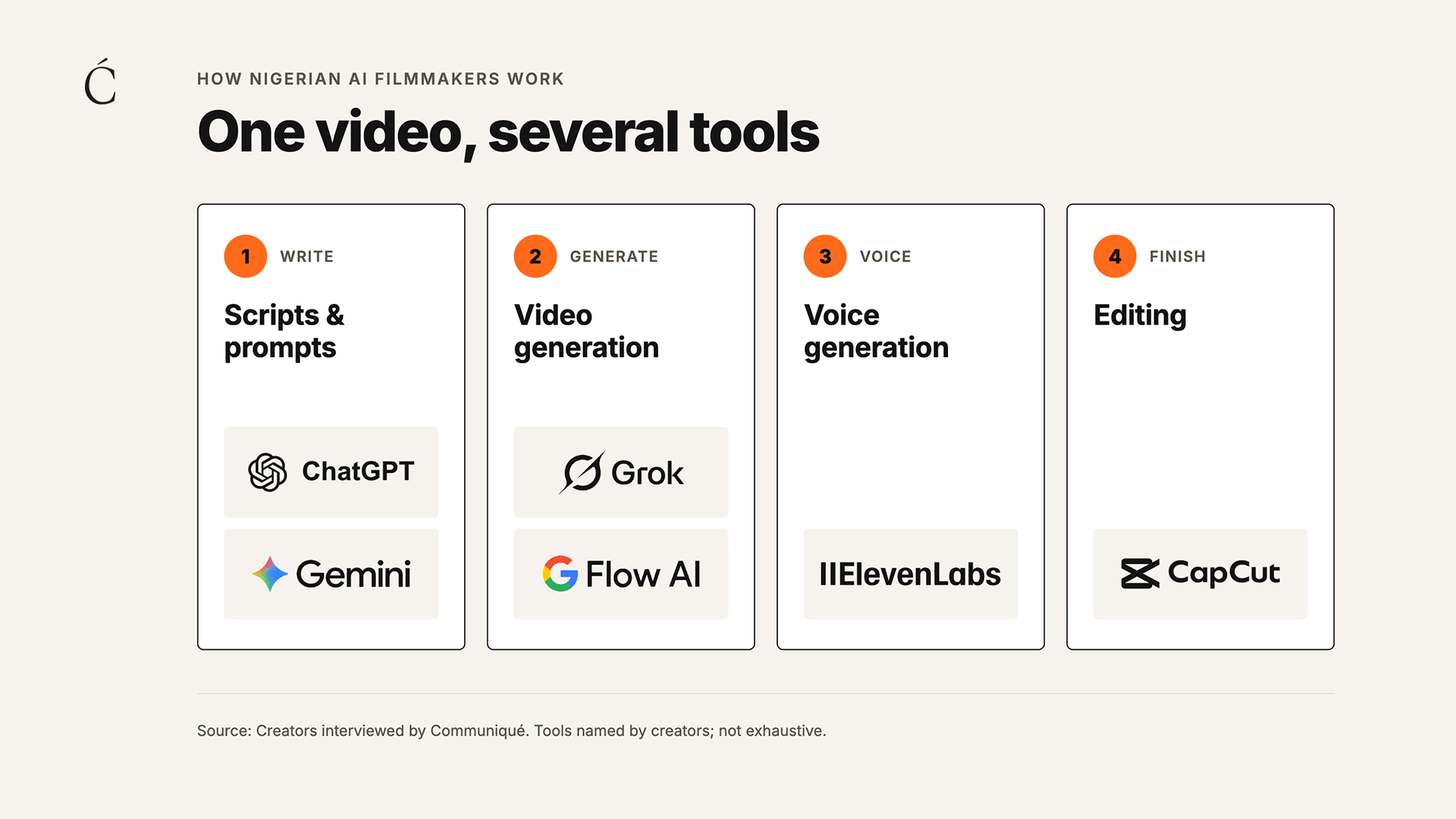
Different tools perform different functions. Creators who shared their experiences with Communiqué described workflows involving ChatGPT and Gemini for scripts and prompts, Grok and Google Flow for video generation, and CapCut for editing. They also used voice-generation tools such as ElevenLabs.
The process becomes more demanding when the production involves recurring characters. A character appearing in the first episode must look reasonably similar in the next. Their clothing, facial features, voice, and movements must stay consistent enough for viewers to recognise them. That requires repeated generation, corrections, and editing.
Jessica George, a Nigerian AI content creator based in Lagos, Nigeria, says a three-minute video can take her between 24 and 48 hours to produce. Nana Aisha Audu, another Lagos-based creator, says a two-minute episode takes her approximately four hours.
For filmmakers working on larger and more structured productions, the process is even more extensive.
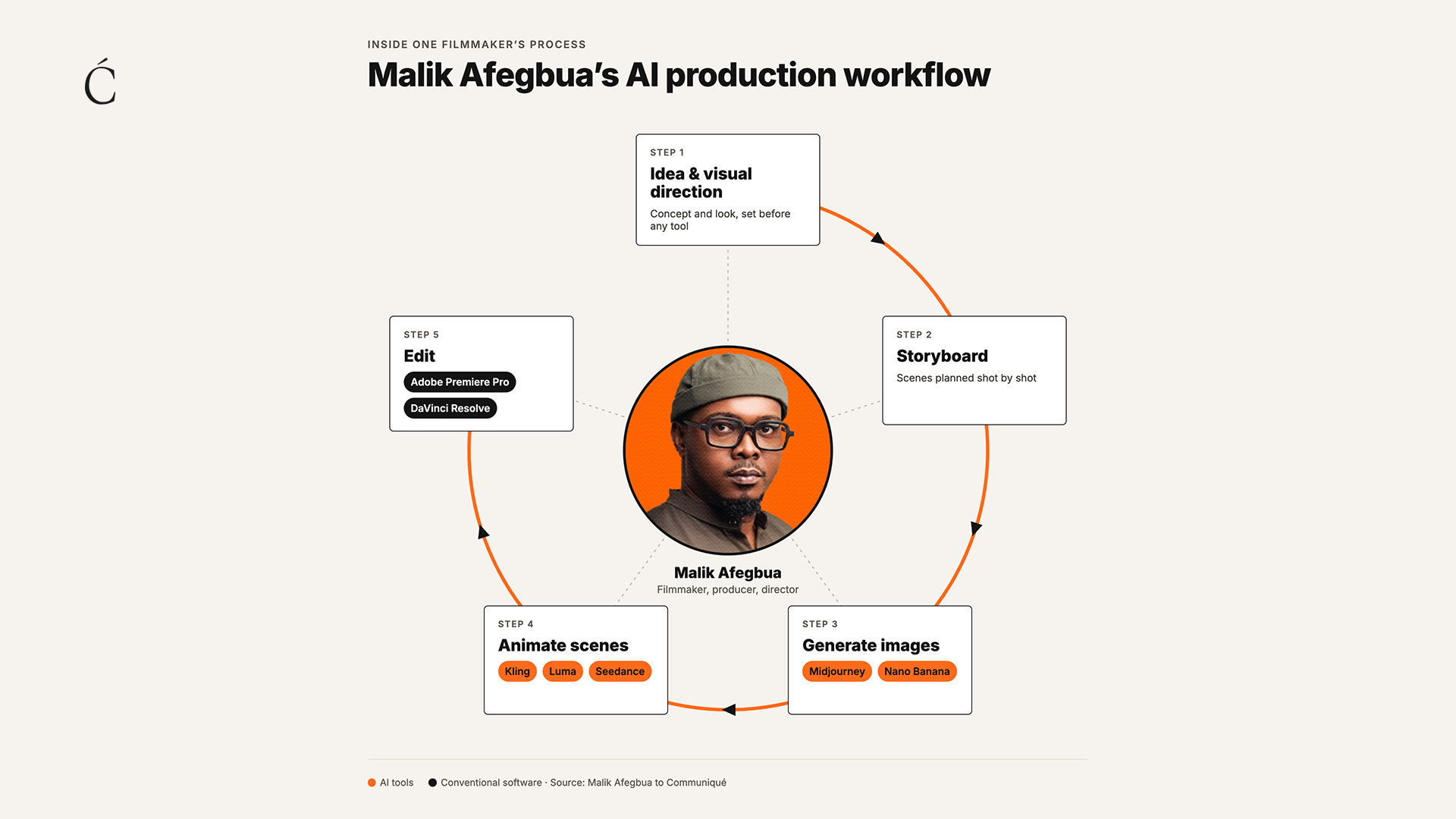
Malik Afegbua, a filmmaker who has been in the business for almost two decades, approaches AI as part of a broader production workflow. He uses tools such as Midjourney and Nano Banana for image generation, alongside Kling, Luma, and Seedance for video generation. The process culminates in editing the footage using conventional software such as Adobe Premiere Pro and DaVinci Resolve.
Depending on the project, he can also combine AI-generated visuals with real actors and traditional production techniques.
“I see AI as a tool, an extension of filmmaking, not as a replacement,” Afegbua told Communiqué.
2. Where the money comes from
For Nigerian creators, AI video production offers several possible revenue streams, ranging from providing production services to businesses to monetising on platforms.
Companies need advertisements, product demonstrations, promotional videos, and social media content. AI gives them another option for producing these materials, particularly when the brief requires elaborate environments, fictional characters, or visual concepts that would be expensive to recreate through conventional filming.
A fashion brand, for instance, might commission an AI video to showcase different ways to style its products; a food company could develop short promotional stories around its products; while a business introducing a new service could use AI-generated visuals to communicate the idea.
For filmmakers, this creates opportunities to work as independent production contractors or establish small AI video studios that handle commercial briefs.
The potential earnings vary considerably.