1. Accidentally on purpose
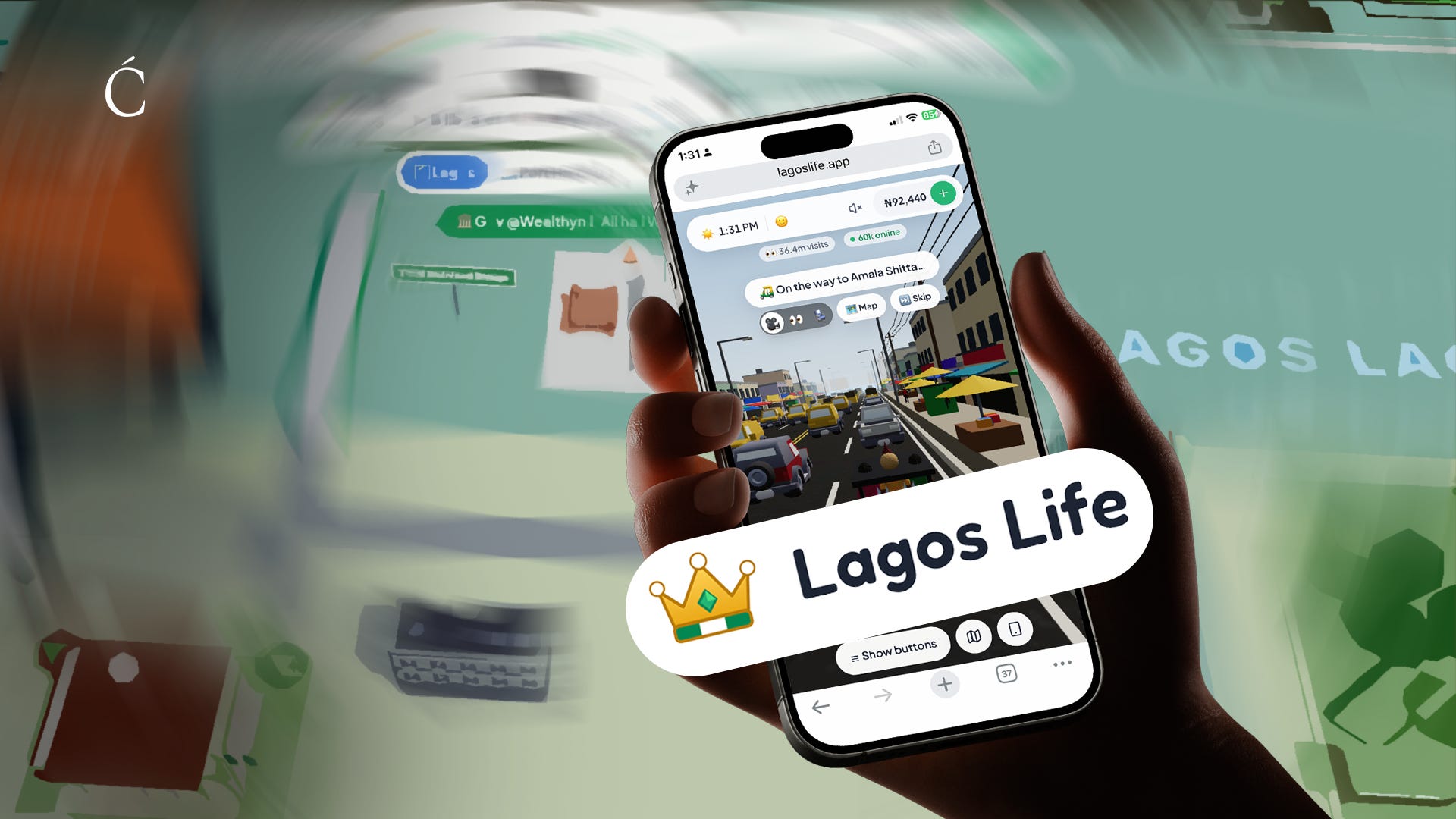
On October 8, Vincent Ehindero, a counsellor finished a therapy session and got paid. What made it unusual was where he had met his client: inside Lagos Life, the browser game that had taken over Nigerian social media.
Vincent the Therapist, as he is known online, joined the game on October 5. He explored the virtual city, then told people on X that a therapist was now available there, offering short sessions in exchange for in-game tokens. Messages followed. Some people wanted the free 15-minute sessions; others went on to book full ones. One client, he wrote on X, paid the balance in real naira into his OPay account.
Vincent told Communiqué that anonymity was part of the appeal. On WhatsApp, a client sees a phone number; on Zoom, a face or an email address. In Lagos Life, people could talk without revealing who they were. “I was trying to create this safe environment for them where they also want to speak, where they also want to tell their stories,” he said.
He says he has since received more than 300 messages and held more than 140 sessions, totalling over 2,000 minutes. More than 40 became paid sessions, and dozens of clients have subscribed.
For another player, the game has become a creative outlet. Dreamgirl, as she is known on X, joined on October 3 after seeing it all over her timeline. Sending large sums of in-game money around was part of the early fun. What kept her was decorating homes and building stories around her character’s life, which she turned into videos without appearing on camera, and without paying for locations, transport, or equipment.
Those videos have drawn some of the highest engagement on her account, she says, adding more than 1,000 followers within days after posting just two. She is now considering making money from content for gaming audiences. “If I had seen it as just any random game, I would have lost interest,” she said. “The ability for the game to be diverse, in the sense that you can interact with people, makes it really look like a real-life world, and that is what keeps me there.”
Vincent and Dreamgirl are using Lagos Life for more than play: one to meet clients, the other to build an audience. They are not the only ones finding commercial uses for it. In the same virtual city, businesses pay for billboards, Chowdeck appears on every character’s phone, musicians pay to have their songs played in clubs, and players buy in-game currency with real money. The game already supports several kinds of commercial activity, some its creator never intended.
You’re reading Communiqué because someone in the Inner Circle paid for it. Pay it forward. Your contribution funds: Original reporting, data licensing, and a small editorial team that actually answers your replies. No ads, no paywalls.
Shalom Rayhamen, the developer, started building Lagos Life at 9 pm on September 30 and released it at 7 am the next morning, Nigeria’s Independence Day. By October 8, it had recorded 4.3 million sign-ups, according to TechCabal. By October 10, Rayhamen said it had passed 7 million. She incorporated Vatar Inc. with two co-founders on October 6. Three days later, the company closed a $500,000 angel round at a $10 million valuation. Investors include Flutterwave CEO Olugbenga Agboola, through his fund Resilience17; Oo Nwoye; Terra Industries CEO Nathan Nwachuku; and Mono CEO Abdulhamid Hassan. Vatar says the round closed in a day. More investors are queuing for a chance to get on the cap table, according to well-placed sources.
The obvious question is whether Nigerian games can become commercially successful. But Lagos Life poses a more interesting one: what happens when a game starts functioning as a media business, a social platform, and potentially a marketplace?
Within days, Vatar attracted millions of registrations, secured paying commercial partners, and began hosting activities beyond conventional gameplay. These developments are related, but they are not the same achievement. A large audience does not automatically produce a profitable business, and a busy virtual world is not yet an economy. Lagos Life is an early test of whether all three can grow together.
2. The business within
Rayhamen told TechCabal that Lagos Life has five revenue streams, ranging from selling audience access to collecting money from players.
Businesses rent billboards and plots within the virtual city. Musicians pay to have their songs played in its clubs. Company deals, including Chowdeck’s presence on every character’s phone, bring sponsorship and brand integration into the game. Football streaming introduces a broadcasting-like activity, though its commercial potential depends on what is being streamed and whether the rights are in place. Players can also top up their in-game cash, putting Lagos Life in the market for virtual goods and microtransactions that sustain many free-to-play games.
These businesses share one environment, but each needs its own evidence of demand. Advertising depends on an audience brands want to reach. Music promotion depends on artists believing in-game exposure has value. Virtual purchases depend on players having reasons to spend. Streaming raises questions about rights and distribution.
Vatar says it has earned and contracted more than $170,000 since launch, up from about $46,900 in its first four days. It has not disclosed how that splits across the five streams, how much it has collected, or how much remains tied to signed agreements. Those distinctions matter: contracted revenue is not necessarily cash in the bank.
Even so, businesses have been willing to spend money on a product that barely existed two weeks earlier. What the figure does not yet tell us is whether that spending will recur, how much it costs Vatar to deliver what it sells, or whether launch-week interest can become a predictable stream of income.
The model suits Nigeria for a simple reason. An entry fee would shrink the audience in a market where consumers have many competing demands on their money. A free game can instead earn from business customers and from players who choose to spend.
But this is not simply the economics of a free newspaper or radio station transplanted into a game. Lagos Life gives commercial partners access to an environment where users spend time, interact, and make purchases. The longer-term opportunity is to build several income streams around that activity, rather than rely on a single advertising format.
The challenge is that five revenue streams don’t automatically diversify a business. If they all depend on the same burst of launch-week attention, they could weaken together. Vatar will need to show that each stream has a reason to exist after the headlines move on.
3. A recipe for attention
Lagos Life didn’t need a long marketing campaign. Its launch coincided with a moment when Nigerians were already discussing a similar game, and its distribution made it easy for that conversation to turn into deeper engagement.
Lagos Run, a danfo-themed browser game, had gone viral days earlier. Rayhamen saw it on X and built Lagos Life in response. People were already familiar with the idea of a Nigerian city turned into a game. Lagos Life gave them more to do and a much wider social world to explore.
Its browser format also helped. Players can follow a link and enter without downloading an app or freeing up phone storage. As WeeTracker has argued, access may have been what held Nigerian games back. Lagos Life supports that argument, though one viral hit cannot settle it.
Then there is the world Rayhamen built. The in-game clock follows Lagos time. Quilox and Amala Shitta appear on the map; players ride danfos, buy generators, pay rent, and start life with different levels of money and connections. These are not just background details. They give players a shared set of references for understanding the game and talking to one another.
The game has also attracted users beyond Nigeria. After Nigeria, the largest shares of sign-ups reportedly come from the US, the UK, Ghana, Canada and the Netherlands. For the diaspora, it offers a digital version of a place they know, rather than a fictional world they have to learn.
4. When players become the content
Vincent shows where Lagos Life could go next: a virtual city as a place to find clients. But the money he earned left the game through OPay, and Lagos Life earned nothing from the transaction. Dreamgirl’s story is similar. The game is her set, but the followers she gains belong to her own account, not to Vatar.
Rayhamen seems to see the opportunity. On October 10, she announced on X that Vatar would release APIs so developers can bring their games into Lagos Life, letting players “join with their existing accounts and spend their in-game money in your games.” If it works, Lagos Life becomes less a single game than a hub other games plug into, the way Roblox grew beyond its own titles. It also means Vatar would have to pay developers for what players spend, turning its in-game currency into something closer to a wallet, with all the questions about fees, payouts, and oversight that come with one.
A therapist finding clients and a player building an audience are small things. They are also the kind of signals platforms are built on.

5. The investors’ gambit
A $500,000 round at a $10 million valuation is a striking outcome for a company incorporated three days earlier. It raises a fair question: what exactly are investors betting on?
The registration count alone cannot explain it. Investors are betting that the team can build on its first audience, grow the commercial relationships already in place, and create products people keep using. Lagos Life could expand into new cities and titles. The risk is that the cultural fluency that powered the first one won’t apply to other. Maybe it doesn’t need to.
Vatar has offered an early signal. A dashboard Rayhamen shared on October 10 showed 1.4 million people active the previous day, about one in five of everyone who had signed up. It is self-reported, and one day in launch week is not a habit. Still, it shows how quickly and deeply people took to the game.
There are precedents for digital worlds becoming valuable businesses. Viacom paid about $160 million for Neopets in 2005, and Disney paid $350 million upfront for Club Penguin in 2007, with more tied to performance. Both had established communities and proven commercial appeal. Their histories show what is possible, not what is guaranteed.
HQ Trivia offers a different lesson. It drew enormous attention and was once valued at nearly $100 million before shutting down in 2020. A product can dominate the conversation without building a lasting business.
Vatar is still at the beginning. Its reported earnings and contracted deals suggest commercial demand, but there isn’t enough data yet to judge whether the model is sustainable. The $10 million valuation reflects terms the company and its investors agreed to, not proof that the business will justify the price.
The bet, then, is on execution. Can Vatar turn a burst of attention into a product people come back to? Can it persuade businesses to renew? Can it build the systems a virtual economy needs without losing control of the experience? And can it stay culturally relevant once Lagos Life is no longer new?
If it can, this round may look like an early entry into a much larger opportunity. If the audience disappears as the novelty fades, the launch figures and the speed of the fundraise will matter far less.
Lagos Life has secured something no founder can guarantee in advance: a dominant place in the public conversation. The investment case now depends on how the company uses that social capital.
6. The anomaly
It is tempting to turn Lagos Life into a formula for Nigerian game development: build quickly, localise the experience, distribute via a link, and sell advertising inside it. That would be the wrong lesson.
The circumstances were unusually specific. A developer with nearly a decade of experience saw Lagos Run on X and built a new virtual world overnight while caring for her four-month-old baby. She released it on Independence Day, when many Nigerians were off work and online. The game arrived as people were already discussing a similar idea, businesses were willing to pay for access to the audience, and investors moved quickly.
Change those factors, and the outcome might have been very different. The game could have been well made and culturally resonant without reaching millions of people in its first week. That is part of what makes the success hard to reproduce.
Copycats illustrate the point. PH Lifestyle and London Red Bus adopted the format within days, but copying the mechanics does not recreate the audience, timing, or commercial relationships that helped Lagos Life take off. Code is only one part of a product’s success.
That does not make Lagos Life a one-off for Nigerian games. More hits will come, and some may build businesses that last longer or become more valuable. They may look nothing like this one, just as Lagos Life looks nothing like the danfo and okada games Nigerian studios have spent years building.
The opportunity is not for every developer to build a browser game or sell virtual billboards. It is about noticing where people already spend their attention, what they want to do together, and what existing products have failed to give them. The next successful game will likely come from a different audience, a different frustration, or a different cultural reference.
Lagos Life is an important case study, but not yet a proven formula. Its lasting significance will depend on whether Vatar can turn an extraordinary launch into a durable business, and whether other developers can learn from its success without simply trying to copy it.