


Hello!
The news never slows down. But once a year, we do.
It is that time of year when we look back, take stock of what we’ve achieved, and figure out what’s next. Today’s Digest celebrates an important milestone for us and includes something special: our favourite essays of the year. Let’s get to it.
Centre Spread 🗞️
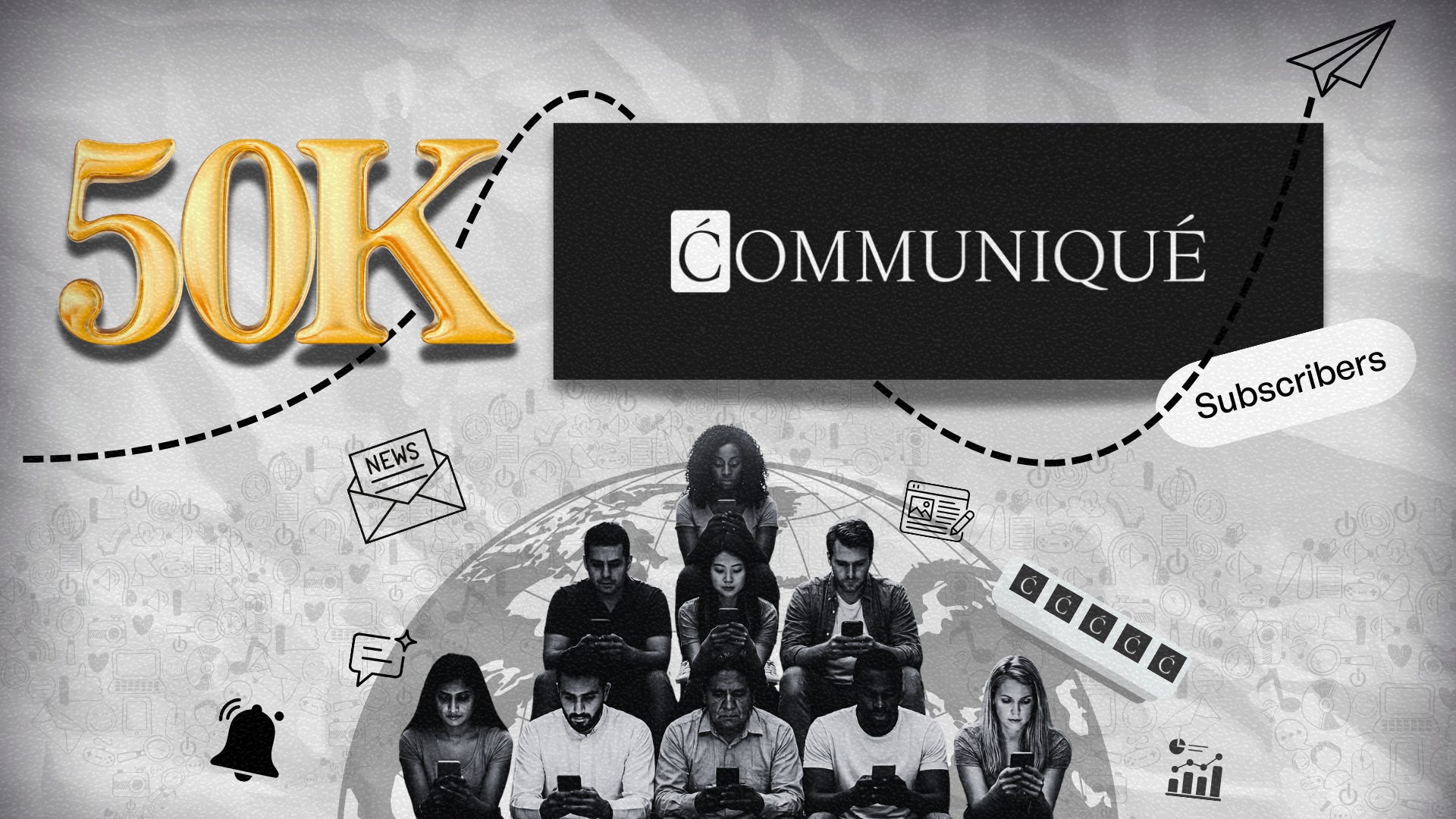
50,000 strong and still growing
This week, Communiqué is celebrating a significant milestone: we now have over 50,000 subscribers across all our publishing channels.
Over the past five years, Communiqué has evolved from humble beginnings as a side project into a full-fledged media and intelligence company, focused on mapping the contours of the broader creative economy on the continent.
The vision is lofty, but this milestone is a testament to its importance. Reaching 50,000 subscribers isn’t just about growth. It’s proof of a hunger for context, for grounded, consistent storytelling about how Africa’s media and creative industries work. But don’t just take our word for it. Here’s what some of our readers have said:
“Such important work! This kind of expertise is sorely lacking on our continent, especially as our media—whether hard news, lifestyle, or business—is facing major challenges.” — Jocelyne Muhutu-Remy, Managing Director, Sub-Saharan Africa, Spotify.
“Scaling the creative economy across Africa is both necessary and inspiring. What you’re building—connecting operators, investors, and policymakers—shows the ecosystem what’s possible when vision meets execution.” — Reza Abbas, Startups and SMEs Consultant.
“Always telling us the stories that matter. Thank you, Communiqué.” – Anita Okafor, IP Lawyer.
To everyone who’s shared our stories, forwarded them, commented, reposted, or convinced a friend to subscribe, thank you! You’re the reason we’ve come this far. Here’s to the next 50,000, and to telling even more stories that move the industry forward.
Our favourite Communiqué stories of 2025
Speaking of milestones, another thing we’re proud of this year is our consistency. For the first time since launching, we published our flagship essays every single week from January through December. They came in different forms and flavours, but each carried the Communiqué’s signature: precise, insightful analysis, commentary, and documentation of how Africa’s media and creative industries are evolving.
As we close out 2025, we’re revisiting a few that best capture what we’ve been chasing all year: stories that told the truth about the African creative economy—its messiness, ambition, and constant reinvention.
This was the essay that opened the year and, looking back now, seems prescient, given how CANAL+ dominated the news cycle throughout the year. The essay posited that the French broadcaster wasn’t just expanding, it was betting its future on Africa. It unpacked the scale of that gamble and why, collectively, its moves had made CANAL+ the most consequential media player in Africa today.
“Canal+ staking a huge part of its future growth plans on Africa might just be asking too much from the continent. Individually, the bets could be considered precarious. But collectively, these bets have made the French company Africa’s most consequential media player.”
Another recurring plot this year was Nollywood’s search for solutions to fix its distribution and financing issues. The partial exit of global streamers revealed a significant gap that needs to be filled. This essay chronicles one of the solutions emerging from an unlikely source to address financing: venture capital.
Long before international streamers came and left, MBO Capital was already backing Nigerian films, pouring billions of naira into an industry starved of structured capital. The essay captured their playbook.
“Despite the reduced activity of international streamers in the Nigerian market, MBO Capital invested 2.3 billion naira last year and plans to double that number this year.”
We launched a new vertical this year to spotlight the people behind the moves, and oh boy, did we meet some fascinating ones. From founders and editors to creators shaping entire industries, we told stories of interesting people doing interesting things across the continent.
Our pick of the bunch is Oluwamayowa Idowu’s story of how he built one of Nigeria’s top digital publications from scratch. His journey is both inspiring and instructive.
‘That impulse to create something bigger than himself led to the creation of Culture Custodian. He launched it in his final year of university, funding it with money his godmother had given him for his 21st birthday. “Instead of using it to have a good time, I used it to build the website,” he says. “I wanted it to be proper-proper, not just a blogspot.”’
Sports coverage in Africa tends to focus on athletes and matches. In this essay, we turned the spotlight on the power behind the scenes and showed how Sporty Group was quietly reshaping Africa’s sports industry from the infrastructure up.
“Over the past three years, Sporty TV, a subsidiary of Sporty Group, the company behind SportyBet, has quietly built a reputation as the continent’s new home of live sport. Its growing portfolio of free-to-air rights now spans some of the world’s biggest competitions, including the English Premier League, La Liga, Bundesliga, the Olympics, the Euros, and even the upstart Baller League.”
Public media is collapsing across Africa, and most coverage treats it as an inevitable decline. But what does survival look like? Though almost five months apart, these two essays provide stellar answers: Nigeria’s NTA focuses on rejigging its content programming, and South Africa’s determined posture to nail its distribution.
“For many public service broadcasters, reinvention begins with content: modernising storytelling, commissioning original programming, and developing new formats for digital audiences. But SABC has taken a different approach. Rather than starting with programming, it began by fixing the plumbing, investing in the technology that underpins digital delivery. With SABC+, the South African broadcaster has chosen to lead with infrastructure: building a platform capable of carrying the institution into the streaming age.”
Finally, our most personal essay of the year revisited the quiet force behind Nigeria’s media industry: campus journalism. It showed how those student networks built the skills and confidence that later defined a generation of newsroom leaders.
“Yet what’s even more striking about the UCJ’s legacy is that many of its most successful alumni never studied Mass Communication or Media Studies. Dapo Olorunyomi read Literature at Obafemi Awolowo University — a discipline that you could consider journalism-adjacent — but Fisayo Soyombo studied Animal Science at the University of Ibadan, a course far removed from the world of news and storytelling. This pattern repeats itself across generations: some of Nigeria’s finest journalists began as outsiders to the formal study of journalism.”
So there you go, this is our list. Tell us yours in the comments section.
Thank you for reading, supporting, and sharing our work all year. See you again in 2026.
Crunch Time 📈
Curiosity Cabinet
A second Guinness World Record wasn’t on Hilda Baci’s 2025 to-do list, but she—together with Gino—pulled it off anyway in September by cooking the world’s largest serving of jollof rice. This is the story of how the feat came to be.
The uncomfortable questions that AI-powered rip-offs and reworks of creative works are forcing Africa’s creative industry to confront.
Here are the events happening across Africa’s creative economy this weekend and next week:
December 11: MaliyoCon, Africa’s first mobile games conference, holds in Lagos, Nigeria
December 12: Silverbacks Awards holds in Kampala, Uganda
December 12: Abryanz Style and Fashion Awards holds in Kampala, Uganda
December 16 - 21: Accra Fashion Week holds in Accra, Ghana
Don’t forget to explore more of Africa’s creative economy in one place. Communiqué’s African Creative Economy Database tracks 1,000+ companies, events, investors, and government actors across the continent.
Thank you for reading Communiqué! Help us give Africa’s media and creative industries the coverage they deserve by donating here.
That’s it for this week’s Digest. See you next year!
Congratulations on this milestone. Cheers to the next 50k
Congratulations- And my favourite is the Hilda Baci one this week.