


1. A challenging story
In July, Nigerian author and publisher, Eghosa Imasuen, will release The Challengers, his third book and his first in more than a decade. Known for his novels, Fine Boys and To Saint Patrick, The Challengers is Imasuen’s first foray into narrative non-fiction. Set against the backdrop of the 2008 financial crisis, the book follows the journey of five friends who leave their jobs to start the VFD Group and grow it into a multi-billion-naira fintech.
The Challengers captures a moment when a generation of ambitious young professionals looked at the aftermath of a global economic collapse and saw opportunity. Their story unfolds alongside broader shifts in Nigeria’s financial services industry, creating a corporate record of how an institution, and the people behind it, emerged from a particular moment in time.
Despite producing some of the continent’s most consequential companies over the last two decades, the African tech ecosystem has generated remarkably few book-length accounts of how those enterprises were built. The stories exist, but they are often fragmented across interviews, conference panels, podcasts, newsletters and news reports. Rarely are they assembled into a single narrative that captures not only what happened, but why it happened.
This absence becomes increasingly striking as the ecosystem matures. The current iteration of Africa’s tech ecosystem now has its own generation of founders, investors, operators and institutions. It has produced several billion-dollar companies, landmark acquisitions, spectacular failures and defining regulatory battles. Yet many of these stories remain undocumented beyond the news cycle that first reported them. The industry has failed to produce canons that bind all these stories into a shared history.
2. But what exactly is a canon?
The term canon originally referred to the rules and texts that defined religious communities. Over time, it came to mean the books, ideas, and works considered essential within an intellectual or professional community. Beyond a mere reading list, a canon is a form of collective memory.
They emerge when a community has accumulated enough shared experience to look back on its own history and decide which stories are worth preserving. It looks backwards, preserving the record of how a community came to be, and forwards, ensuring that future generations inherit the lessons, myths, triumphs, and mistakes of those who came before them.
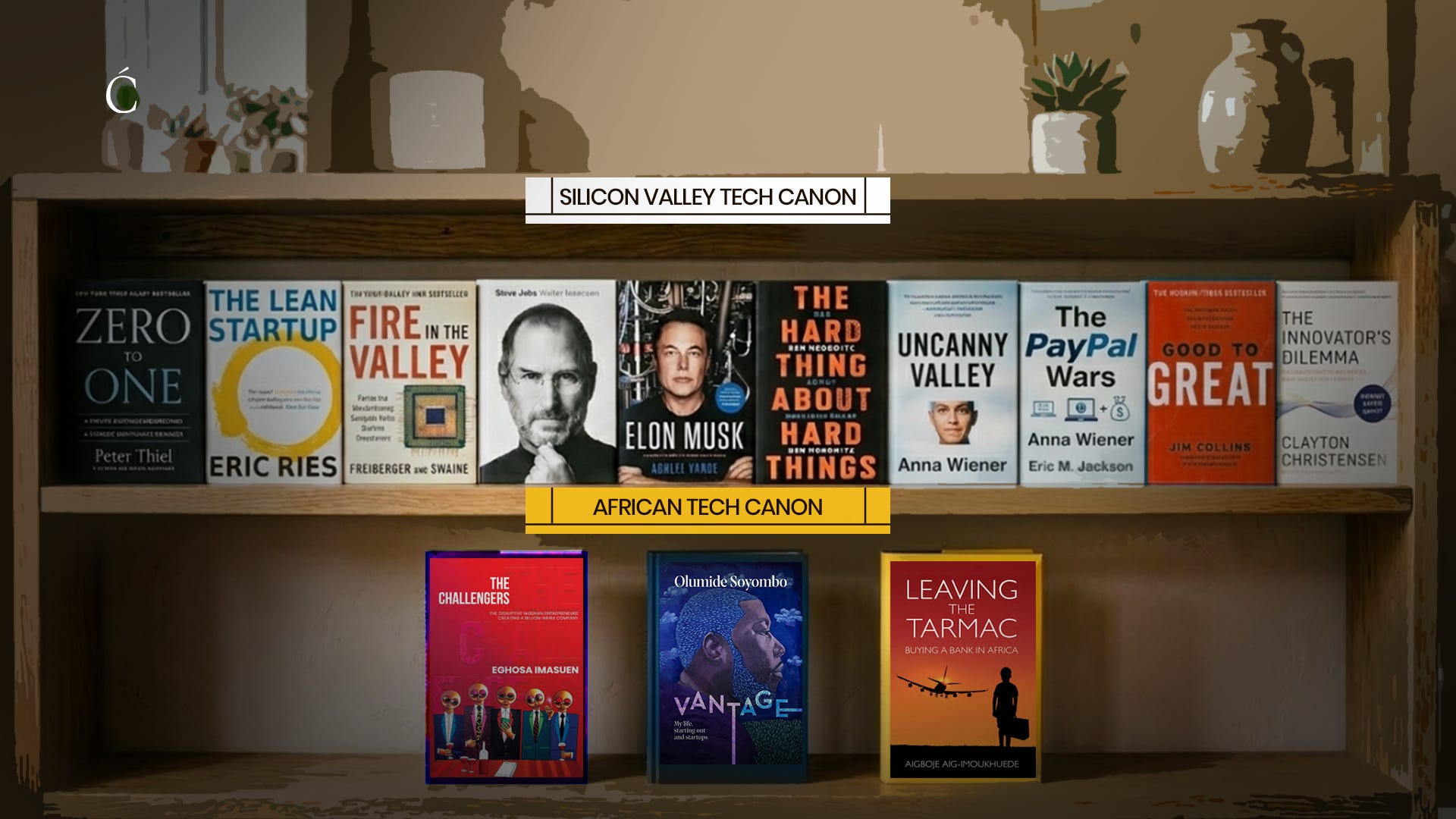
The existence of a canon is therefore a sign of maturity. It suggests that an industry has moved beyond the immediacy of building and has begun the work of interpretation. Over the years, this has happened in Silicon Valley; a collection of books that collectively explain how that ecosystem was built has been written. Some chronicle the rise of individual companies (The Everything Store) and founders (Steve Jobs). Others document the emergence of venture capital (Secrets of Sand Hill Road), the personal computer revolution (Fire in the Valley), the dot-com boom (The New New Thing), or the workings of startups (The Hard Thing About Hard Things). Taken together, they form a shared historical record that allows founders, investors, employees and observers to understand where the industry came from and to develop a deeper understanding of the ideas, decisions and cultural norms that shaped the ecosystem.
The influence of the Silicon Valley canon extends far beyond the Valley itself. In China, Xiaomi founder Lei Jun has credited Fire in the Valley, Michael Swaine and Paul Freiberger’s history of the personal computer revolution, as an early inspiration. Before building Stripe, the Collison brothers read several books in the Silicon Valley canon while growing up in Ireland. Patrick Collison has publicly shared reading lists covering many of these texts. Even in Nigeria, the Silicon Valley canon holds sway. Home service startup, Eden Life made reading and discussing books from this canon like Working Backwards, Colin Bryar and Bill Carr’s account of the Amazon management philosophy, part of the leadership team’s weekly routine. Also, when Njoku Emmanuel shut down his crypto startup, Lazerpay, in 2023, one of the books he turned to was The Hard Thing About Hard Things, Ben Horowitz’s memoir on navigating the challenges of startup building.
Yet there are no books rooted in local context that an embattled founder like Njoku Emmanuel could turn to for guidance. No definitive account of the rise of Nigerian fintech. No book on CcHub and its 2010s cluster of startups. No history of MainOne and the internet cable that enabled most of those startups.
To be fair, there have been attempts at creating these accounts. Russell Southwood’s Africa 2.0 documents how mobile phones and the internet became accessible to millions across sub-Saharan Africa. In Leaving the Tarmac, Aigboje Aig-Imoukhuede recounts how he grew Access Bank into a continental banking giant alongside his late business partner, Herbert Wigwe. Also, in 2023 Voltron Capital founder Olumide Soyombo released Vantage, a memoir of his investing journey and role in helping incubate startups such as Piggyvest. The book became the third best-selling non-fiction title in Nigeria in both 2023 and 2024, according to Open Country Mag bestseller rankings.
Increasingly, there appears to be demand for such stories. “Nigerians are becoming more interested in non-fiction personal stories—not just of global figures like Bill Gates, Warren Buffett, or Steve Jobs, but of their own leaders,” Anwuli Ojogwu, Imasuen’s co-founder at Narrative Landscape Press, told Communiqué last year. The question, then, is not whether people want these books. It is why so few of them have been written.
3. Big questions require big answers
Part of the answer is that African technology is still a relatively young ecosystem. Only now has enough time passed for participants to reflect on its history. Until recently, the founders best positioned to write these accounts were occupied with the immediate demands of building companies, raising capital, and scaling products. More importantly, many of the ecosystem’s pioneers have not yet completed their story arcs. Writing a definitive account of Flutterwave today, for instance, would feel premature without knowing how the story ultimately ends. You cannot canonise an unfinished story.
Then there is the question of access. Canonical books are built on information that was not previously available to the public. In some cases, the writer has lived through the events themselves. “Africa 2.0 was a summary of 25 years of working in the communications industry on the continent. This gave me the experience to know some of the key players, and where I didn’t, I knew someone who did,” Russell Southwood told Communiqué.
Where the writer lacks first-hand experience, they must be willing to spend years with a subject, and the subject must be willing to grant access not only to themselves but to investors, former employees, emails and internal documents. Walter Isaacson spent two years shadowing Steve Jobs, conducting over 40 exclusive interviews, supplementing these talks by staying on and off at Jobs’s Palo Alto home and speaking with more than a hundred of his colleagues, friends and competitors. Such access can be uncomfortable. Canonical books are rarely polite histories; they examine failures, betrayals, power struggles, regulatory battles and costly mistakes. Few founders are willing to open themselves up in that way. The Challengers only exists because Imasuen leveraged a pre-existing relationship with the VFD founders.
Academia can also play a role. Some of the most important accounts of technology ecosystems emerge from researchers seeking to understand how industries evolve. Money Real Quick, a study of how M-Pesa transformed Kenya through mobile money, was written by Tonny Omwansa of the University of Nairobi and Nicholas Sullivan of Tufts University’s Fletcher School.
Even with access, writing these books requires time and money. A serious narrative history can take years of reporting, yet Africa’s media economics rarely support projects of that scale. Money Real Quick was supported by funding from the Rockefeller Foundation, while Southwood drew on the resources of his consultancy, Balancing Act, to produce Africa 2.0. The market for such books may be growing, but the institutions, incentives, and financial backing needed to produce them consistently are only beginning to emerge.
If Communiqué has shaped how you see the industry, return the favour. Every contribution keeps us accountable to you.
4. Market forces
Ultimately, producing more canonical books requires a market that can sustain them. “To have books, you need to have a reading culture, and with some notable exceptions, that audience is quite small on the continent. Those readers also need to be interested in where we come from and where we are going,” Southwood said.
Until now, many of the closest things the African tech ecosystem has produced to canonical accounts have largely been self-funded projects by founders wealthy enough to underwrite the cost without worrying about whether the book would sell. But The Challengers suggests an audience may finally be emerging.
This creates opportunities across the ecosystem. For journalists, it presents the chance to create the definitive histories the industry lacks. There are already writers who fit the bill. Olumuyiwa Olowogboyega, former editor-in-chief of TechCabal and publisher of Notadeepdive, has reported extensively on Jumia and is perhaps best positioned to write a definitive account of the e-commerce giant. Fu’ad Lawal’s long-form account of the Paystack story similarly contains the raw material for a book-length treatment.
The opportunity extends to media organisations as well. Publications such as TechCabal and Techpoint have spent years building archives of interviews, investigations and reporting that could serve as the foundation for future books. For publishers, the opportunity may be even greater. Unlike literary fiction, where the market is already relatively established, African tech narrative non-fiction remains largely unexplored territory. A publisher that succeeds in creating this category could occupy the same position that business publishers like Harvard Business Review Press occupy abroad. More importantly, publishers do not need to wait for these books to arrive in their inboxes. They can commission them: identify significant companies, founders and industries, and pair them with capable writers.
The African tech ecosystem has spent the last two decades building companies, products, and institutions. The next challenge may be documenting how all of that happened. Because industries are not only shaped by the people who build them, but by the stories we tell about how they were built.
What does it take to make this happen? We will break this down in the next essay.

I think also the creation culture needs to be up. As in we can drive the demand for the books through movies as well. We can start by taking bets on the established boring businesses because they have fully developed stories. Then carry that forward into startup culture. An ideal case study would be a film adaptation of Femi Otedola’s “Making it big”
This is really interesting, I would definitely want to hear more stories on African startups and lessons from building them. I think these relatable stories would make a big impact, even if it’s not immediate but we will definitely see the impact in future generations who will learn from the current startup ecosystem.