


1. First movers
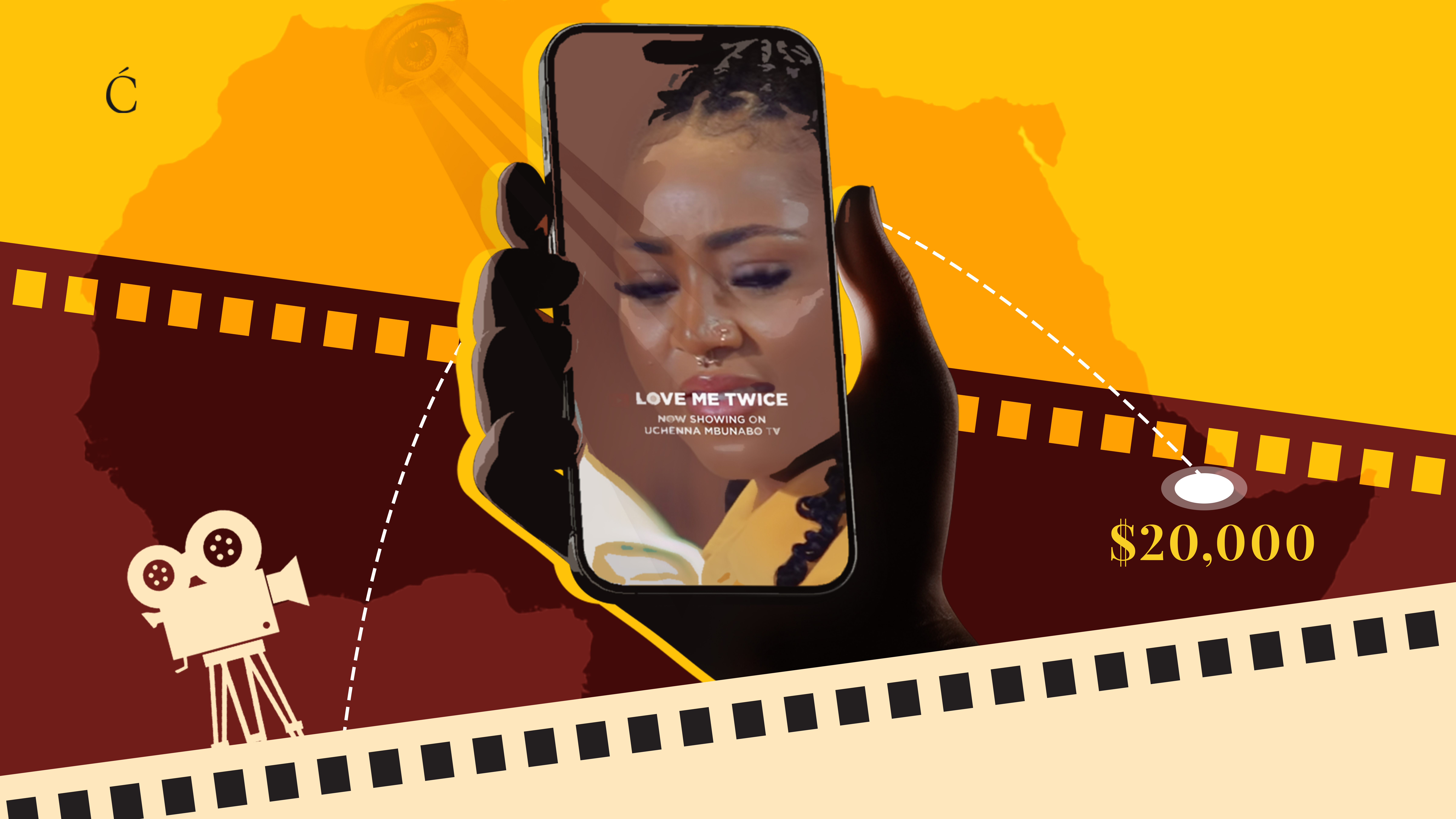
In March, EbonyLife Group announced it was entering the microdrama market with Love Me Twice, a vertical short starring Tobi Bakare, Atlanta Bridget Johnson, and Shine Rossman, and directed by Kayode Kasum, which will be released on EbonyLife ON Plus, the producer’s streaming platform. Around the same time, Toribox, which markets itself as Africa’s first microdrama platform, stepped up promotion ahead of a planned launch later this year.
Taken together, the two developments signal that Africa’s microdrama economy is beginning to shift from speculation to market formation. In Communiqué 104, we argued that the continent was structurally positioned to participate in this shift:
“Africa has yet to get in on the game. The continent has a natural affinity for the format. Many of the systems and values that underpin the explosive growth of microdrama—fast production cycles, dialogue-driven narratives, emotionally charged storytelling, and serialised output—are the same strengths that built traditional African film industries like Nollywood. But what will be the continent’s place in the global market?”
That question is now becoming more concrete. The entry of an established producer such as EbonyLife suggests that microdrama is beginning to attract institutional attention, while Toribox’s positioning points to early attempts at building local distribution infrastructure rather than relying solely on imported platforms and formats. To understand whether these moves mark the beginning of a viable industry, we must examine the economics taking shape beneath them: what it costs to produce microdrama in Africa, where revenues are emerging, and which parts of the value chain are most likely to scale first.
2. Counting the cost
In Nigeria and across Africa, it currently costs about $20,000 to produce a 60-episode microdrama. This compares to roughly $100,000 in the United States and around $50,000 in China. At the lower end of the market, newer platforms are beginning to accept shorter, 30-episode formats in a bid to reduce barriers to entry. These can be produced for as little as $10,000.
The cost differential is not accidental. China’s microdrama industry has already undergone several cycles of iteration and scale. Production pipelines are standardised, talent pools are specialised, and infrastructure is optimised for speed. As a result, the ecosystem benefits from economies of scale that newer markets have yet to develop.
In Africa, costs are still being discovered—and one of the most significant drivers is location. Microdramas tend to trade in fantasies of wealth, social ascent, and domestic intrigue, which means they often need to be shot in houses, offices, and environments that can credibly signal status. Renting a suitable location, usually a house, can cost between $370 and $590. Since shoots usually run between five and seven days, location costs alone can quickly become one of the biggest line items in the budget.
After location, the next major cost is the cast. Microdramas tend to avoid A-list actors. The format prioritises narrative intensity over star power. What keeps audiences returning is not the recognisability of faces, but the momentum of the story itself. That has helped keep acting costs relatively contained, while also allowing producers to test new faces. Daily actor rates range from about $110 to $183, depending on the performer. A budget for three lead actors at $147 each over seven days comes to $3,079.
Also, the format deliberately restricts the number of actors. Microdramas tend to keep the principal cast to three people, or at most five. Beyond that, the story risks becoming too complex. The format depends on speed and a tight, dramatic arc. Too many characters create narrative drag and add cost.
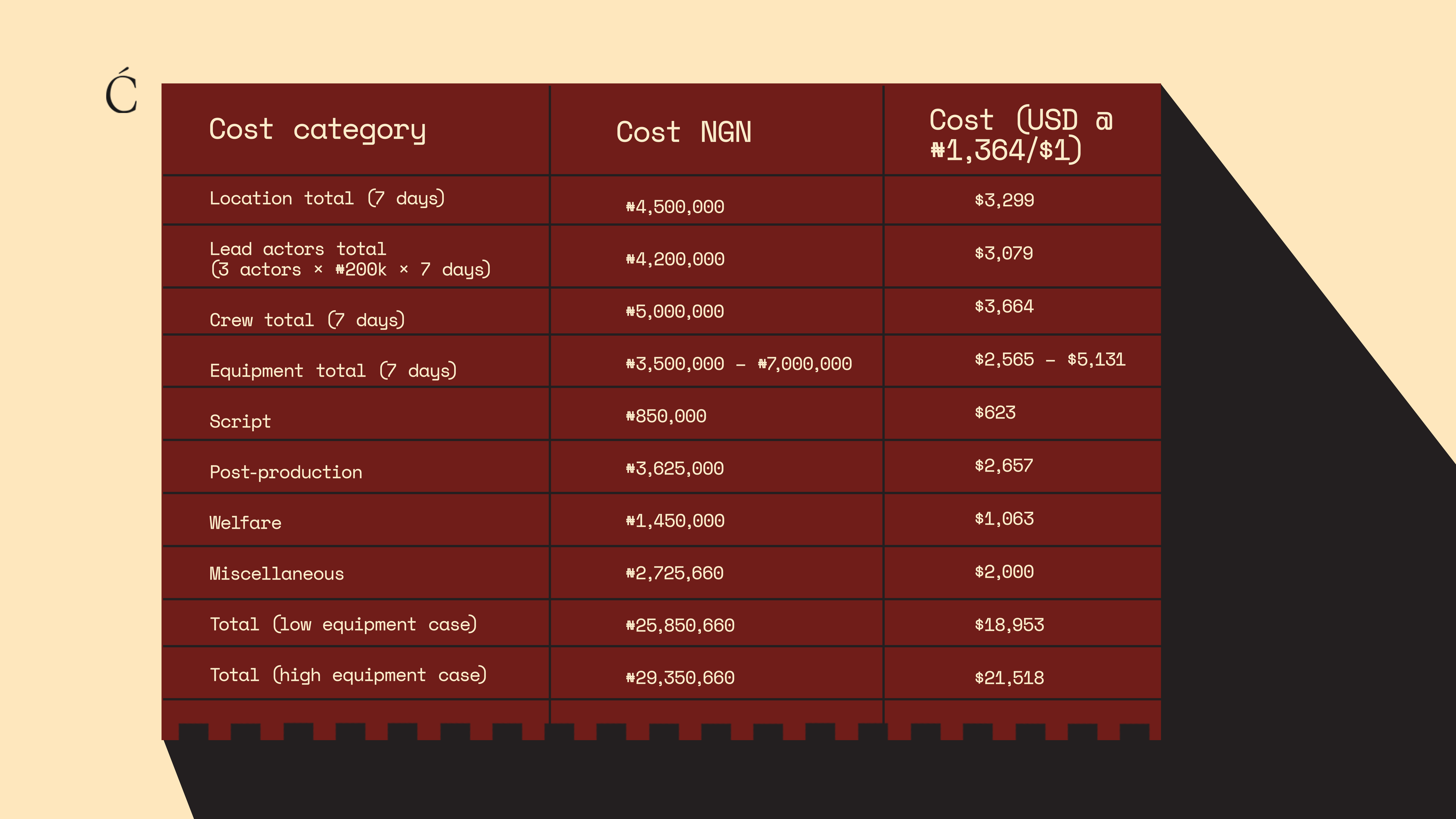
After the location and cast comes the crew. This is another area where the format’s apparent simplicity can be misleading. A microdrama may be short, but it still requires a crew able to work quickly and understand the pacing demands of the format. Crew costs can reach $3,665 for a seven-day shoot, with a minimum of $2,932 for a five-day shoot.
Equipment is another major expense. Rentals range from about $366 to $733 per day, depending on the setup. Some productions can be done with two cameras; others require three. Over seven days, equipment costs range from $2,565 to $5,131. Then there is the script and post-production. A good writer costs about $623 at a minimum. Post-production, which includes editing, colour correction, and sound design, starts at around $2,500. In practice, editing is especially important in microdrama because cliffhangers, emotional beats, and paywall tension have to be engineered with precision. The format compresses production, but it does not remove craft.
3. Money trees
Monetisation is what ultimately determines whether the microdrama industry becomes viable. While production costs set the barrier to entry, revenue defines whether that barrier is worth crossing. In Africa, that revenue model is still taking shape—and it begins earlier in the value chain than expected.
Even before producers recoup their investment from finished episodes, the first lever of monetisation is scriptwriting. Microdrama has created a parallel market for high-concept, serialised storytelling, in which writers are commissioned to develop scripts capable of sustaining dozens of short episodes. In this emerging market, African writers are already earning as much as $1,500 per script, depending on the platform and the strength of the idea. “We commission writers, alumni of the academy, on behalf of global platforms to write microdrama scripts.” Ifeoma Areh, convener of the Digital Creator Academy for Africa, told Communiqué. “This is more than their counterparts in Nollywood make.”
Over time, however, the larger monetisation opportunity is expected to come from global microdrama platforms acquiring content from African producers. This model has already taken hold in more mature markets, where platforms fund production or license completed series to fill their content pipelines.
In Africa, this has not yet begun to happen at scale. But when it does, the economics become clearer. Producers expect to earn in the region of $30,000 per project from platform deals, enough to recoup production costs and generate a margin. The implication is that profitability will depend less on direct audience payments and more on the ability to supply content into a global distribution system. For now, the industry remains in a proof-of-concept phase, with producers still testing the economics of local production and platforms still figuring out how African stories fit into global catalogues.
Africa’s microdrama economy remains early and experimental. But the outlines of a business are beginning to emerge. Production budgets are low enough to allow entry, even if they remain high by local standards. Scriptwriting is already functioning as an early monetisation lever, while platform licensing appears to be the most likely path to scale. What is missing is industry maturity: specialist crews, repeatable workflows, financing structures and distribution systems that can turn isolated projects into a continuous market.
Microdrama offers African film industries a rare chance to enter a global format before its hierarchies fully harden. The question is no longer whether the continent has the storytelling instincts for it. It does. The more important question is whether producers, platforms and creative talent can build the systems required to convert that instinct into a durable commercial advantage. The answer will determine whether microdrama remains a niche experiment or becomes a genuine new growth sector.
Independent journalism on Africa’s creative economy is rare. Help us keep it that way. Communiqué is reader-supported. If our reporting has been useful to you, consider contributing.
Timely analysis. Thanks for sharing.