


1. Déjà vu
You’ve seen the ads for platforms like ReelShort or Dramabox. They start mid-chaos. A woman in an office dress storms into a glass-walled boardroom. Her billionaire boss slides a document across the table. “You’ll sign this…or I’ll ruin your life.” Or a young martial arts student in a crowded teahouse discovers an ancient scroll meant for someone else. Before he can read it, a group of bandits bursts in, in search of that same scroll. A fight breaks out. The episode ends with him fleeing into the night, the scroll clutched tightly in his hand.
What you’ve just seen in those ads is the essence of microdrama. Unlike traditional television or film, microdramas are short, episodic stories designed for mobile consumption. Each episode usually runs between 30 seconds and three minutes, and the storytelling is built around high-stakes conflict, emotional cliffhangers, and a rapid pace that keeps viewers coming back for the next instalment.
Microdramas often lean into melodrama: intense relationships, betrayal, family secrets, class tension, or revenge. Production costs are kept low, but the stories are crafted to maximise emotional impact and audience engagement. The content is serialised, bingeable in small doses, and engineered to hook audiences in seconds.
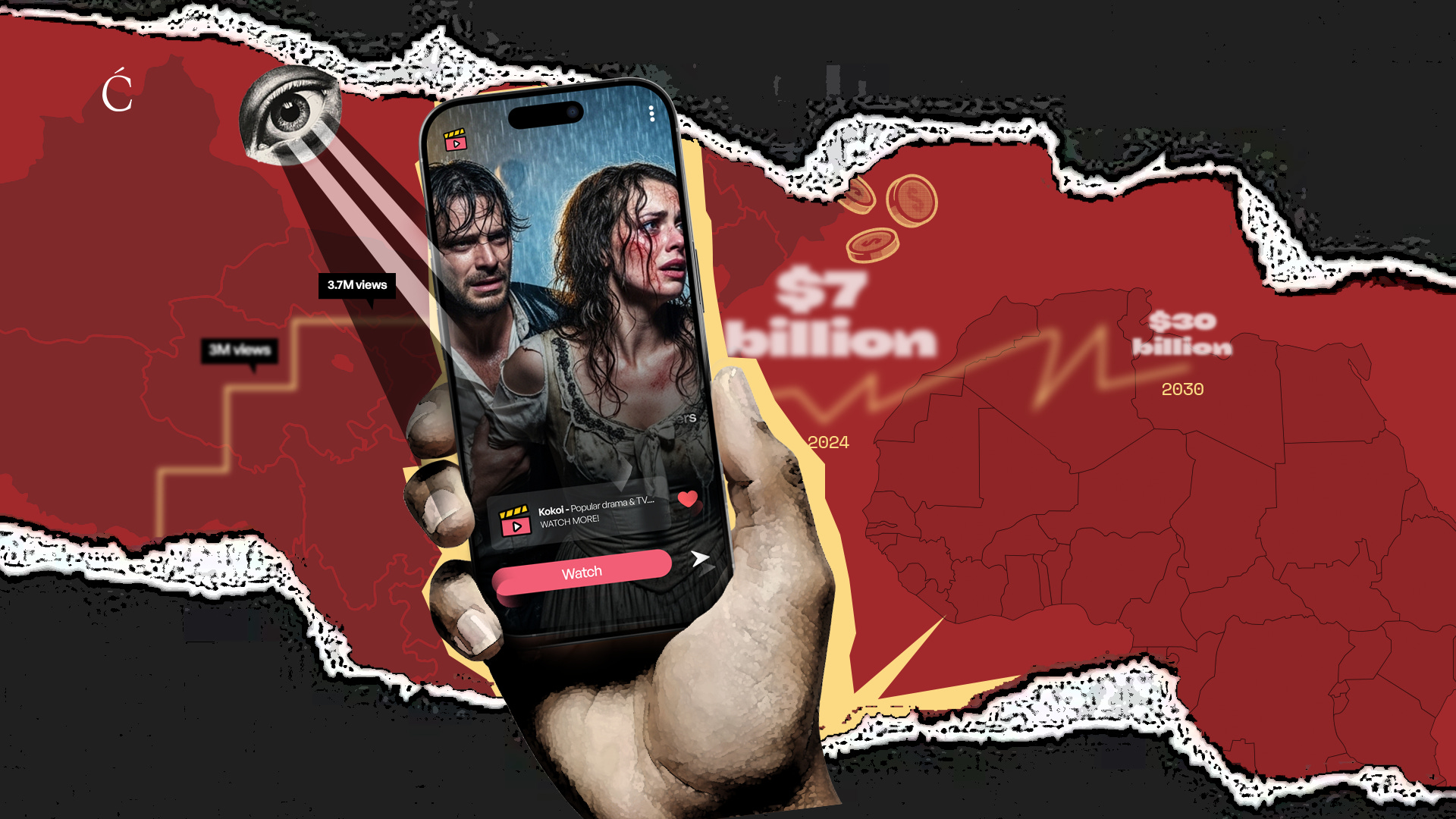
The microdrama industry has grown in leaps and bounds since its inception in China. In 2024, revenues in China alone surpassed $7 billion, exceeding the Chinese box office’s earnings for that year. The format has not stayed confined to the Chinese mainland; it has expanded rapidly to Southeast Asia and the United States, where it generated $814 million in revenue in 2024. The global microdrama market is projected to reach $30 billion by 2030, fueled by mobile-first consumption habits, algorithm-driven distribution platforms, and the low-cost, high-volume nature of production.

But Africa has yet to get in on the game. The continent has a natural affinity for the format. Many of the systems and values that underpin the explosive growth of microdrama, fast production cycles, dialogue-driven narratives, emotionally charged storytelling, and serialised output are the same strengths that built traditional African film industries like Nollywood. But what will be the continent’s place in the global market? This is the question some Nollywood executives are trying to answer.
2. From China with love
Serialised storytelling, the type that microdramas are now popularising, has existed for centuries, from newspaper novels in the 19th century to radio dramas and soap operas. But the internet changed two things at once: speed and feedback. Stories could now be published in fragments and judged instantly by audiences.
In the late 2000s and early 2010s, online fiction platforms such as Wattpad, Jinjiang Literature City, and Qidian made this model mainstream. Writers released stories chapter by chapter, often daily. They learned, quickly, that shorter chapters, dramatic turns, and unresolved endings kept readers coming back. If a story gained traction, it was extended. If it didn’t, it was dropped.
China took this system further. By the mid-2010s, the country had built a vast web-novel ecosystem, complete with editors, ranking systems, and monetisation tools. Popular online stories were routinely adapted into television dramas, films, animations, and games. Storytelling became industrial: high-volume, audience-responsive, and optimised for scale.
The next shift came with short-form video. Platforms like Douyin and Kuaishou trained users to consume content in seconds. Producers began experimenting with ultra-short and vertically shot episodes designed specifically for phones. These experiments accelerated during the Covid-19 pandemic, when audiences spent more time on mobile devices and production budgets tightened.
By the early 2020s, microdrama had solidified into a distinct format. Dedicated apps emerged. Studios specialised in fast-turnaround production. Business models formed around subscriptions, pay-per-episode access, and advertising. In 2021, the microdrama industry generated $500 million in revenue.
Once the model worked at home, it travelled. Chinese companies realised that these stories crossed borders easily. They relied on universal emotions, simple setups, and mobile-friendly viewing. Platforms expanded into Southeast Asia and North America, often localising actors and settings while keeping the same narrative structure.
Microdrama is now one of the fastest-growing segments of global entertainment. It sits somewhere between film, television, and social media. “After four years of rapid global growth, the microdrama industry is now entering its third phase of evolution.” Ronan Wong, COO of microdrama distribution platform AR Asia, told Variety. The first phase began in China, and the second phase saw the format expand successfully to North America. The third phase will see countries around the world develop their own microdrama systems, producing content that reflects their local cultures. In India, for instance, microdramas are estimated to be the fastest-growing segment in the country’s $2.4 billion interactive media sector. This is where Africa comes in.
3. The Storyformat playbook
Two years ago, two Nigerian film executives quietly began working on a way to plug the continent into a fast-moving global industry before it calcified. Elijah Affi, cofounder of TakeOut Media and producer of Tokunboh, Nollywood’s second most-watched film on Netflix, and Ifeoma Areh, convener of the Digital Creator Academy, came to the same conclusion: Nigeria already had the instincts for microdrama. What it lacked was structure. “We already know how to do low-budget projects. We already know how to tell very crazy stories. We already have the secret sauce,” Affi said to Communiqué.
Their response is Storyformat Studios, a platform designed to localise microdrama production, beginning with Nigeria and then expanding across the continent. In May, the pair will launch the Digital Creator Academy for Microdrama, training 300 established filmmakers across the continent to adapt their skills to the demands of vertical, short-form storytelling.
Available data suggests demand already exists for microdrama on the continent. According to Sensor Tower, Nigeria is among the top five global download markets for microdrama apps. In the third quarter of 2024, ReelShort recorded more than 300,000 weekly active users in the country, while DramaBox saw strong growth in Ghana, reaching 33,900 weekly active users during the same period.
However, monetisation is still a problem. Weekly revenues in Nigeria peaked at $3,800. South Africa remains the most profitable market for microdrama, with ReelShort’s weekly revenues ranging from $7,000 to $15,000 in 2024.
A major reason is a lack of market fit in the business. The prevailing in-app purchase model used by microdrama platforms struggles in markets accustomed to free, ad-supported content. Also, the content being pushed on the continent—werewolves, European-style fantasy tropes—does not reflect local realities. To address these structural challenges, Storyformat Studios is launching a pan-African microdrama alliance, a coalition of independent creators and studios designed to reduce gatekeeping, set standards, and negotiate collectively with global platforms.
The academy feeds the alliance. The alliance feeds production. Production feeds platforms. Together, they form an ecosystem.
For decades, Nollywood and the larger African film industry have arrived late to global entertainment cycles. By the time new formats mature, the rules are already set and the power consolidated elsewhere. Microdrama offers a rare exception. It is still forming, with its creative language, business models, and global hierarchies far from settled.
“This is the first time that Africa will be able to join an industry that is literally in its infancy. We have the opportunity to be at par globally in terms of storytelling, in terms of technical skill, and in terms of creativity,” Ifeoma Areh said to Communiqué.
Affi and Areh see familiarity as their competitive advantage. Fast production cycles, heightened emotion, dialogue-driven plots, and audience-first storytelling have long defined industries like Nollywood. These are the same values that power microdramas’ success in China and beyond. What has changed is the container: vertical screens instead of cinemas, minutes instead of hours, algorithms instead of schedulers.
The opportunity now is structural. If, as Affi and Areh believe, African film industries invest early in training, creator coordination, and local platforms, they can shape this format rather than adapt to it. Microdrama allows the continent to enter not as a latecomer, but as a co-author of a new global storytelling economy.
If you like and find what you just read useful, consider supporting Communiqué with a donation.
Absolutely. I believe we have an opportunity, which is why I started building ToriBOX, a vertical microdrama platform for Nollywood. ToriBOX will be live on Google Play Store at the end of this month for Andriod users. You can join the waitlist on www.tori-box.com . For collaborations or enquiries, we can connect via email: david@tori-box.com
Super excited!