


1. Inception
I spent the last week in Kigali at the Africa Creative Economy Investment Forum, where Communiqué was an ecosystem partner. Alongside the main programme, we ran a Communiqué IRL event in partnership with Africa in Colours, and I sat on a panel with Deborah Oguike, who leads events and partnerships at Communiqué, and Raoul Rugamba of Africa in Colours. We discussed how to build a viable investment ecosystem for Africa’s creative economy. During that conversation, I shared a thesis I’ve been ruminating on for a while now.
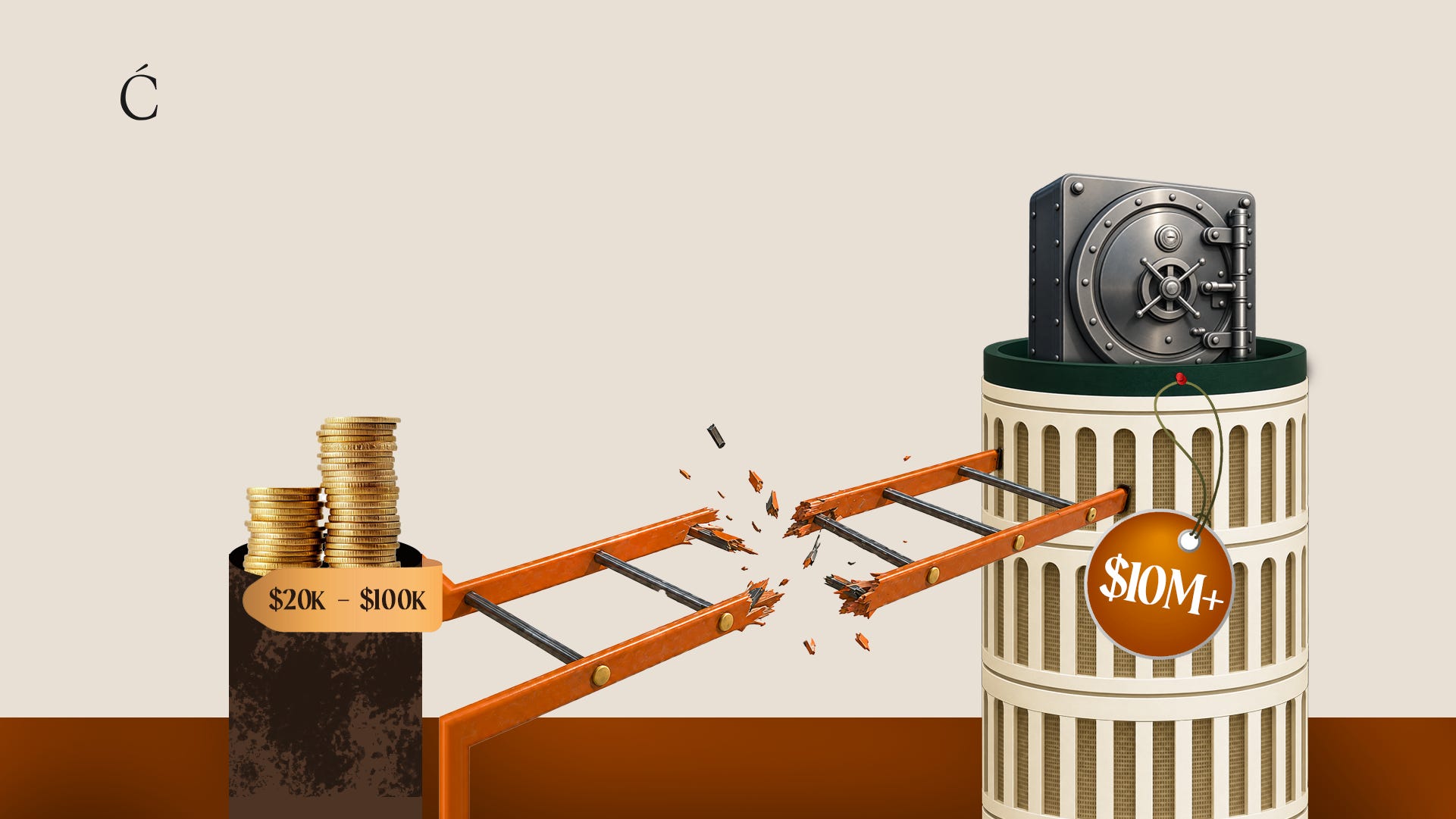
It is clear that Africa’s creative economy has a massive investment gap, but that gap isn’t really about (a lack of) available capital. It’s about the size and destination of said capital. On one end, you have small cheques, the $20,000 to $100,000 range that come through grants and, now, some small-scale investment funds. These are genuinely useful, but nowhere near enough on their own to form durable enterprises. On the other end sit the big tickets, the $10 million and above that DFIs and their vehicles are built to write, which is simply bigger than what most enterprises in this ecosystem can absorb right now. And in between those two ends, there’s a wide stretch of companies in limbo.
A few people in the audience corroborated the point from their own experience. One founder talked about how many companies had outgrown the available grant programmes but weren’t remotely close to what a $2 million cheque would require of their business. Those companies, we agreed, are stuck in the gap, and that gap needs to be closed for the ecosystem’s sake.
You’re reading Communiqué because someone in the Inner Circle paid for it. Pay it forward.
2. Demand, partially fixed. Supply, not really
In her book Creative Cash Flow, Marie Lora-Mungai, who has spent close to two decades in the industry and now advises the DFIs in this space, makes the point that there is more capital circulating in African creative industries today than there are investment-ready businesses to absorb it. Afreximbank, the World Bank and IFC, the African Development Bank, Agence Française de Développement, and a growing list of private investors have all repositioned themselves around the sector in the last three years. The demand side of the equation, which involves making capital available to the market, has been partially addressed. What remains unsolved, and painfully so, is the size and delivery style of that capital.
We need to make that distinction clear because it changes the kinds of problems we discuss.
If this were a policy problem, the fix would be lobbying governments to change tax regulations or tighten IP laws and systems (spoiler alert: a lot of them are already doing this). If it were purely an awareness problem, the fix would be more advocacy through panels, reports, and roundtables to convince investors that this sector is worth their money. But look at the list of names above again: Afreximbank, the World Bank, IFC, AfDB, AFD. They don’t need much more convincing. The awareness problem is mostly behind us. The policy conversations are already happening, however slowly.
What is left is a twofold issue. The first part is that too much of the available capital is designed for market dynamics that don’t yet exist. The second is that even when the cheque sizes are right (and many of them are), the manner in which they are disbursed isn’t quite so.
3. Hard truths
Take CANEX Creations Inc, the intellectual property investment subsidiary of FEDA, Afreximbank’s equity arm. On paper, the thesis — which is to commercialise African IP across film, music, fashion, and sport, in a continent producing more culturally significant work than it currently captures value from — makes sense. In Communiqué 121, I said, “[CCInc’s] vision is coherent and generous, but it also relies heavily on several other actors to play their roles.” Part of that is what this essay explores.
CCInc is already deploying capital. For instance, it has an equity stake in talent monetisation platform C.R.E.A.M and a co-investment in the feature film Clarissa, which NEON picked up for worldwide distribution. But all of this exists on top of a market where copyright enforcement is inconsistent, and collection societies barely function in most countries where they exist at all. Afreximbank has pledged $2 billion for the broader CANEX platform through 2027, plus a separate $1 billion film debt vehicle. So, in this context, for CCInc to succeed in the long run, it needs companies and platforms whose value proposition is to enable and simplify IP protection, distribution, and monetisation. But CCInc’s investment ecosystem cannot accommodate many such companies right now, because they would first need to show significant traction beyond the seed investment stage.
The same problem shows up in the DFI-scale funds writing bigger cheques. AfDB’s iDICE programme launched in 2023 with a $618 million budget and a projected $6.4 billion economic impact, targeting more than 200 tech and creative startups in Nigeria. IFC has stated an ambition to invest $1 billion a year in creative industries across emerging markets. Commitments at that scale come with tickets typically starting at $10 million. The vast majority of African creative businesses, at the moment, do not have the capacity to absorb even $1 million. That is the missing middle that we need to figure out. But what does that look like?
Your contribution funds: Original reporting, data licensing, and a small editorial team that actually answers your replies. No ads, no paywalls.
4. Readiness Capital, and a leaf from the MDIF’s playbook
The solution, I believe, is providing what I call “Readiness Capital.” This, I define, as capital structured to make a company investable, not one that assumes it already is. There’s already a lot of the latter in existence, and not enough of the former.
Readiness Capital operates through two arms: a development arm that gets a company to the point where it can absorb the right capital, and an investment arm that writes the cheque once the company is actually ready. An organisation that embodies this concept is the Media Development Investment Fund (MDIF)*.
A few weeks ago, MDIF published its 2025 year-in-review, marking thirty years of operation. I’m referencing that report because it’s the closest thing I’ve found to a working blueprint for what Africa’s creative economy actually needs: Readiness Capital actually working, at scale, over several years.
The numbers are interesting. By the end of 2025, MDIF held $119 million in assets under management across 56 companies in 31 countries. Since 1996, it has deployed $280 million in loans and equity across 159 companies in 50 countries, recovered $146 million of that principal, and returned $134 million to investors, with a 100% on-time repayment rate and a 10% write-off rate. MDIF’s chief strategy officer, Patrice Schneider, makes the case in the report that independent information is investable and deserves to be financed for sustainability rather than mere survival, and that where commercial capital has entered the sector, it has too often come at the cost of independence. MDIF’s answer, in his words, is a third path in which philanthropic and public capital absorb early risk and give commercial investors the confidence to come in afterwards. By the end of 2025, 56 investors and donors had bought into that approach.
That structure, more than the money, is Readiness Capital in practice, and it’s what I think actually works for Africa’s creative economy. On the one hand, there’s a development strategy that doesn’t hand out grants and hope for the best. It runs programmes that give companies room to experiment, fail, and learn, then iterate, providing a way out of the missing middle. The investment arm would then back some of those companies once they’re ready for capital they can actually absorb.
I’m not selling this as a silver bullet, though. Readiness Capital is difficult to fundraise for, because it asks investors to accept a lower return ceiling in exchange for lower risk and real impact. That pitch doesn’t excite the LPs who came to Africa’s creative economy in search of unicorn stories. It’s also operationally heavier than a pure investment fund. Running in-house development programmes requires headcount and patience that most fund structures aren’t built for, and results show up slowly, which is a hard sell to anyone reporting to a board on an annual cycle.
I also want to be careful not to oversell what a single fund like this could do. It will not fix the entire ecosystem on its own. MDIF took thirty years and a global vision to get where it is, and even then it operates across 56 companies, not 5,600. One fund running on Readiness Capital here would move the needle for its own portfolio and prove the concept, not solve the sector’s supply problem by itself. But imagine if multiple funds adopted this approach? That would be a game changer.
Another major risk is impatience. There’s every likelihood that this model will be tried once, judged against unrealistic return expectations by year three, and written off as proof that Readiness Capital doesn’t work here. That lesson would be wrong and drawn far too early. Again, it took MDIF three decades to compound. This model needs time to work.
$10 covers a reader. $100 covers a story. $1,000 covers a month. Communiqué is built on direct support from people who believe Africa’s creative economy deserves serious coverage.
5. More real-life examples
None of this is hypothetical. HEVA Fund in Kenya, Africa’s first dedicated creative industry fund and one that Communiqué has written about before, has mobilised more than $40 million for over 300 creative businesses in East Africa over the past decade, writing cheques suited to the businesses that actually exist. Its shared-risk lending arrangement with NCBA Bank, where the two jointly evaluate applicants and structure loan terms around the irregular, project-based income typical in creative work, is close to a blueprint for what a mainstream lender partnering with a specialist fund should look like.
There’s also a live example unfolding right now that I think is worth examining. In May, IFC and Zaria Group, the pan-African sports and entertainment company co-founded by Masai Ujiri, announced a partnership to develop sports and entertainment districts across African cities, starting with Nairobi, building on Zaria’s work in Kigali, where it operates BK Arena, Amahoro Stadium, and the newer Zaria Court complex next door. BK Arena has hosted the Basketball Africa League finals since the league launched, and the model Zaria and IFC are now trying to replicate in Nairobi is essentially that Kigali template. That, in a way, is Readiness Capital taking shape.
6. Final notes
Nobody in this ecosystem is short on ambition: not the investors, not the entrepreneurs. CANEX has pledged $2 billion. iDICE is carrying a $618 million mandate. IFC wants to write a billion dollars a year, and it’s already testing what patient, platform-level capital looks like through its bet on Zaria Group. Those are not small commitments, and I don’t think the people behind them are wrong. (Who am I to say so?) But I think the sequencing could be better and more realistic. Most of these investment strategies are not optimised for market realities. And until more funds are willing to go against the grain, adopt something closer to Readiness Capital, and build in the missing middle, much of the available capital will be wasted or remain exactly where it is now: announced in press releases, searching for the right takers, but hanging in the balance because it is incompatible with too many parts of the market.
You are welcome to disagree.
*Disclosure: Communiqué is part of MDIF’s ecosystem. We are recipients of a grant, and that relationship is ongoing.
Readiness Capital' is the right frame. The ambition and the money are both real, what's missing is the layer that makes the market legible enough for that capital to actually land. Until someone builds that, I suspect most of these pledges keep circling the same safe bets instead of reaching the missing middle.
Insightful article.
Is the core issue not that the creative sector is competing for a small pool of investor $$$ against other sectors that have more proven business models already.
In the creative sector it still feels like the unit economics are very hazy on the continent. How does the investor make their bank back - how many models are replicable?