


1. Farming content
In September 2025, Tech Safari, a publication that had built a reputation for explaining African tech to an international audience, launched a weekly newsletter focused on agriculture across Africa. Ag Safari, the new publication, promised to tell stories about agribusinesses in the same way Tech Safari had covered technology startups, breaking down opportunities that investors and operators might be missing.
Choosing agriculture wasn’t accidental. Across the continent, the sector contributes significantly to GDP but remains underinvested and under-innovated compared to others like fintech. Ag Safari started by profiling startups from the German development agency GIZ’s agritec programme, grouping them by sector to tell broader industry stories. One early piece examined Africa’s dairy industry and why most Africans drink powdered milk instead of fresh milk. However, the newsletter has since evolved beyond startup spotlights to focus on the economic opportunities and systemic challenges that hold the sector back. Within seven months, Ag Safari has grown to over 3,000 subscribers, with more than 80% being C-suite executives and senior stakeholders in agribusinesses.
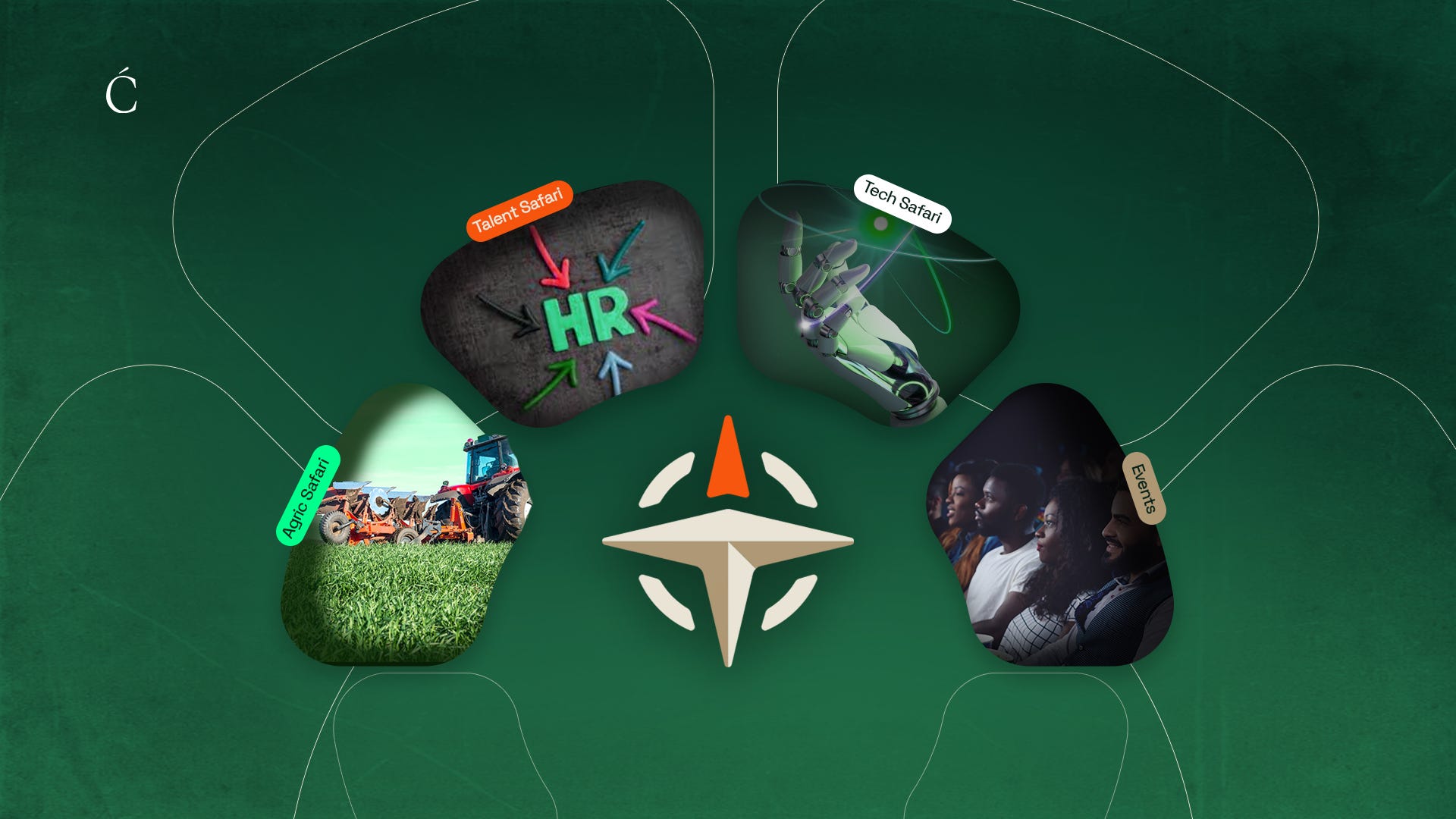
The agriculture newsletter represents just one part of Tech Safari’s broader business evolution. Earlier this month, the company cemented that evolution with a rebrand that repositioned it from a single publication into a parent brand overseeing multiple entities. Tech Safari now operates recruitment services, runs specialised summits, and has launched programmes targeting the African diaspora. What began as a tech newsletter is quietly becoming something more expansive: a multi-vertical media and services company using information, talent, and convening power to shape key African industries.
2. Origin story
Tech Safari started in 2022. Its founder, Caleb Maru, was travelling across the continent after leaving his job in post-conflict reconstruction. He had spent three years helping to stabilise countries after wars, but found the work wasn’t delivering the impact he had hoped for. He saw bigger opportunities in Africa’s growing tech sector.
Maru began writing LinkedIn posts about his observations of the tech industry. The content resonated particularly with international audiences. A breakthrough came with a single post: Maru created a graphic showing all the people who had left Nigerian payments company Paystack to start their own companies, calling it the “Paystack Mafia”. The post went viral, attracting founders, investors, and media professionals who wanted to connect. That response convinced Maru that something bigger was happening.
He quit his job and moved into his parents’ spare room in Australia for three months, committing to writing about African tech every day. The experiment worked. His posts consistently went viral, building an engaged following of industry insiders and international observers. However, Maru wanted to test whether this digital engagement translated into a real-world community. In 2023, he travelled to the United States and organised meet-ups in San Francisco, Washington DC, and New York. Expecting perhaps 15 people at each event, he was surprised when more than 100 attended almost all of them.
The meet-ups proved that Maru had built something more valuable than a publication; he had created a community of people working in African tech who wanted to connect. That realisation shifted Maru’s thinking from creating content to gathering people, setting the stage for everything that followed. The challenge then became figuring out how to turn that community into a sustainable business while continuing to serve the audience’s needs.
3. The Tech Safari playbook
In Communiqué 75, we wrote about how media businesses can build adjacent businesses on top of their core media product:
“The concept of media as a means to an end is simple: media companies can use the skills they’ve developed in audience engagement, trust, and distribution to test, build, and scale other business ventures. It is the idea that content doesn’t have to be the final product. Instead, it can serve as a platform—a lab, if you will—for testing ideas that have the potential to scale.”
Tech Safari’s growth has closely followed this trajectory. The company first created successful events and helped other organisations tap into its community. Those early meet-ups evolved into more structured gatherings across African cities, consistently drawing hundreds of attendees. This success led to a more focused offering: the Tech Safari Summit, which brought together growth and marketing professionals helping companies figure out how to scale across Africa.
Next came talent, driven by what was already happening within its ecosystem, where people came together to collaborate, connect, and consistently find jobs, investment, and partners at Tech Safari’s events. This organic networking pointed towards the company’s next business line: talent sourcing. Recognising how effectively its community connected job seekers with employers, Tech Safari formalised these interactions into a structured offering called Talent Safari.
“We ran a test to see if we could build a recruitment business,” Caleb Maru told Communique. “We said let’s try it for a few months, and we ended up trying it out for a year. It worked, became a six-figure business, and is profitable.” Talent Safari now operates as a mid-level recruitment platform, leveraging Tech Safari’s community to help employers find candidates across African markets. Some of its clients include Paystack, HoneyCoin, and Turaco.
The agriculture vertical emerged differently. Rather than growing organically from its existing audience, Ag Safari launched through a partnership with GIZ and the World Bank. These organisations have long been involved in unlocking Africa’s agricultural potential. The reasoning was clear: agriculture remains one of the continent’s most important sectors, yet it continues to face coordination challenges.
“There are a number of partners trying to mobilise in this space and struggling,” Maru said. “Given the billions of investment going into the space, if you can create a trusted platform and spaces where you bring people together, you can provide real value to these organisations.”
Building on Ag Safari’s media product, the company launched the Ag Safari Summit, bringing together agribusiness executives, development agencies, and investors for focused discussions on scaling agricultural innovation across the continent. The event attracted partners, including GIZ, the World Bank, and the United Nations, who funded the summit to facilitate connections between financiers, government officials, and agritech companies.
Alongside tech and agriculture, Tech Safari has also begun building a third vertical focused on the African diaspora. This is a natural extension of its early audience. From the beginning, Tech Safari’s content resonated strongly with Africans living abroad—people working in global tech ecosystems but interested in opportunities back home. The early U.S. meet-ups were proof of that demand.
Now, the company is developing programmes specifically targeted at this group. Its diaspora initiative, Building Back Home, targets African diaspora professionals, particularly those in Europe and North America, to help them relocate to the continent to build meaningful ventures. The programme goes beyond typical “move back to Africa” initiatives by focusing on economic impact rather than cultural connection.
The initiative recognises a significant opportunity: millions of Africans living abroad have accumulated capital, skills, and networks that could accelerate development if deployed on the continent. However, most lack the local knowledge, connections, and support systems needed to make the transition successfully.
Building Back Home provides structured support through a fellowship programme that helps diaspora professionals identify opportunities, navigate regulatory environments, and build local networks before making the move. The programme represents a long-term bet that diaspora talent and capital can become a major driver of African economic growth.
Tech Safari’s evolution from newsletter to multi-vertical platform reflects broader changes in how media companies can build sustainable businesses in emerging markets. By focusing on trust and community rather than traditional advertising models, the company has created multiple revenue streams while serving specific industry needs.
This “Media as a means to an end” model appears scalable. Each vertical follows a similar playbook: identify an underserved market, create high-quality content to build credibility, and then develop services and events that address that community’s practical needs. This approach has allowed Tech Safari to generate revenue from day one.
As African economies continue developing, demand for specialised business intelligence and networking will likely grow. Companies like Tech Safari that can combine content, community, and services around specific sectors are positioning themselves to capture significant value in this evolution.