



1. A little personality goes a long way
During the week of September 21, as heads of state and their delegations descended on New York for the 81st United Nations General Assembly, African fintech firm Flutterwave staged its own gathering on the sidelines. The payments unicorn hosted public- and private-sector leaders to discuss how to improve cross-border trade and payments in Africa. Pictures and videos from the gathering filled its social media pages, including a video of its chief executive, Gbenga Agboola, casually strutting through the city.
This was not the first time in recent weeks that Flutterwave had leaned on the personalities of its executives to tell its story. An earlier “most likely to” game with Agboola, Bankole Falade, the company’s legal and public policy chief, and other senior staff drew thousands of views across social media. Taken together, the posts point to a communications strategy that increasingly prioritises giving audiences a glimpse of the people running the company as it continues to prepare itself for an elusive IPO.
The shift may owe something to Oluchi Ezeugo, who joined Flutterwave in June as executive communications lead. Ezeugo previously led corporate communications at Helium Health and headed communications in the chief executive’s office at Sand Technologies. Her brief was to shape how the company’s leaders present themselves to the world: what they say, how they say it, and what audiences come to understand about the business through them. Flutterwave’s recent content shows how much that can involve beyond speeches and formal announcements. An executive’s humour, personality, and interactions with colleagues can give people a way to connect with a company whose products might otherwise feel abstract. Executive communications is one strand of that story. The job of holding all the strands together is one that companies around the world are now scrambling to fill: the corporate storyteller.
You’re reading Communiqué because someone in the Inner Circle paid for it. Pay it forward.
2. Storytelling moves in-house
A company contains the raw material for many stories. There is the founder’s account of why it exists, the employee who can explain a difficult product decision, and the customer whose experience lends credence to the company’s reason to exist and serves as a testimonial for prospective customers. The corporate storyteller’s job is to gather all these stories into a coherent account of the business: what it believes, what it is building, and why anyone should care.
The title is enjoying a global renaissance. In December 2025, The Wall Street Journal reported that the share of LinkedIn job postings mentioning “storyteller” had doubled within the previous year. About 50,000 marketing listings and more than 20,000 media and communications listings included the term. Separately, FactSet counted 469 mentions of “storyteller” or “storytelling” on earnings calls and investor days through December 11, 2025, compared with 359 in 2024 and 147 in 2015.
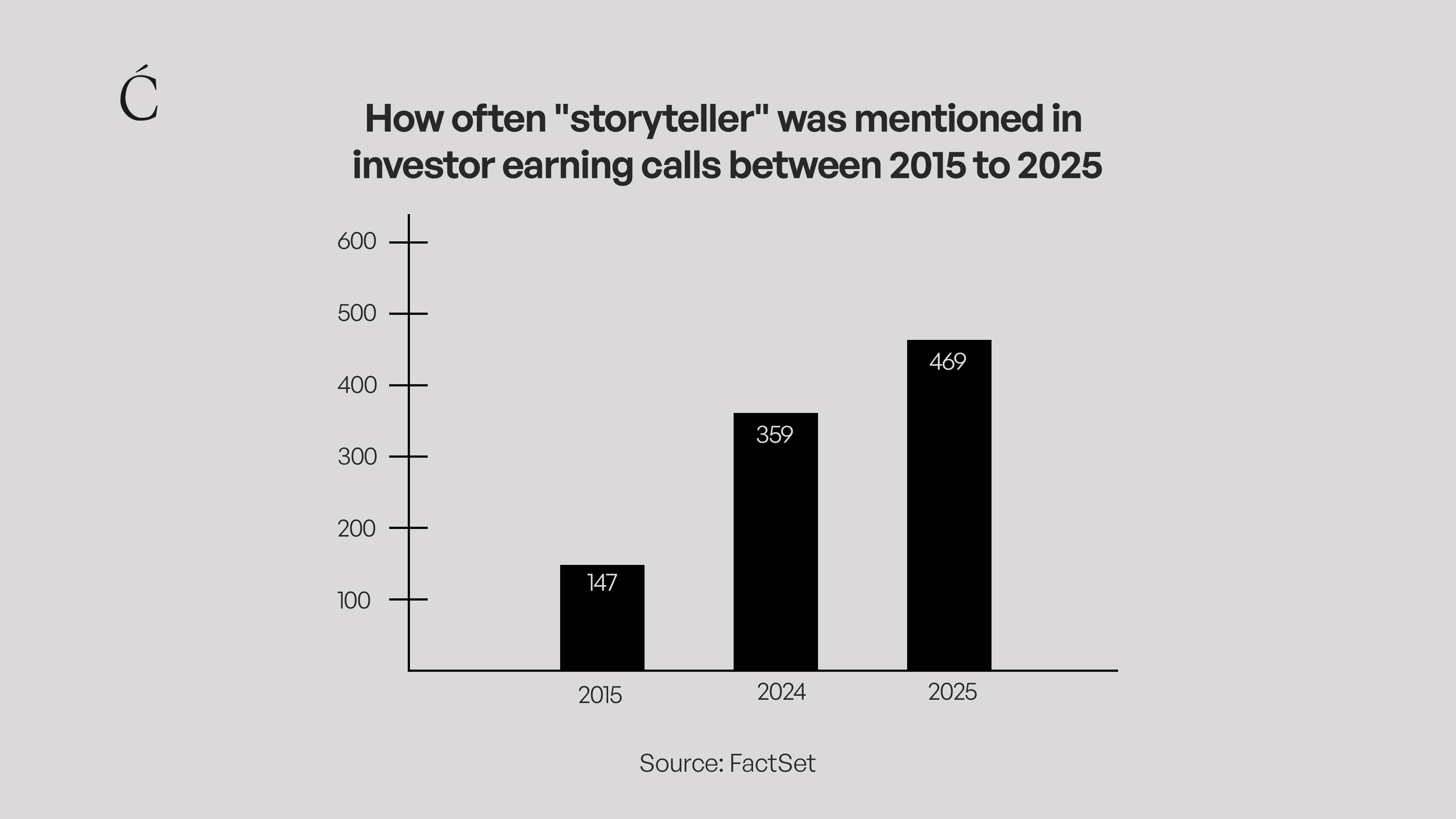
Corporate storytellers matter now because the institutions that once helped companies earn attention and trust are weakening. Previously, businesses could rely on traditional media to explain who they were. But newsrooms have shrunk, audiences are scattered across feeds, and trust in institutions, including the press, has fallen. Brands can pay podcasters, creators, and celebrity ambassadors to bridge the gap, but those relationships can be expensive and fragile. The audience belongs to the creator, and once the partnership ends, the brand loses access to that audience too. Also, with AI making content more abundant, a recognisable voice, a specific experience, or an honest explanation of a decision can give audiences something more substantial to connect with. Companies are increasingly bringing storytelling in-house to build those connections themselves.
3. Have we been here before?
African tech companies producing their own content is nothing new. In 2021, a wave of editors and writers left traditional media companies to build content engines inside startups newly flush with venture capital. Communiqué tracked the shift at the time. In April 2021, Paystack advertised for a managing editor to help build what it called “Africa’s largest digital business media network.” Some of those engines worked. PiggyVest is the clearest example of what that investment could produce. Its content team developed articles, comics, animations and research around Nigerians’ experiences with money. Others did not. When the tech bubble burst in 2022, many of the writers and editors who had crossed over returned to the media companies they had left.
The corporate storyteller belongs to this same lineage, but it is not the same job. Nor is it corporate communications, though it borrows from both. The three roles share tools: writing, a feel for audiences, and command of owned and earned platforms. What they do not share is purpose. A content marketer uses content to help attract, convert, and retain customers. At a payments company, that could mean publishing guides that help merchants run their businesses, then encouraging those readers to try its payment tools. The work is connected to a customer’s decision to use the product. The corporate communications manager owns relationships and the record: press releases, media relations, regulatory correspondence, and crisis statements. Their audience is mostly the press and, through it, everyone else. The work is custodial and often reactive, measured in coverage secured and crises contained.
The corporate storyteller owns the narrative and entire channels. Their responsibility is to develop the company’s account that runs through all its activities. They look for the experiences, people, and decisions that explain what the business stands for, then determine how to tell those stories across different settings. Their work can support both content marketing and corporate communications, but it’s rarely the same as either.
$10 covers a reader. $100 covers a story. $1,000 covers a month. Communiqué is built on direct support from people who believe Africa’s creative economy deserves serious coverage.
4. Where is all this heading?
As Africa’s leading tech companies outgrow their challenger status, corporate storytellers will become even more necessary. A startup can win supporters by presenting itself as an ambitious outsider taking on an inefficient industry. Its audiences forgive a founder who speaks off the cuff, because candour is part of the appeal. An incumbent has no such licence. It answers to regulators, employs thousands, and serves millions. It needs a clear and cohesive account of itself, one that holds regardless of who is speaking. Some tech companies have already learned this the hard way.
In May, Tosin Eniolorunda, the co-founder and chief executive of Moniepoint, drew public ire after an appearance at The Platform Nigeria’s Workers’ Day edition. Eniolorunda said the company struggled to find candidates who met its global standards. Critics, who heard a broader dismissal of the Nigerian talent pool, reacted swiftly. They argued the problem lay in pay and in companies unwilling to train junior staff. Several pointed out that Eniolorunda himself had been shaped by years at Interswitch. He later clarified that he meant a shortage of experienced technical professionals, citing emigration and weaknesses in the talent pipeline, and pointed to Moniepoint’s investment in training and its predominantly Nigerian workforce. But the damage was already done.
The gaffe was all the more unusual because few companies in Nigerian tech have invested as heavily in corporate storytelling as Moniepoint. Its team draws on experience across television, film, advertising, and agency communications. And the work shows. Its Informal Economy Report, first published in 2024, was welcomed by the federal government as a basis for policy. The 2025 edition added an AI chatbot for exploring its data and a documentary series on the people who run Nigeria’s informal businesses. Across it all, Moniepoint tells a story of faith in ordinary Nigerians: their resilience, their enterprise, and their capacity to build. Then its CEO told a different story about Nigerian workers on Workers Day.
If a company that has built this much narrative infrastructure can still have its story contradicted by its own leader, then the lesson is not that storytelling investment is wasted. It is that even the best-resourced operations slip when nobody is guarding the script. That is the corporate storyteller’s job: not to produce more content, but to hold one account of the company steady across all touchpoints.
Chowdeck faced a similar reckoning this month when an older interview with its co-founder, Femi Aluko, resurfaced. In it, he said the platform’s bicycle riders earned an average of ₦100,000 a week. He compared this to doctors’ monthly pay. The comments provoked backlash for seemingly overlooking the conditions under which riders earn that money: the risks on the road, running costs, and earnings that fluctuate week to week. The comparison with doctors, in a country where professional pay is a sore point, struck critics as distasteful. When Chowdeck was a challenger looking for riders, talking up earnings made sense as a recruitment pitch. But Chowdeck now leads its category. At that size, a recruitment pitch becomes a statement about how the company treats the people who deliver for it, and riders, customers, regulators and the wider public are all paying attention.
Still, a better story would not have solved Chowdeck’s problem on its own. If riders feel they earn less than the company says, no amount of good writing will change that. There is a limit to what storytelling can do. It cannot fix a business problem, and it will not save a company from a bad reality. The storyteller’s most valuable skill may be telling leaders when the story and the reality have drifted apart. As a result, much of the hiring for this role will be reactive, following public stumbles rather than preventing them.
What happens after the hire will matter more than the title. The storyteller needs enough experience to understand the business and communicate its values, enough access to know what is changing, and enough authority to challenge the people running it. If they are only invited into the room when a decision needs announcing, they will spend much of their time explaining choices they had no opportunity to question.
Proving the value of this work will be difficult. The evidence may lie in easier hiring, stronger relationships with regulators, smoother fundraising, or an emerging problem addressed before it becomes a crisis. As African tech companies become institutions that people depend on, their stories become promises about how they will behave. The corporate storyteller’s job is to help the company make those promises clearly and tell its leaders when they are failing to keep them.
