1. Nobel intentions
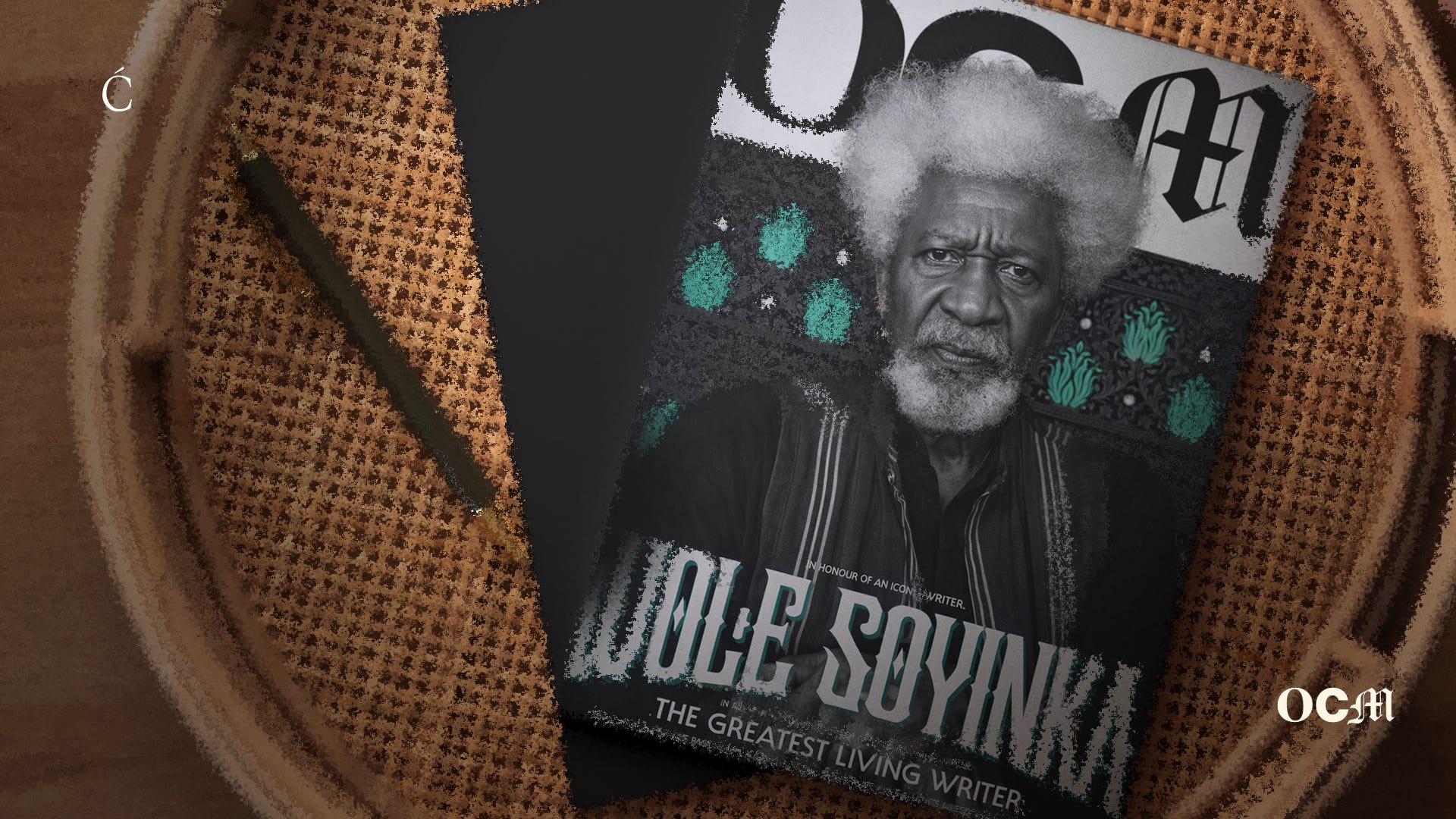
In December 2025, when a new profile of Wole Soyinka began circulating online, the dominant reaction in many corners of the internet was a quiet sense of intrigue. Not because of what the piece said, but because of what it was. A definitive chronicling of Soyinka’s life, it ran to nearly 20,000 words. It moved deliberately across the literary giant’s lifetime, lingering on his early career, intellectual formation, literary battles, exile, and the long arc of a life lived in public thought. It read less like a magazine article and more like a historical document.
This was striking because, at the time, the dominant story about Soyinka was far smaller: a viral political moment. In the month before, headlines across local and international publications had focused on the Trump administration’s decision to revoke his visa. It was the latest episode in a long-running feud the Nobel Laureate has had with the US president, dating back to his 2016 election, when he tore up his US green card. In the compressed logic of contemporary media, Soyinka had been reduced to a symbol in a political argument.
The longform profile did the opposite. It refused immediacy and resisted the gravitational pull of the news cycle. Instead, it attempted something much harder: to chronicle the full intellectual and historical weight of one of Africa’s most consequential cultural figures.
That ambition to exhaustively document African lives and ideas sits at the heart of Open Country Mag. Founded as a literary magazine and deeply reported narrative nonfiction, Open Country Mag operates on a premise that runs against the structural logic of Africa’s digital media economy: that some stories cannot be told quickly, cheaply, or briefly without losing their meaning.
In a media ecosystem optimised for virality, speed, and short-form consumption, Open Country Mag has, over the last five years, positioned itself as the platform for longform writing that treats African contemporary life not as episodic content, but as something worthy of depth, permanence, and record.
2. Open Country Mag’s literary origins
In 2020, Africa was experiencing what many observers described as a quiet literary renaissance. A new generation of digital literary journals, including Lolwe, Doek, and Isele Magazine, was emerging with a shared ambition: to publish both new and established writers, expand the reach of African literature online, and introduce younger audiences to contemporary literary work. It was within this broader wave that Open Country Mag first took shape.
Its founder, Otosirieze Obi-Young, had until April 2020 served as deputy editor of Brittle Paper, one of the most influential African literary platforms of the previous decade. His departure came after a highly public dispute with the magazine, which fired him after he published a critical piece on the wife of popular author and wife of Former Kaduna state governor, Hadiza El- Rufai. Obi-Young accused the publication’s founder of censorship and editorial overreach, and framed his exit as the culmination of tensions over autonomy, and decision-making power. The episode quickly became one of the most widely discussed controversies in African literary circles that year.
In the aftermath, Obi-Young was clear that he wanted to continue the work he loved. But he was equally determined to build something structurally different. Rather than follow the traditional literary magazine model of opening submissions and publishing short fiction, poetry, and essays, he chose a more unusual starting point: longform, deeply reported profiles of major African literary figures.
For Obi-Young, starting with longform profiles was a deliberate choice to address a critical gap: African writers were increasingly visible internationally, but rarely fully understood. Short coverage often focused on prizes, controversies, or book launches, without situating writers in their broader intellectual, cultural, and historical contexts. “People think that because you see African writers getting international coverage that they have been contextualised,” he said to Communiqué. “That’s not it. I can count probably on one hand African writers who have been covered in the West with real context.” Longform writing gave Open Country Mag the space to do what shorter formats could not: tell stories that capture both the life and the literary significance of Africa’s leading writers.
Obi-Young’s extensive network in the African literary scene, built during his time working at Brittle Paper, and judging some of the continent’s most important literary competitions including the Miles Moorland Fellowship, and The Gerald Kraak prize proved pivotal in shaping Open Country Mag’s early work. Leveraging these connections, he secured interviews with some of the continent’s most sought-after literary figures, including Chimamanda Ngozi Adichie, Teju Cole, Maaza Mengiste, and Tsitsi Dangarembga, both of whom had been shortlisted for the Booker Prize that year. Even Wole Soyinka agreed to be interviewed in 2021, though the interview didn’t take place until 2025.
By 2023, Open Country’s scope had widened beyond literature to include cultural figures across film, media, and public life, featuring personalities such as Rita Dominic, Chidi Mokeme, Chude Jideonwo, Tunde Onakoya and Cardinal Francis Arinze. “In the process of doing this [literary stories], I realised there were many more use cases for this,” he told Communiqué. “We will acknowledge a person for what they’ve created in culture, which is the whole point. But we will also look at every other thing. We’ll ask you the hard questions.”
“It’s as close as possible to the center of culture. People don’t know that because they cannot see that there is a center of culture. But in time, they will see it. Because when you have a novelist on a cover and you have a prelate on a cover, and you have an actor on the same magazine cover, and you have a sports person on the same magazine cover, there’s something new being built. And literature is the anchor, tying it all together.”
3. The longform playbook
On August 31, 1946, readers of The New Yorker were surprised by the content—a 30,000-word chronicling of the devastation the US nuclear bomb had wrought on Japan. The piece, which nearly filled all the editorial space in that issue, would later be published as a book.
John Hersey’s “Hiroshima” was a seismic event in American journalism. The magazine sold out all 300,000 copies within hours. Albert Einstein attempted to buy 1,000 copies to send to fellow scientists. Within two weeks, a second-hand copy of that New Yorker issue sold for 120 times its cover price. But the article’s true significance was demonstrating that longform journalism could achieve what conventional reporting could not: not merely inform, but immerse readers in the subject of a piece, whether an event or a person’s life.
This breakthrough laid the groundwork for what would emerge in the 1960s as the New Journalism movement. Writers like Tom Wolfe, Gay Talese, Truman Capote, and Joan Didion pushed the form further, applying techniques previously reserved for fiction, like scene-by-scene construction, full dialogue, and third-person point of view, to nonfiction reporting. Magazines like Esquire, Harper’s, and The New Yorker championed this storytelling style.
The editors were as crucial as the writers. At Esquire, Harold Hayes transformed the magazine into what one former editor called a “literary and cultural proving ground”. He gave writers space to experiment, and they delivered: Gay Talese’s 1966 profile “Frank Sinatra Has a Cold” became a landmark of the form—a deeply reported portrait built entirely around the singer not wanting to talk. At Harper’s, Willie Morris ran Norman Mailer’s “The Steps of the Pentagon,” a 90,000-word story on the Vietnam War protests in a single issue. It was the equivalent of a 300-page book.
The business impact was profound. Esquire’s circulation grew from 500,000 to 2 million during the 1960s. Magazines discovered that longform distinguished them from daily newspapers and created a durable product readers would seek out and keep. This is the tradition that Open Country Mag adheres to, but with a uniquely African flavour.
In Communiqué 93, we observed that African publications were returning to print, signalling a renewed appetite for tangible, lasting media. But a crucial ingredient for a successful print publication is longform writing. Deeply reported, context-rich, and ambitious in scope, this kind of storytelling is what allows magazines to create a durable record, distinguish themselves from ephemeral digital content, and cultivate readership that values depth over immediacy.
Yet the ambitions of Open Country Mag remain difficult to realise. Obi-Young is the only editor at OCM and continues to shape its editorial direction, he has trained a couple of writers in the magazine style, but there is a limited pool of writers across Africa who can consistently produce narrative nonfiction at this scale. Sustaining such output over time demands both discipline and significant institutional support, elements that are scarce in our media ecosystem. Financial constraints, inconsistent reader habits, and the challenge of monetising longform in Africa add further pressure. Editorial infrastructure, fact-checking, and the time-intensive nature of immersive reporting remain luxuries few publications can afford.
Despite these structural challenges, Open Country Mag’s work carries a symbolic and practical significance. It shows what is possible when African publications commit to longform storytelling: that the continent’s writers, thinkers, and cultural figures can be chronicled with nuance, rigour, and ambition. Even if its model is difficult to replicate at scale today, it establishes a blueprint, a proof of concept if you may, that longform in Africa is not only feasible but essential for documenting the intellectual and cultural life of the continent.