


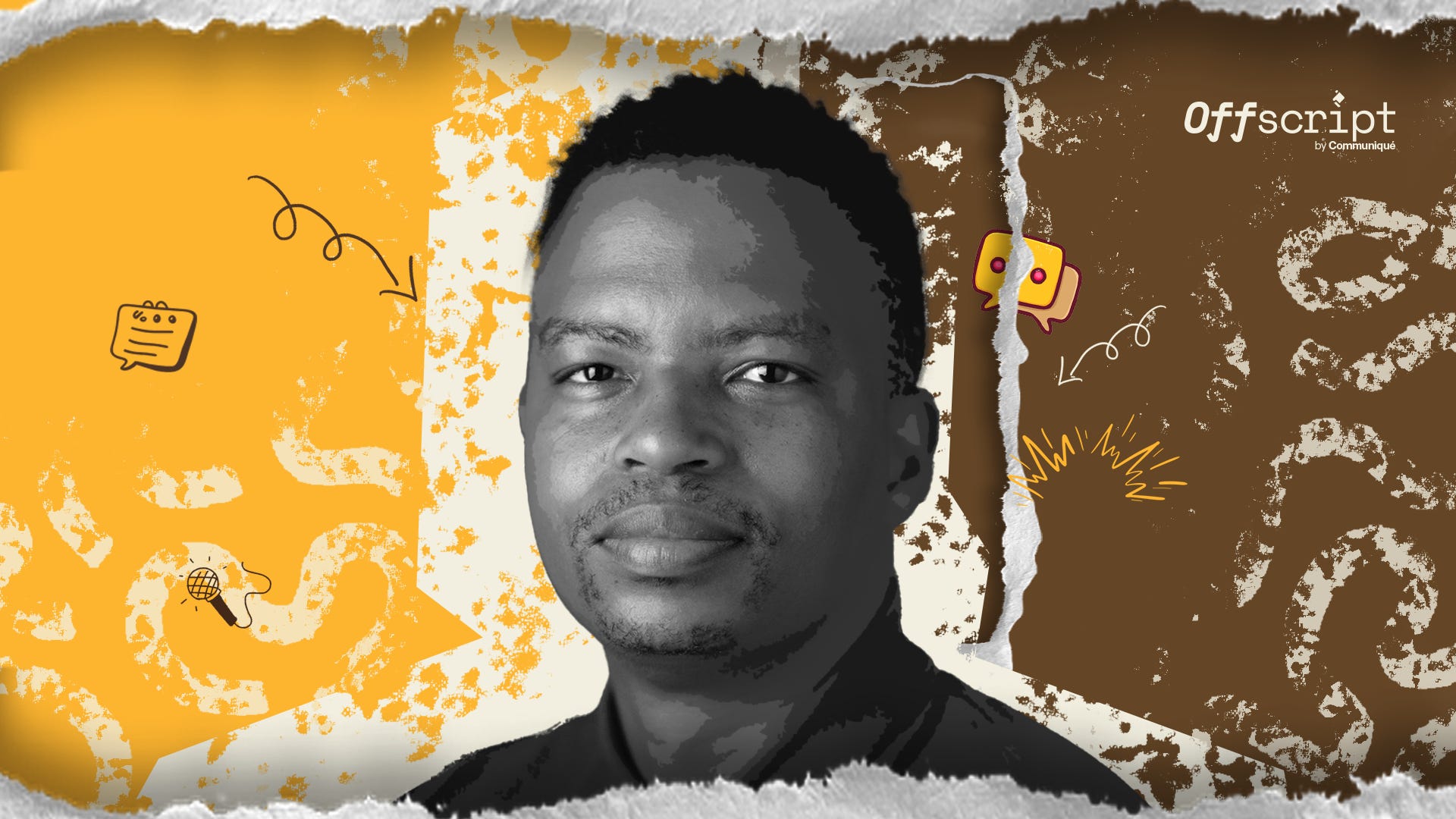
“Growing up, I wanted to travel, but I didn’t know how I would do it. And so journalism was, I guess, one way of doing it.”
For Tshepo Tshabalala, becoming a journalist was a way to explore the world, to listen to the beautiful stories of other people. His 15-year-old self would never have imagined doing all that and more, while making journalism better in the modern world.
Tshabalala, who now serves as Project Manager and Team Leader for JournalismAI, spent the better part of a decade working at Jamlab, Africa’s first-ever journalism innovation lab. But the road to both ran through a small town in the Northwest Province of South Africa, and it started with his grandfather and a stack of newspapers.
Tshabalala spent much of his formative years in Jericho, a town of less than 10,000 people, with his grandfather, a newspaper deliveryman who also worked in many other jobs. He later moved to Pretoria to live with his parents during high school. There, he became curious about student leadership and joined the school paper to meet and interview student leaders. “That’s where my passion for understanding more about people and what makes them tick started.” The school publication lasted until grade 10, his third year, before it was shut down due to declining interest. Even so, the experience left a lasting impression. “That’s where the life of journalism started. And I knew from then on that it’s something that I had wanted to do.”
At home, television expanded his sense of what journalism could be. He watched reporters travel widely, driven by curiosity. Lifestyle show Top Billing introduced him to a glossier form of journalism that had nothing to do with wars or press conferences, while The Amazing Race offered a fast-paced, global adventure. He connected these influences into a single idea: journalism could be the vehicle. “All those different shows contributed to that idea that, as a journalist, I could potentially travel or use journalism as a way of travelling and meeting people.”
His father wasn’t convinced when Tshabalala announced his intention to study journalism at a university far from home. At the time, he did not yet have access to the internet, so his father bought two large books listing all the possible careers a young man could pursue. “I just couldn’t find anything that was appealing. And I was like, maybe a graphic designer. And he’s like, no, that’s not a job. Find something else.”
The standoff ended when his uncle visited. He had a son the same age and in the same position. His uncle advised Tshabalala’s father to let him be. His father relented, but with a condition. “I never want a child who will ask me for money while they are supposedly earning a salary.”
He studied for a diploma in Journalism at Tshwane University of Technology (TUT), near Pretoria, where his parents lived. The school was not his first choice. “I wanted to go to university far away from home. And my dad was like, ‘No child of mine is going far away. You’re going to go to the closest university.’” Affordability also mattered; his parents were teachers.
It turned out that going to TUT was the right call. The campus sat in a township, while he had grown up in the suburbs. The culture shock was both real and clarifying. Being around students from different backgrounds and hearing fragments of lives unlike his own made journalism feel even more necessary. The programme was also practical. “We did theory, but for the most part, they taught you what you would be doing on the job.” By graduation, students could walk into a newsroom and report confidently. Tshabalala took full advantage, trying different forms of journalism—writing, presenting, and working at the campus radio station, which he loved.
After his diploma, he applied for an honours programme at the University of the Witwatersrand (Wits), partly for the education and partly for the credentials. “We know that perspective or perceptions play a role in a lot of things. Wits gave me a bigger exposure to what else could be done as a journalist.”
The Wits honours cohort was small and competitive, and it came with scholarships funded by major media organisations. Tshabalala landed a Reuters scholarship, which meant that, at the end of the year, he would complete an internship at the news organisation’s local office. When Tshabalala left TUT and enrolled at Wits, he hadn’t yet decided which kind of journalism he wanted to pursue, but the internship at Reuters made him consider financial journalism. “Financial journalism allowed me to really tap into my curiosity and learn more about how politics is connected to money and how money is connected to people.”
The internship was meant to last six months, but stretched to nine. When it ended, a Reuters editor introduced Tshabalala to the editor at Forbes Africa, who encouraged him to apply for a job there. He got the role and spent three years there, a period he describes as “amazing” because it allowed him to live the dream of writing stories while travelling. “With Forbes, I got to travel the continent for the first time. I went to Mozambique and Uganda and got to interview some of the continent’s leading entrepreneurs.”
While at Forbes, he began considering a return to school for a master’s degree. That, combined with a desire to slow down, led him to Business Day, where he worked as a web producer. Instead of chasing stories, he edited and uploaded them. It was quieter work, but it gave him room to breathe and to pursue further studies. During this period, he completed two postgraduate degrees: one at Stellenbosch University and another at the University of York, funded by a Chevening Scholarship.
The defining pivot in his career came almost by accident. After returning from York, he sent a thank-you note to a former Wits lecturer, who replied with an opportunity to join a new initiative: the Journalism and Media Lab (Jamlab). At the time, Africa had no equivalent to the journalism innovation labs already active in the US and Asia. Jamlab set out to fill that gap by running a publication, an accelerator, and documenting the evolution of media on the continent.
“I thought maybe this could be another way that would allow me to travel on the continent, learning more about innovation in journalism and media. And telling it from an African perspective rather than relying on Western publications to tell our narratives and our stories.”
He became the lab’s editor, working closely with startups coming through the accelerator. Many were genuinely exciting: a platform focused on women’s representation in news media, Nigeria’s The Republic, and Politically Aweh, a YouTube channel making politics accessible to young audiences. Each was trying to solve a problem that mattered. “I think the beauty of work is that it opens you up to other forms of work. Right when you are studying, or when you’re in high school, you are not exposed enough to know what else you can do within a certain industry or career path.”
At Jamlab, that exposure became real. He began to see beyond journalism, beyond reporting and to its operational side. He began to learn how media startups were built and run, and how founders thought about sustainability, audiences, and growth. After three years as editor, Tshabalala gradually took on more leadership when his director fell ill. What started as a temporary adjustment became permanent. “It became more admin than doing the actual [editing] work,” he says, “but it was a nice learning curve into moving into management.”
The travel he had hoped for did not come in quite the volume he expected. Instead, he found opportunities to participate in various journalism innovation programmes around the world. One instance was when he was invited to coach, virtually, on a product immersion programme at the Craig Newmark Graduate School of Journalism at CUNY. It was during this programme that he met Mattia Peretti, then project manager for JournalismAI.
In mid-2022, Tshabalala left Jamlab and took several months off work. He was still on that break when Paretti reached out. Paretti was stepping back from his role at JournalismAI. The position was being advertised. No guarantees, he said, but apply if you’re ready. Tshabalala applied. Three rounds of interviews later, he got the job. There was one condition: he would have to do it from London.
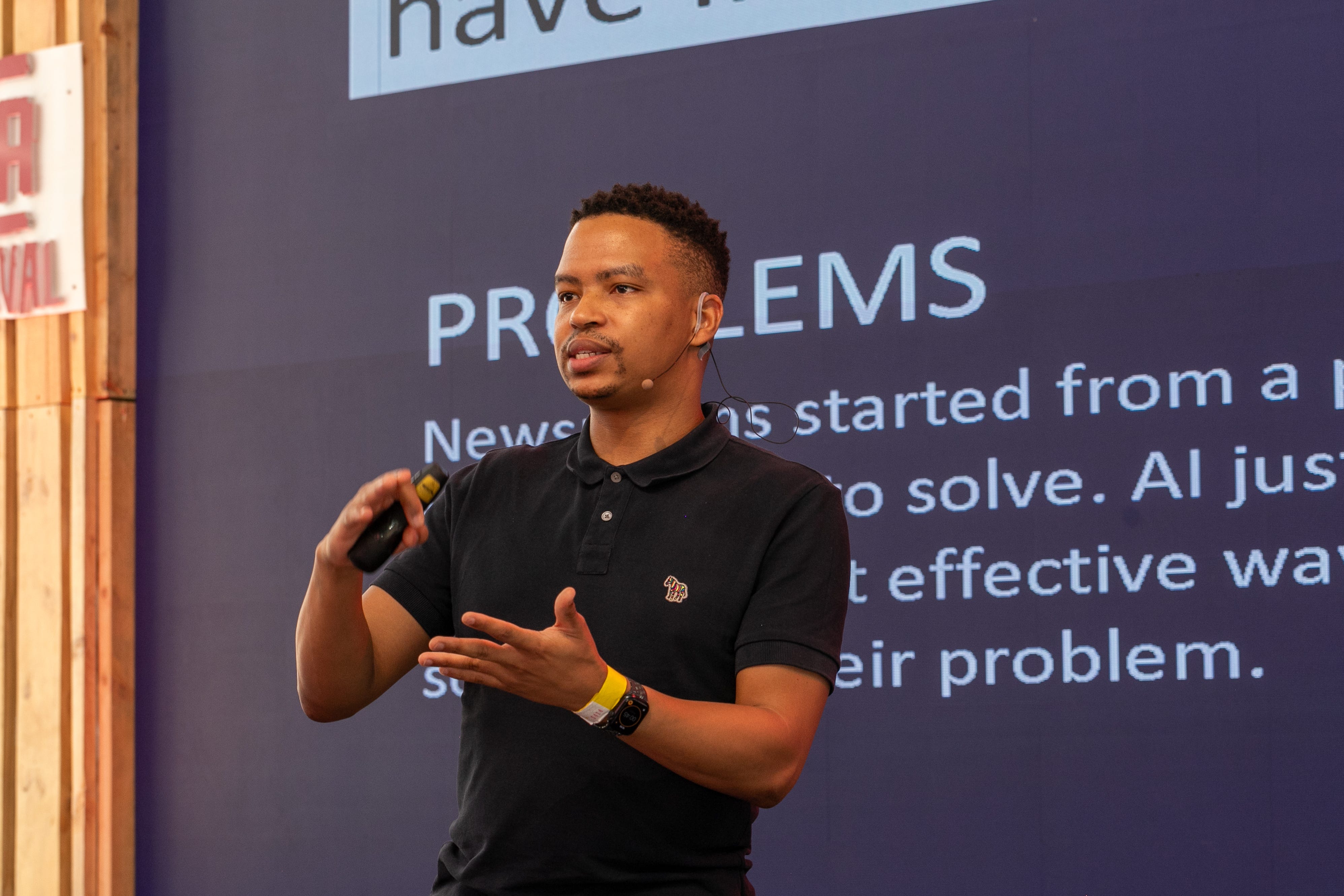
He arrived in February 2023, three months after ChatGPT broke into global consciousness and sent the media industry into a collective spiral. JournalismAI had been doing this work since 2018; the world was only now catching up. “By the time I joined, it was a baptism of fire,” he says, “because now I was learning about AI at the same time as all the other journalists in the world.” The invitations to conferences followed almost immediately. He was on the move again, this time as a voice at the frontier of journalism’s most uncertain moment.
The work is straightforward in its mission: help newsrooms, especially smaller ones, understand and use AI in ways that strengthen rather than undermine what they do. The big outlets have the resources to work it out themselves. Everyone else needs support, training, research, and practical guidance. “The idea is to support innovation and capacity building to make AI, or the potential of AI, more accessible to news organisations around the world,” he says.
If his fifteen-year-old self in Pretoria could see where the plan ended up, Tshabalala thinks he would be satisfied. “I went for what I wanted, and I’ve achieved a lot of the goals that I set for myself.”