


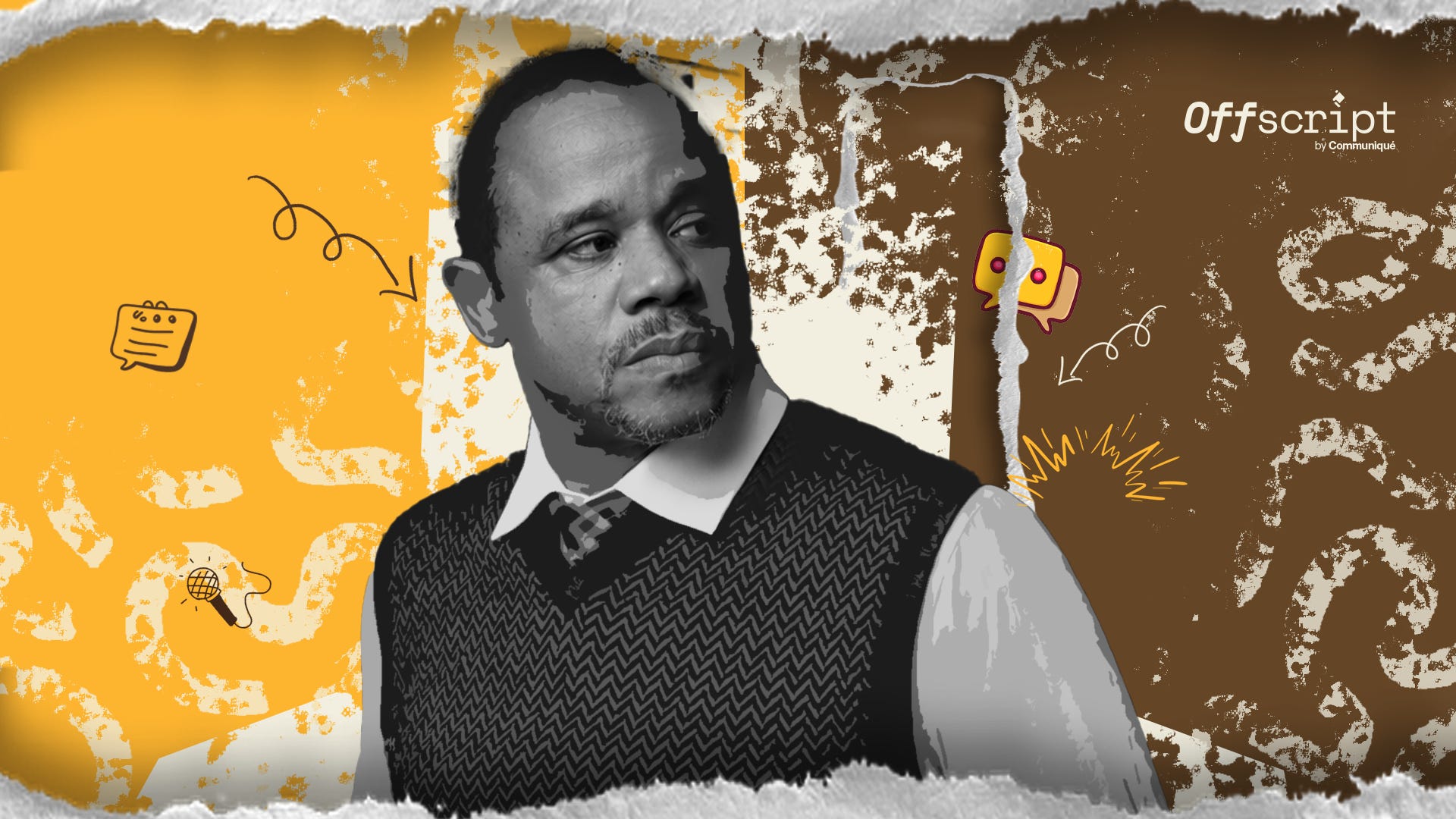
“I realised I love art. I love creative stuff, but I was not a very good artist.”
Sam Onyemelukwe made that discovery during his first two years at the University of Southern California. He had chosen Fine Arts because he loved drawing, jewellery, and making things. But art school placed his work alongside that of people with gifts he knew he lacked.
He could have walked away from creativity. Instead, he looked for another way to remain close to it. Whenever Onyemelukwe reached the limits of what he could do as an artist or musician, he found that he was better at building the machinery around the work. “I’m more creative as a businessman,” he says.
It took him from computer graphics and Disney to a clothing company, a rap collective, a Nigerian record label, MTV and, eventually, TRACE. Together, the moves became an education in how creative businesses are built. Today, Onyemelukwe is one of the main reasons the TRACE brand became synonymous with African music. He was instrumental in pushing it out of a single generalist channel into genre-specific arms like TRACE Naija and TRACE Gospel. But his journey to this converging point is much wilder and more winding than this role might initially suggest.
Onyemelukwe was born in Lagos in 1971, the youngest of three children. His father rose from a village childhood to become the first Nigerian chief electrical engineer at the Electricity Corporation of Nigeria. His American mother came to Nigeria with the Peace Corps in 1962. They met and built their life in the country.
At Hillcrest School in Jos, Onyemelukwe studied with Nigerians and the children of missionaries from around the world. When he had to leave for the United States at about 16, he was heartbroken. America was not completely unfamiliar; his mother was from there, and he had lived there briefly as a child, but it changed how other people saw him. Some Black Americans treated him as white; some white Americans treated him as Black. In Nigeria, people called him Oyinbo.
You’re reading Communiqué because someone in the Inner Circle paid for it. Pay it forward.
He found a place among the creative students. He grew dreadlocks and was given unusual freedom by a father who had tread a more conventional path. Years later, his father admitted that some friends thought he was mad to allow it. “Secretly, I felt like the cool dad because I had this cool son,” he told him.
His father carried that same openness into Onyemelukwe’s decision to study Fine Arts at the University of Southern California. He did not necessarily know what his son would do with an arts degree, but he trusted that he would find his way.
At USC, Onyemelukwe came to a difficult conclusion. He loved drawing, making things, and working with his hands. As a child, he had made jewellery and crafts with his mother. But he could also see the gap between his own work and that of peers who were likely to become exceptional professional artists.
“I couldn’t paint, I couldn’t draw,” he says. “I looked at some of my friends’ work, and I was like, ‘Guy!’”
Instead of walking away from art, he changed the way he engaged with it. USC allowed students to create independent-study courses, so Onyemelukwe proposed one focused on computer graphics. His plan was simple: travel around Los Angeles and meet artists working with computers. At the time, he did not know much about computers. He was not a programmer and had no deep technical background. But he sensed there was something worth exploring.
For his final project, he made a portrait pixel by pixel on an early Apple program. The image was less than an inch wide, but when enlarged, it resembled an impressionist painting. More importantly, the project led him to an artist who knew someone at Disney running post-production and looking for an intern. A few weeks later, Onyemelukwe was working there.
The opportunity did not become a career in Hollywood. Onyemelukwe had taken classes at USC’s film school as a student and worked on student productions, sometimes handling production design, but discovered that he disliked movie sets. Not long after, a friend who was starting a clothing line asked him to create a digital catalogue. Doing that led him to take a larger role within the company, and he left Disney.
Music was developing alongside this work. Onyemelukwe played bass in Dark Leaf, part of a Los Angeles rap scene that included groups such as Jurassic 5 and the Black Eyed Peas. “The funny thing is I actually also wasn’t very good at bass guitar. In fact, if anything, my better instrument should have been percussion drums. But I played it in bands with friends. At that point, it’s not always about being the best instrumentalist in the band.” But he did not need to become the star to understand the opportunity around the music. He wanted to help make it and build a business around it.
That opportunity arrived through his elder brother, China Onyemelukwe, a finance executive who also loved music. The brothers and their friends started DKG Music. One of their early acts was KUSH, the Nigerian gospel group made up of Lara George, TY Bello, Emem Ema, and Dapo Torimiro. “The idea that we had was to bring KUSH to the US and take them to perform in churches and sell CDs in front of churches at $10 a piece.”
Before doing that, however, they needed to create demand at home. Onyemelukwe returned to Lagos to build the group’s image and audience. His earlier experiments suddenly became useful. Friends from the clothing business helped create KUSH’s graphics and branding. Onyemelukwe worked on the video for “Let’s Live Together,” sourcing archival footage of the Nigerian Civil War from NTA. Then he spent six to eight months pushing the group onto television and live stages. The video entered heavy rotation on NTA, AIT, and Silverbird, while KUSH headlined some of MTN’s earliest Yellow Fests.


The American tour never happened. One member could not travel because her mother wanted her to remain in school, and the plan unravelled. The disappointment strained relationships, but the months in Lagos gave him a working knowledge of Nigeria’s entertainment industry. He now had an unusual combination of experience. He understood the American entertainment industry, but he also knew the Nigerian market and the people who could make an international media company work locally.
That trait was quite important to Alex Okosi, who at the time was putting together a team to establish MTV Africa. “Me, Alex, and somebody in the industry that’s around till today had a meeting. Towards the end of the meeting, the guy was laughing, and he said, ‘Alex, this is your guy.’” Okosi hired him. Onyemelukwe spent the next year and seven months helping set up the systems and sell the network’s channels to local television operators.
After MTV Africa, Onyemelukwe was looking for his next move. TRACE, then best known as a French music channel, appeared to have a larger opportunity in Anglophone Africa. Onyemelukwe found an employee’s number on the company website and called. She tried to arrange a conversation with the founder, but weeks passed without a meeting. So he bought a ticket to Paris. He had one day in the city and managed to arrange lunch with TRACE’s chief operating officer and several executives. He pitched a larger commercial and cultural presence in Anglophone Africa. By the end, he felt he had won them over.
Rather than accept a job, Onyemelukwe founded Venator Partners to handle advertising and sponsorship sales for TRACE and other media clients. In 2011, the company secured the master licence for TRACE in Anglophone West Africa. As the TRACE business grew, Venator focused more of its attention on it, helping to localise the brand and develop channels, including TRACE Naija and TRACE Gospel.
Your contribution funds: Original reporting, data licensing, and a small editorial team that actually answers your replies. No ads, no paywalls.
The partnership eventually became something more permanent. While TRACE was changing its shareholders, its co-founder, Olivier Laouchez, proposed bringing Venator fully into the group. TRACE acquired the company after negotiations. Onyemelukwe received an equity position and joined the group’s management.
Building TRACE Nigeria at scale presented a problem that Onyemelukwe’s previous ventures had not. He had run projects, but leading a team exposed how much he still had to learn. He carried a precise picture of how every task should be completed and constantly checked whether people had followed it. “I was stressed out all the time,” he says. He began studying performance management and putting clearer systems in place. The harder lesson was allowing people to produce good work in ways different from his own. It took years, but the organisation slowly became less dependent on his presence. “Life became a lot easier.”
Now Onyemelukwe wants to apply that experience beyond TRACE. He sees creative entrepreneurs with strong ideas but little experience building investable companies, and investors who want exposure to entertainment but struggle to find their way into it. “I want to be a bridge between the creative community and investors,” he says.
He is also interested in the work required to strengthen Nigeria’s creative economy: management systems, capital, intellectual property and coordination between business and government. He points to South Korea, which spent decades developing its cultural industries. Nigeria cannot repeat that path, but he believes the private sector can build more of the missing structure while engaging the government where possible.
It is the same problem Onyemelukwe has been solving since art school. He may not be the person painting the picture, playing the bass line, or standing at the front of the stage. His skill is seeing what the creative work needs around it, then finding the people, money and systems to help it travel.
He never became the artist he wanted to be. Instead, he became an operator, and one could argue the industry needed this version of him more.