


“Up until recently, we would have people come for interviews to Chocolate Tribe, and they would be like, ‘I’ve always wondered who did these ads. Now it makes sense because I always thought it was some company in Europe or something.’”
Chocolate Tribe quietly became one of Africa’s most successful animation and VFX studios.
The studio has worked on everything from Disney’s Kizazi Moto: Generation Fire (“Surf Sangoma” episode) to Netflix’s iNumber Number: Jozi Gold, which featured the first computer-generated creature ever in a Netflix African production. Their fingerprints are also on projects that have triumphed at Cannes Lions, Ciclope, and Loeries.
But for a long time, few people connected that global-quality work to a studio based in Johannesburg. According to Nosipho Maketo-van den Bragt, Chocolate Tribe’s co-founder and CEO, that gap is about more than branding. It reflects how limited the idea of imagination can be when you grow up without examples of what’s possible. “Animation and VFX weren’t anything that, even as a young child, you learn about,” she says. “You may watch animation on TV, but for you, it’s like, this is not a career. This is for kids.”
Today, Chocolate Tribe is part of a small but growing group of African studios proving that animation is not only a viable career, but a powerful tool for storytelling. The irony is that Nosipho had to walk away from a stable, successful legal career to help build that future. Her life, like her company, has been shaped by movement—across countries, professions, and ideas of what is allowed.
Nosipho was born in the 70s in Soweto, at the height of the Soweto Uprisings and of apartheid in South Africa. Her father was politically active, and although her parents tried to shield their children from the political tension, the environment was inevitably intense.
When she was ten, the family moved to Zimbabwe. The change was immediate. “Living there felt different,” she says. “I saw what it felt like to be liberated.” For the first time, she found herself in an environment that allowed her to imagine freely. That freedom found an outlet in writing. She began writing poetry and short stories, using them as a private space to work through thoughts, desires, and confusion.
By the time she reached her A-levels, it was clear where her instincts lay. The sciences didn’t appeal to her. She admired people who could master formulas and equations, but she knew that wasn’t her path. She applied to Rhodes University and was accepted on her first try. But when she couldn’t afford the fees, she had to give up her place.
It would take four more years before she returned to university. During that time, she moved back to South Africa and lived with relatives, working whatever jobs she could find. Those years tested her resolve. Nothing about them was glamorous. But they were formative. “I pushed myself to realise that I wanted this,” she says. “I was going to find every way to get to university.” When she finally got another chance, it was at the University of the Witwatersrand (Wits), where she studied law.
It was also at Wits, in her second year, that she met Rob van den Bragt, who would become her husband and business partner. They met in a public laundromat. She was there to wash clothes and study for an exam. He was fresh from overseas, an animator and VFX supervisor, standing before the machines, completely confused. He asked for help. She ignored him.
“I didn’t want to be bothered,” she says, laughing.
A friend stepped in, helped him out, and later introduced them properly. They sat near each other, books open. “I’ve got my book. He opens this very big book with colours and pictures,” she recalls. “And my judgy self is thinking, how can you be reading a book with so many pictures?”
That book was about animation, and it became the bridge that connected them. Robert asked about her studies. She asked about his, too. She had recently watched The Lion King and was curious. The conversation flowed easily and never really stopped. They married a few years later.
After Nosipho finished law school, the couple moved to the UK. In London, she built a legal career and completed a master’s degree at Birkbeck College, University of London. One elective course, Law and the Moving Image, shifted her thinking. “I didn’t know you could connect law, politics and film,” she says. “I didn’t even know they lived in the same space.”
After nearly a decade abroad, they returned to South Africa. Nosipho joined a law firm, but it didn’t feel right. “It was too dry,” she says. “I needed something more exciting. More purpose-driven.” She quit.
For a year, she stayed at home. She tried knitting—then arts and crafts. Ideas came and went. Friends and family questioned her choices. She stayed firm.
By the end of 2014, clarity arrived.
“I realised it’s not that difficult to run a company,” she says. “I had already done that as a lawyer—for other people. I understood risk, strategy. And I trusted that I could learn the rest.” With that conviction, she cofounded Chocolate Tribe with her husband.
Working with her husband wasn’t simple. “It was hard learning how to disagree at work and then go home and eat dinner together,” she says.
Still, they pushed forward.
Their big break came with Robot and Scarecrow, a short film by UK director Kibwe Tavares about an unlikely love story between a robot and a scarecrow. The project drew international attention and helped put Chocolate Tribe on the map. “That project was the gift that kept giving,” Nosipho says. It led to work with directors like Ravi Ajit Chopra, whose short film Cognition went on to hold the Guinness World Record for the most awards won by a sci-fi film, 383 in total.
For the first four years, Chocolate Tribe said yes to work others found impossible. “People told us certain things couldn’t be done in Africa,” Nosipho says. “We said, ‘Give it to us.” They worked long hours, took risks, and built a reputation for delivering what seemed impossible. Recognition came from outside first. But locally, the response was slower.
“From a South African perspective, people weren’t really alive to the possibilities that animation and VFX bring,” So Nosipho took on a new role—not just as a studio head, but as an advocate. She began visiting schools, universities, festivals and meetups, across South Africa and beyond. She spoke openly about creative careers and their economic potential.
“I felt like I had found this secret,” she says. “And I wanted to share it.”
That energy grew into AVIJOZI, the Animation, Visual Effects and Interactive in Jozi Festival. “For me, AVIJOZI is about awareness,” she says. “When you create an animated series, thousands of people can be employed. Why wait for the government?”
The festival’s first edition in 2022 drew about 1,000 attendees. By 2025, it had grown to more than 5,000, with Emmy-nominated artists and global studios participating. Nosipho envisions it becoming a continental movement, inspiring similar initiatives across Africa. Nosipho wants it to be even bigger, hitting about 10,000 attendees and having even more impact across Africa.
“We want to continue growing it to be this formidable movement again into the rest of Africa. I want you guys to come and come to our AVIJOZI and to Chocolate Tribe and feel a sense of comfort and pride that hey, this was done on our continent.”
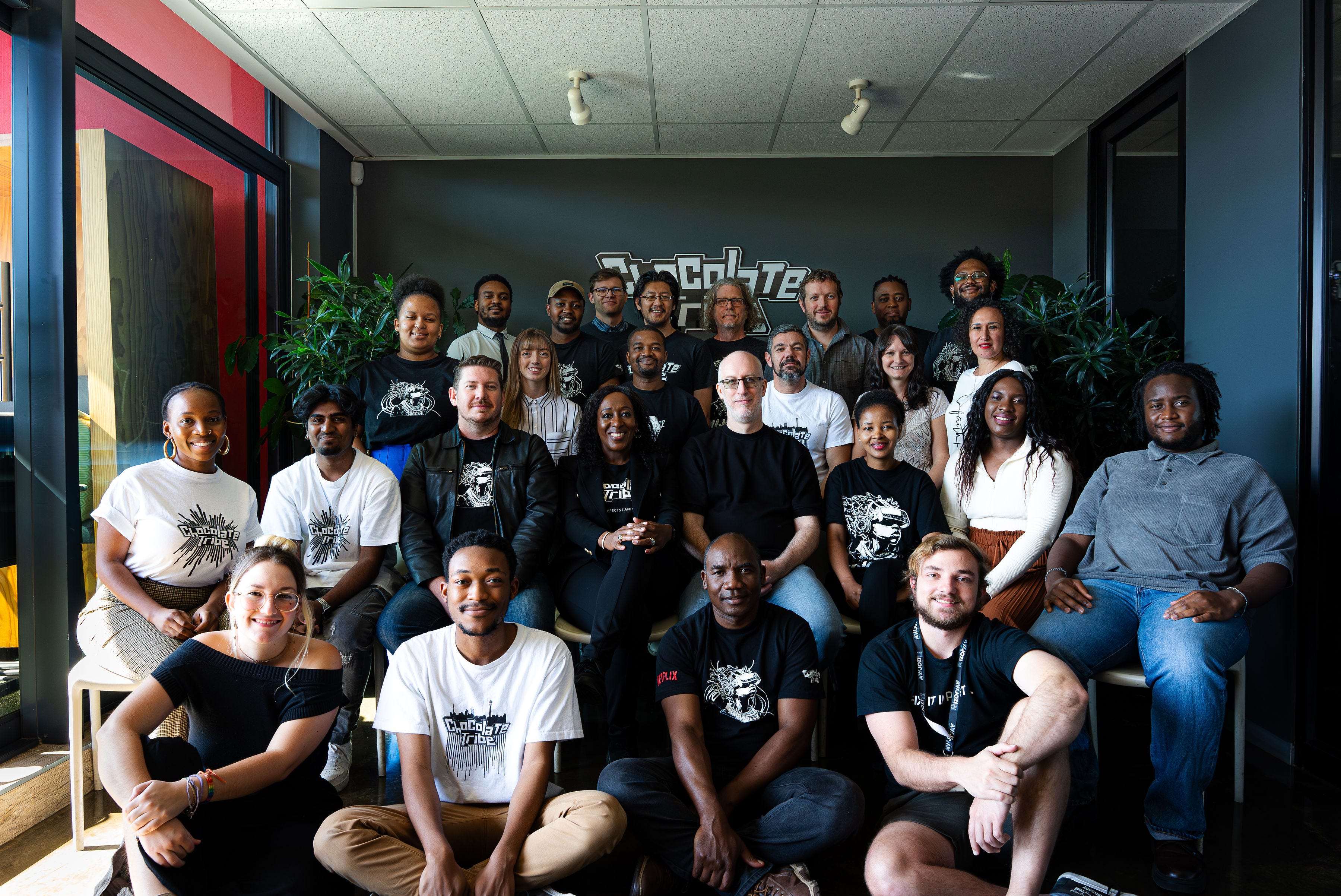
Nosipho is also very optimistic about Chocolate Tribe’s future. The company celebrated its 11th anniversary in October 2025 and, over that period, has evolved from an animation and VFX studio to a full-content development company. The next phase, she says, is transitioning from being a “service studio” that works on other people’s projects and IPs to creating their own IP.
“It’s good to be a service provider because you learn all the skills and you learn how to deliver things fast and according to spec. But how about we do it for ourselves? How about we raise a production within Chocolate Tribe that can speak to a changing narrative in Africa, that can tell stories that represent us the way we want to be represented.”
Even with all she’s achieved, there’s one box still unchecked. “I still want to write that bestseller book that when people read it, they can’t stop,” she says, smiling.
It’s a fitting ambition for someone whose life has been a series of chapters, from law to building an animation/visual effects company to advocacy for the growth of the creative economy. Nosipho Maketo-van den Bragt’s story is proof that imagination, when pursued with courage and conviction, can build both careers and industries.