


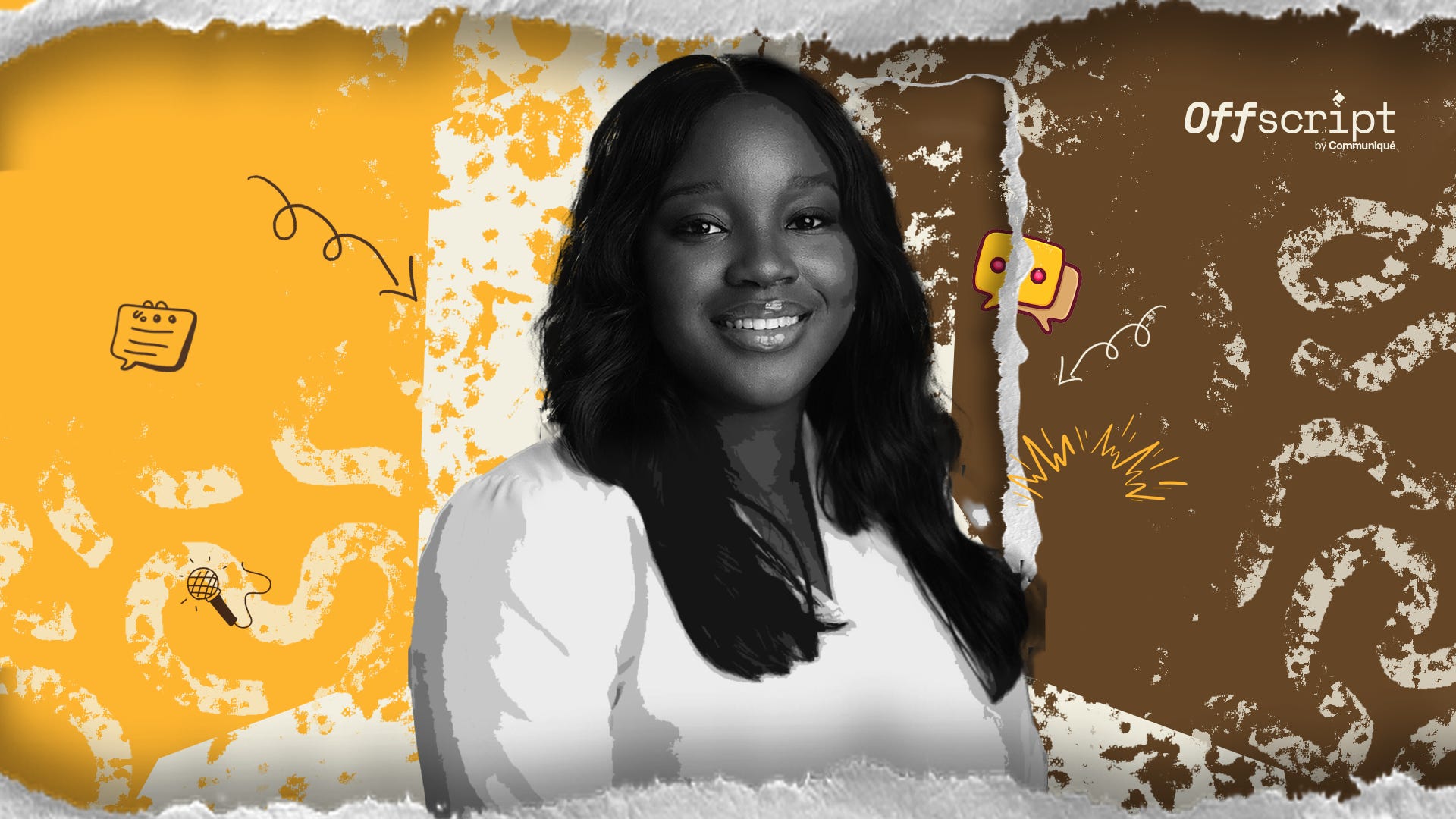
“When I drafted contracts, there would be corrections. And I would feel a type of way about not knowing things. So after work, I would stay back and read through old contracts to see how things were done.”
Nky Ofeimun describes her early days as a rookie legal executive in EbonyLife’s legal department. At the time, she was still learning the ropes of entertainment law, trying to understand the complex contracts and agreements that shape the business of film and television.
Seven years later, she has become one of the leading legal and strategy operators working in Nigeria’s film industry. But the path to that position did not begin in a law office or a film studio. It began with stories.
Ofeimun grew up in Port Harcourt as the first child and first daughter in her family. Her mother was a doctor, and her father an accountant who later became a businessman. Their household placed a strong emphasis on education. At home, her parents organised spelling competitions for their children. It was partly an exercise in learning and a way to keep them engaged.
Even as a child, she had a natural flair for language. She liked to write and was known among her classmates for telling stories. Reading was also a big part of her early life. Like many Nigerian children of her generation, she spent hours reading the adventure stories of British author Enid Blyton. By the time she reached secondary school in Enugu, writing had already become part of her identity. She joined the press club and continued experimenting with short stories. Naturally, she began to imagine a future as a writer.
But Nigerian parents tend to prefer more predictable careers for their children. When the time came to choose a course of study, her parents encouraged her to consider something more practical. “My parents said, ‘You’re good at English, and you can always write stories. Maybe go study Law. There are lawyers who write.’”
So she chose Law and enrolled at the University of Benin. Ofeimun arrived at the university unsure of what kind of lawyer she wanted to become. So she leaned on what she already knew—writing.
Alongside a group of fellow law students, she helped create a blog called Legal Watchmen. The site was essentially an informal publication for law students to explore legal topics, campus issues, and ideas that interested them. At the same time, she found other outlets for her writing. During her time in law school, she began sending short fiction pieces to BellaNaija. Sometimes the site published them, sometimes they did not. But the process allowed her to keep her creative instincts alive while in school.
After graduating from the university and attending the Nigerian Law School, Ofeimun was still not sure what she wanted to do with her legal career. But clarity came when she attended a conference focused on entertainment law. The event brought together lawyers, music executives, and media companies working within Nigeria’s creative industries. For her, the conference was eye-opening.
Up until then, entertainment law had not seemed like a realistic career path. But at the conference, she encountered several law firms and professionals working in the space. One person stood out in particular: Tomi Edwards, who at the time headed EbonyLife’s legal department. “She was quite young. I didn’t realise this was like a career option. And here was someone within my age bracket doing it. She sounded really smart, and I decided this is what I want to do.” She decided to pursue Entertainment Law.
Around that time, she had already begun working with The Wedding Channel, a niche television platform focused on wedding-related content. Initially, the job had little to do with law. She had first encountered the company through an Instagram ad seeking writers. When she eventually joined, the work was closer to executive assistance: preparing presentations, supporting operations, and assisting the small team running the channel. But once she began focusing on entertainment law, the company started sending legal work her way. “They gave me contracts to draft,” she says. “That was really my first actual foray into entertainment law.” It would not be long before a much larger opportunity would appear.
In 2019, Ofeimun joined EbonyLife as a legal executive, working directly under Tomi Edwards, the lawyer she had admired at the entertainment law conference. At the time, EbonyLife was one of the most structured media companies in Nigeria. Founded by media mogul Mo Abudu, the company operated a television network, produced films and television series, and was beginning to form partnerships with international studios and streaming platforms. For a young lawyer trying to understand the industry, it was the perfect training ground.
The legal department handled everything from film production contracts and distribution deals to partnerships with international studios. It was also an opportune time as global streaming platforms were beginning to take a serious interest in Nigerian content. “Netflix came in with their own standards and how they had to do things, and you could see that there was a different level of experience that was required. And because a lot of these deals were confidential, and it was the first time anything like it was being done in Nigeria, there was really nobody you could ask. So it was a lot of reading and figuring out stuff.” The learning curve was steep. But Ofeimun approached it with the discipline she had developed early in her career.
Over the next four years, she worked on a wide range of projects, including Òlòtūré and Blood Sisters. EbonyLife partnered with global companies including Sony, Amazon, and Netflix. She also worked on the legal agreements that supported EbonyLife Place, the company’s entertainment complex in Lagos. By 2022, she had risen to become the head of legal.
But by then she was already thinking about what came next. The experience at EbonyLife had given Ofeimun deep exposure to the business of film and television. She had negotiated deals, worked with international partners and managed the legal framework behind major productions. But she wanted to move closer to the industry’s strategic and operational sides.
“As far as Ebony Life went, I kind of knew everything that there was to know [about] entertainment law. And I wanted to now kind of explore what it would be like on the operational side of things rather than just being in legal advisory.” So she left EbonyLife and joined Papaya Studios.
Papaya was a different kind of organisation. Instead of simply producing films, it also helped finance and develop them. That meant the team had to decide which projects deserved investment. And that required everyone, including the legal team, to participate in creative and strategic discussions. “Papaya was a very heads-together kind of space. Everyone had to participate in reviewing scripts, looking at what it would look like to produce and market a film before we funded it.” For Ofeimun, this was the operational exposure she had been looking for.
She also became involved with Circuits, a streaming platform connected to the Papaya ecosystem. She worked on preparing the platform for launch and eventually served as its project manager after it went live. The role broadened her understanding of how technology, distribution, and content intersect in the modern film industry.
After several years moving between legal, strategic, and operational roles, Ofeimun began asking a bigger question: what kind of infrastructure does the Nigerian film industry still need? Her answer to that question is Backlots, a company that provides production support services for filmmakers.
Backlot works across several areas of the filmmaking process. One of its core functions is business affairs, helping filmmakers structure deals, navigate contracts and manage the legal aspects of production, particularly when working with international partners. But the company also tackles another often overlooked area: marketing.
Ofeimun believes many Nigerian independent films struggle to travel globally, not because the stories are weak, but because the surrounding infrastructure, marketing strategy, and packaging often fail to present them effectively. Backlots, therefore, works on marketing strategy and other services designed to help films reach broader audiences.
Ofeimun also operates Cast Closet, a platform focused on wardrobe and costume support for film productions. Both ventures reflect the same underlying philosophy. “A lot of my creativity is expressed via film and the film infrastructure and the film industry. And so that finds expression across different platforms.”
Ofeimun’s career has followed an unusual arc. She began as a child who wanted to write stories. Law was initially the practical compromise. Yet, in a way, she has returned to storytelling, just from a different angle. Through entertainment law, she has found a way to remain close to the stories she once wanted to write while shaping the systems that enable them to be produced. And in Nigeria’s fast-evolving film industry, those systems are just as important as the stories themselves.

Such an insightful read , I truly wish her success