


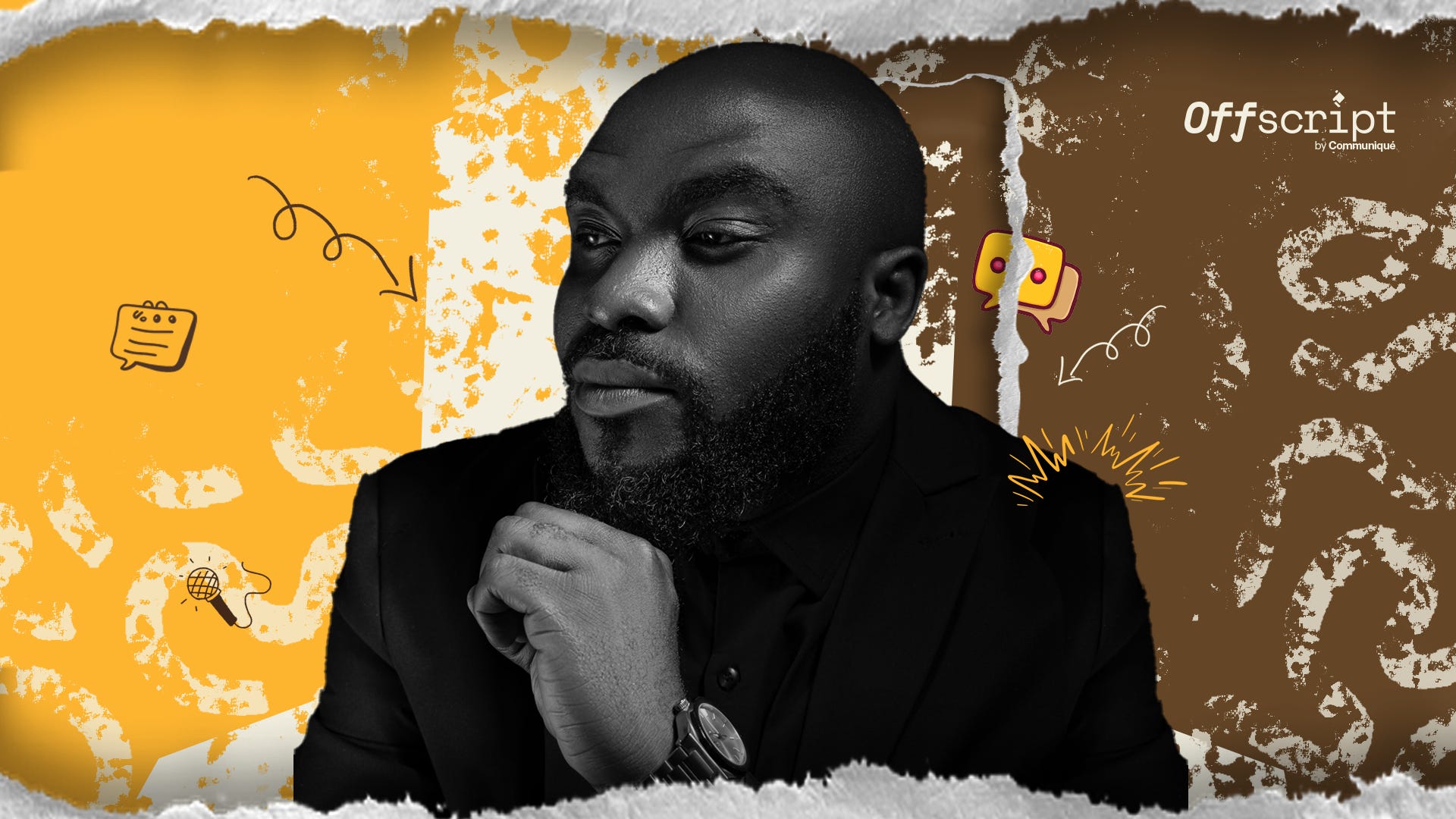
“Music led me to journalism. It wasn’t the other way around.”
There was a period, not too long ago, when Motolani Alake’s name was nearly unavoidable in conversations about Nigerian music. He was the critic whose reviews artists waited for nervously, whose voice international outlets reached for whenever they needed someone to explain Afrobeats to the rest of the world. He built that reputation loudly, but ask him how he got there, and he tells a quieter story.
Music was the first language he was fluent in, long before he had words of his own to write with; it was the thing he argued about in secondary school, the thing he spent hours listening to. He tried to understand it even when he lacked the language to explain why certain songs worked, and others did not. Everything that followed — the journalism, the critiquing, his current executive role at a major music record label — has, in his telling, been the same instinct finding new forms of expression.
“I feel like everything that has happened in my life led me there,” he says.
As a child, Alake was not the bookworm people might expect a future journalist to be. In their household, his father insisted that he and his siblings “read wide.” His two sisters followed the advice, burning through several novels in a week. Alake did not. His interest lay elsewhere, in music, sports and other entertainment pursuits.
At 16, after finishing secondary school, a friend introduced him to Fruity Loops, digital music production software. Alake taught himself production and sound engineering, spending hours trying to understand how records were built. Years later, when people praised his criticism, they often focused on the writing. What they didn’t see was the years he had already spent studying music before he ever wrote about it professionally.
Alake got into university to study Law, largely because his grades allowed it and Law was, for any Nigerian teenage art student, the obvious ceiling to reach for, but he had no plans of ever practising professionally.
After graduation and law school, Alake was posted to a law firm in Akwa Ibom State, southern Nigeria, for his compulsory national service. The period provided one of the most important influences on his writing. His boss was a good writer who helped him fine-tune his skills, focusing on precision and clarity. Those lessons would stay with him long after he left his law degree behind.
By the time his service year ended, he knew he was not to practise law. The problem was that he wasn’t entirely sure what he wanted to do instead. What followed was one of the most uncertain seasons of his life. He took on different jobs, consulted briefly for USAID, and later worked for the Foreign Investment Network in Abuja. But none of it felt right. “I felt like a round peg in a square hole.” Looking back now, he knows he was depressed. But the one thing that consistently made him happy in those times was writing.
Alongside a group of friends, he had started a Medium publication called Urban Central. It wasn’t sophisticated, but it gave him a lifeline. “Any time I would write, I was really happy doing it.” The more he wrote, the more obvious it was that the media was where he belonged. In 2018, he applied for a role at Pulse and was rejected. A few months later, he tried again—then he got in.
If Communiqué has shaped how you see the industry, return the favour. One-time or recurring: every contribution keeps us accountable to readers.
Today, when he talks about Pulse, he sounds less like someone describing an employer and more like someone describing a turning point: “Pulse gave me clarity. And the second thing is, it gave me community.” Before Pulse, he says he often felt like a misfit. At Pulse, he found people who understood him. More importantly, he found people who believed in him. Writers he had admired from a distance, like Osagie Alonge, became colleagues. Their confidence in him strengthened his own. “If this guy is telling me that I’m the shit, then maybe I am.”
Pulse gave him the opportunity, but not immediately. Although he was hired as a pop culture reporter, he was soon moved to the Metro desk, one of the toughest beats in the newsroom. The stories were often grim and emotionally draining: murders, assaults, domestic violence, the kind of stories that can wear a person down. Alake hated it.
His editors began to notice and soon found a compromise. If he could complete his Metro assignments and spend the rest of his time writing the longer culture and music pieces he actually cared about. He arrived with a chip on his shoulder, and the chip showed up in his writing. He had strong opinions about music, and he wanted people to hear them. “I had a lot of fire, and I felt like the world needed to hear my voice.”
In 2019, he wrote his first hit story. At the time, the long-running feud between rappers M.I Abaga and Vector was dominating conversations in Nigerian music. One Friday night, Alake slept at the Pulse office to avoid the notorious Lagos traffic on his way home. The next morning, he woke up to find social media in a frenzy over the latest development in the rivalry, so he wrote a detailed history of the feud, and the article went viral. “That was when my life changed. Literally.”
Before then, a good article might get a few dozen shares. Afterwards, television stations began inviting him to discuss music. More people started paying attention to his work. His name began travelling beyond the confines of Pulse. The rest of 2019 only accelerated the process. There was the decade list that generated endless arguments. Some reviews angered fans and artists alike, including a particularly critical review of Wizkid’s Soundman Vol. 1 project. Within a few months, Alake had developed a reputation as one of Nigerian music’s most fearless and controversial critics.
Then came 2020, his annus mirabilis.
While Burna Boy’s Grammy nomination dominated headlines, Alake became interested in a different story. He wanted to find the first Nigerian ever to win a Grammy.
Through a series of hopeful Instagram messages, he eventually tracked down percussionist Sikiru Adepoju, who had won the award in 2009 for his work on the Global Drum Project, and secured an interview. This story also went viral. Around the same time, COVID-19 lockdowns pushed more conversations online. As Afrobeats continued its global rise, international media organisations began seeking Nigerian voices to explain the genre and the culture surrounding it. Alake became one of them.
Pulse also revived its Facts Only video series with him fronting it; by the end of the year, it had become one of the publisher’s biggest products. His newsletter and playlist, Listen Africa, were also gaining traction. Labels, artists and industry executives increasingly knew who he was.
His growing visibility soon brought conflict—the most public of those conflicts involved musician Tiwa Savage. The tension dated back to his criticism of her 2019 single “49-99”, and lingered into the following year when he interviewed her for Pulse. Savage initially declined the interview, citing discomfort, before eventually agreeing. Although the conversation was cordial, Alake could sense the strain between them. When he later reviewed her album Celia, a review he maintains was fair, the existing friction appeared to have shaped its reception.
Things escalated when Alake left Celia off his year-end list just as the album made The New York Times’ top ten albums of the year. Savage responded with a tweet referencing the biblical line that a prophet is never honoured in his hometown, widely interpreted as a swipe at him. Alake responded by turning the tweet into a news story and later publishing a longer defence of his position. The disagreement spilt onto X (formerly Twitter) until veteran journalist Azuka Ogujiuba stepped in to mediate. During the conversation, Alake stood by his criticism but conceded one point. Ogujiuba felt he had crossed a line by invoking the age difference between himself and Savage. “I didn’t have a defence for that part,” he says. “I apologised.” The dispute was resolved soon afterwards, and today he describes Savage as one of his good friends.
By 2022, Alake was Editor-in-Chief at Pulse. From the outside, things looked perfect, but he was exhausted. “I was burned out,” he says. “I would have loved to continue, but I needed a one- or two-year break.”
Since 2021, he had been receiving job offers to move client-side, so he had begun to take them seriously. In October 2022, he left Pulse and joined M.A.D Solutions, a music distributor, publisher and technical solutions provider in Africa, where he served as General Manager of Engage, their record label arm. A few months later, a major music label came calling. This time, the decision was easy.
The move from critic to executive has been, in his words, both “eye-opening” and “very humbling.” As a journalist, he could focus almost entirely on ideas and creative judgment. As an executive, he has had to learn an entirely different set of skills: financial analysis, strategy, negotiation, portfolio management, and so on. Understanding not just what makes artistic sense, but what makes business sense. “I now need to think strategically as opposed to just creatively.”
The experience has also changed how he views the industry he once reported on. He now understands the complexity behind decisions that once seemed simple. He understands the pressures artists, labels, and executives face. Most importantly, he understands that building an industry requires more than commentary. It requires participation.
Even though the titles have changed — from reporter to critic and reviewer, from editor-in-chief to executive — even inside the spreadsheets and the strategy decks, the drive and hunger that got him here in the first place haven’t. Alake insists the story is still unfinished.
“I really don’t think I’m at my peak yet.”
Join a growing group of readers who keep Communiqué independent: Founders, journalists, investors, and operators from 100+ countries fund this work directly.