


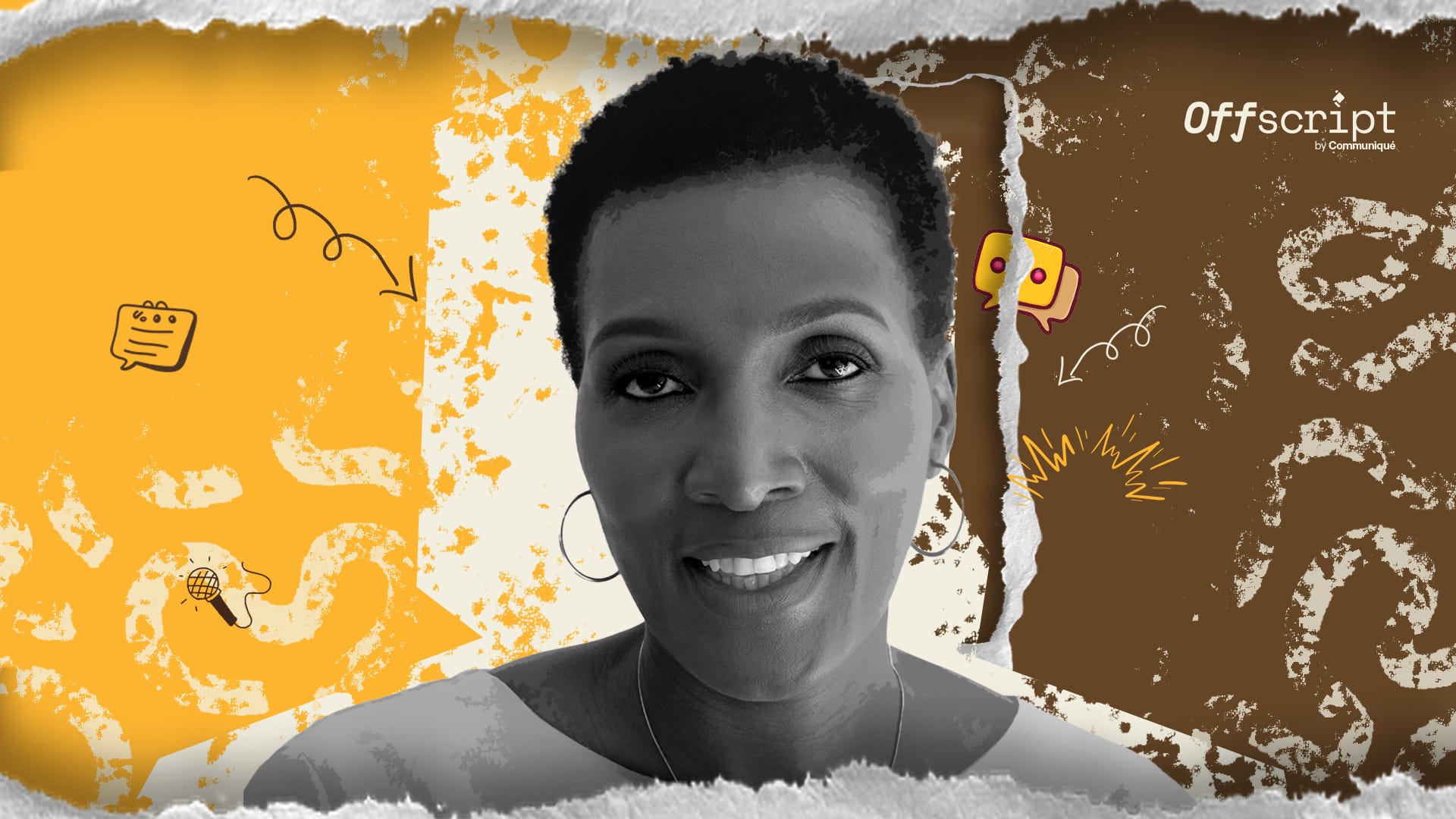
“My philosophy in life is this, and I do say this to a lot of people: life is what happens when you’re busy making plans. I had a lifetime of ‘yes.’ I never said no to anything.”
Moky Makura has done a lot: publicist, TV anchor, actress, author, book publisher, communications executive, scriptwriter, and media entrepreneur. Today, she runs Africa No Filter, an organisation dedicated to shifting how the world tells the African story. Looking back, where she has ended up feels almost inevitable. But it wasn’t always like that. It was brute force, driven by sheer will, a refusal to be left behind, and an instinct to seize every opportunity that came her way.
Makura was born in Lagos and spent the first nine years of her life riding bicycles and roller skates through the streets of Ikoyi. “I had a very simple but nice childhood. We used to roam the streets; It was a very idyllic childhood, which doesn’t exist anymore.” Her father raised her to think for herself, to be assertive, and to form her own opinions. “My dad used to treat me like a little adult. So we’d talk about things, and he’d explain things to me.”
By the time she was nine, her older brother was heading to England for secondary school. She decided she was going too. “I was young. I wanted to go because my brother was going. You know, youngest children, sometimes you don’t see why you can’t do things.” The family could afford it, so she got her way. She was placed two classes ahead of her age group, which made the academics harder than they needed to be, mostly because she wasn’t putting in the effort. But boarding school itself suited her perfectly. “Not every child fits into boarding school. I did. I enjoyed it. I stopped missing home quite quickly.”
The one thing that didn’t fit was authority. Being told what to do without being told why didn’t sit well with her. “You couldn’t just tell me something, you have to explain why.” That quality, the refusal to simply comply, would follow her everywhere.
When it was time for university, she chose Buckingham University specifically because it had the highest concentration of Nigerians. The consequence was that the law course she wanted was full, so she ended up doing a mix of Politics, Economics, and Law instead. She graduated with honours and stepped into the job market just as her family circumstances changed significantly. Her father had died, and the family’s money had thinned. If she was going to stay in the UK, she needed a job quickly.
She found her answer in media sales, and it turned out to be the most important first job she could have had. “If you don’t have any money to take a course and you really want to be successful, learn how to sell. It is the best skill set you can have.” She came to believe that selling was at the core of almost everything. “In life, we’re always selling something. I’m selling an idea right now — I’m selling myself to you. Sometimes you’re pitching an idea. People don’t understand that there is sales in everything.”
From media sales, she moved into public relations, recognising it quickly as the same skill in different clothing. “PR people don’t call themselves salespeople, but they’re essentially selling.” She freelanced, then joined an agency, then another. She was good at the work. But she noticed something that bothered her. Promotions weren’t going to the most capable people. They were going to the most connected ones. “I realised that it wasn’t about your capabilities, your knowledge, your expertise, it really was about your connections.”
She decided she wanted to go somewhere her network would actually work for her. Nigeria seemed like the obvious answer, but the timing was bad, the country was under military rule, and her mother warned her off. “Why are you coming back? Now’s not a good time.” So she looked elsewhere. A magazine feature on successful Black women in marketing and communications in South Africa provided a blueprint for her. And even though she did not know anyone in the country, she booked a ticket there anyway.
South Africa brought its own turbulence. When a new job in Cape Town fell apart over a work permit, she drove the eleven hours back to Johannesburg alone, setting off before dawn, watching the sun rise over the flat, dead-straight road through the Karoo. “I remember just thinking: I will never ever let anybody else be responsible for my own destiny.” By the time she arrived, she had made up her mind to start her own business
She set up a PR agency and got her first client the same way she had learned to get everything, by selling. She cold-called an exhibitor whose ad she had spotted in a newspaper. He was taking an exhibition to Nigeria. She told him she had a PR agency there. She didn’t. But by the time the call ended, she had found one she could partner with, put together a proposal, and won the business. She worked with that exhibitor for the next three years.
She eventually sold the agency to the advertising group FCB in 2001, who then employed her to keep running it, retaining both the network she’d built and the freedom she’d been after. But she wasn’t done expanding “I didn’t want to just do PR in South Africa. I wanted to do PR across Africa. Because the gap I saw was that people wanted a one-stop shop. If you wanted to do advertising in 20 countries, you could go to one advertising agency. Nobody was offering that in PR, at least not from South Africa.”
What followed looked, from the outside, like a series of unrelated detours. She joined Carte Blanche, South Africa’s flagship investigative journalism programme, as a Nigerian presenter. She hosted a 26-part marketing show on Summit TV. She acted in the lead role in MNet’s pan-African drama Jacob’s Cross. She co-produced Living It, a lifestyle series about wealthy Africans. She wrote Africa’s Greatest Entrepreneurs, which launched with a foreword by Richard Branson and made the bestseller list in South Africa. She started a publishing imprint, MME Media. She created Nollybooks, a fiction series aimed at getting young Africans to read, and later adapted it for television, co-producing over 20 movies for eTV.
In a 2012 TED Talk, she explained the thread running through it all. It was about finding the other stories, the ones that didn’t make it onto the international news, the ones that looked more like the Africa she actually knew. But that tension, between the continent’s actual complexity and its flattened global image, had been with her since 1985 when she watched Live Aid Concert.
“I remember watching the concert, Queen, all these stars singing ‘Do They Know It’s Christmas?’, and all these images of Ethiopia, the famine, were flashed up on the screen. And there was a moment when I realised: but hold on, this is not the Africa I grew up in.”
The Africa she knew was Ikoyi, bicycles, roller skates, and an idyllic childhood. Nobody was coming to save them. The gap between those two realities became the animating force of everything that followed. She was always trying to close it. She just didn’t have the words for it yet. The phrase, she would eventually learn, was narrative change.
She returned to Nigeria to work for Tony Elumelu as head of marketing communications, something she had long wanted to do. But Nigeria proved harder than she had expected, and after some time she returned to South Africa, this time joining the Bill & Melinda Gates Foundation as deputy director for communications in Africa. It was there that a project landed on her desk: an initiative called Africa No Filter. She loved it immediately. It was exactly what she had been doing her whole career. But there was no budget for it at the foundation, so she had to let it go.
Although the Bill & Melinda Gates Foundation could not back Africa No Filter, the initiative secured funding from a consortium of investors, including the Ford Foundation, Bloomberg, the Mellon Foundation, Luminate, and the Open Society Foundation, among others. Not long after, a friend sent Makura a job listing. Africa No Filter was looking for an executive director. “The shoe just fit. Everything about my career, every skill set I have, had set me up for the job.”
Since 2020, Makura has been the Executive Director, leading an organisation that funds storytellers, journalists, and creatives working to change how the world sees the continent. For now, it is where she intends to stay, for as long as the work continues. The only thing that might pull her away is something she quietly thinks about: doing something like this specifically for Nigeria. “If there was something I was called on to do for Nigeria,” she says, “then yeah, I would absolutely put this on hold to do that.”
There is a particular kind of person whose story only makes sense in hindsight. Someone whose choices look scattered until, suddenly, they don’t. Makura is that kind of person. The publicist, the actress, the author, the entrepreneur. Each role was preparation. And now, sitting at the head of an organisation built entirely around the idea that Africa’s story deserves to be told better, she is exactly where all of it was pointing. She just had to get there her own way.