


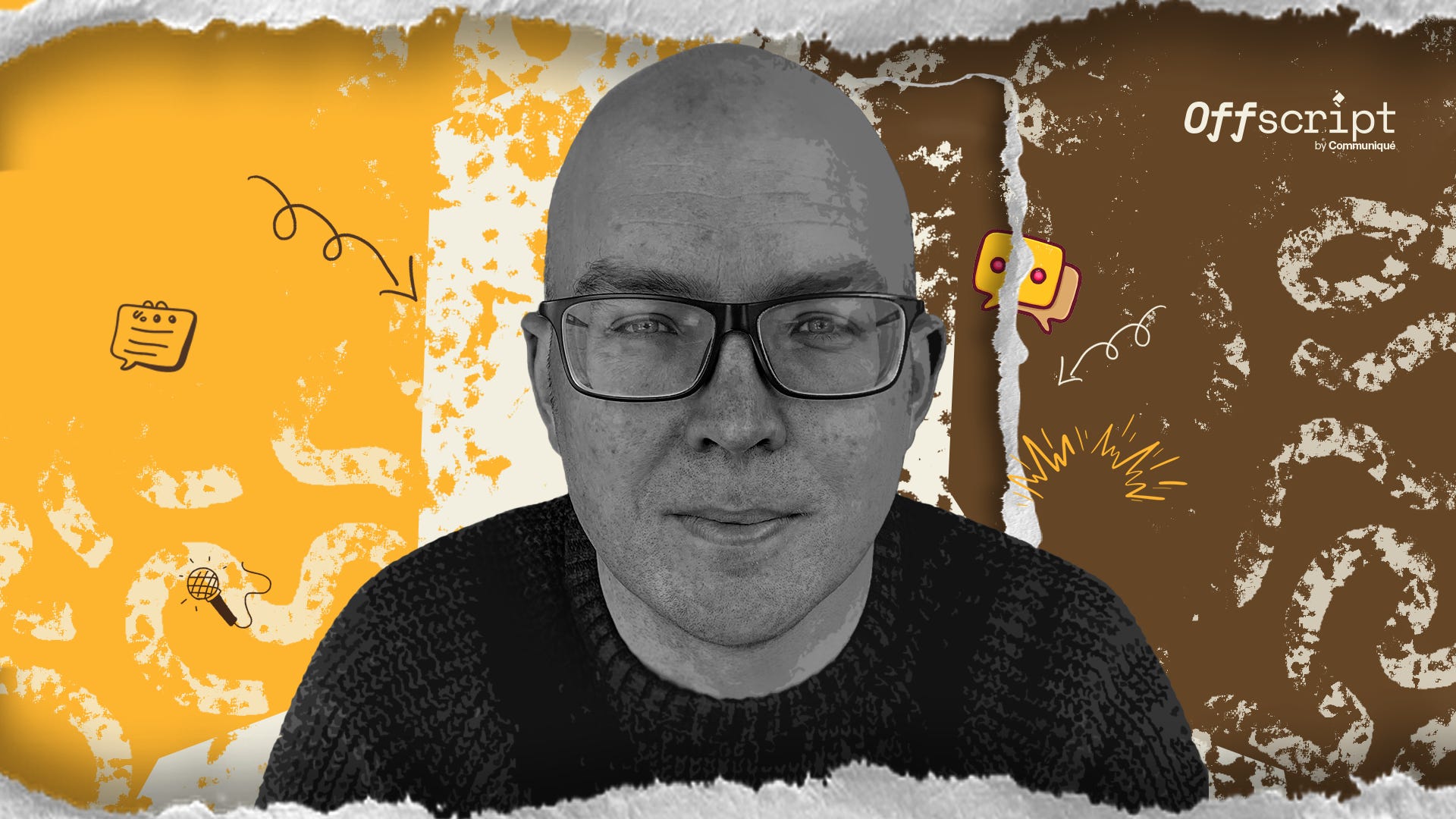
“If I’ve got a gift, it’s for picking the interesting project, and if the project is interesting, that does half the work for you.”
For Kevin Kriedemann, this is less a philosophy than a description of how his career has unfolded over three decades championing South Africa’s film industry. It was his desire, or “luck” as he calls it, to pursue things that interest him, even though some of them were by necessity, that placed him in positions where he could establish himself as a publicist par excellence.
The environment he grew up in made that almost inevitable.
“I grew up in a very strange family by South African standards,” Kriedemann recalls of his childhood in the suburbs of Cape Town, South Africa. His father was a fine artist who made a living via landscape painting, and his mother was a real estate agent. The conversations around their house were always about his dad’s art.
But it was not just art that shaped him. His upbringing was layered with different belief systems and ideas. His parents belonged to a spiritual offshoot of Islam called Subud, a movement with Middle Eastern roots that had given them new names. He attended a Jewish pre-primary school. Sometimes he went to church on Sundays. At home, there were influences ranging from martial arts and Tai Chi to neuro-linguistic programming and past-life regression. “I wasn’t one thing,” he recalls. “It was a whole bunch of things that weren’t on any list.”
That openness shaped how he thought about the world. It also shaped how he thought about stories, who told them, how they are told, and where their power came from. At the same time, he was growing up in a country in transition. Apartheid ended while he was still young, and South Africa was reinventing itself. There was a strong sense, at least for a time, that anything was possible. “I kind of thought I was going to be a writer,” he says. “I was going to write the great South African novel.”
For Kriedeman, writing came early. He wrote his first screenplay before finishing high school. Around the same time, he was playing water polo competitively and working as a waiter to support himself. He was, by his own admission, doing “everything but studying.” The screenplay was optioned three times but never produced. He completed a novel, then a non-fiction book. Then he started a third book, which never saw the light of day. His laptop was stolen, and he had no backup. He tried to rewrite it, but something had changed. “It stops being as fun when you’re trying to remember what you wrote rather than just being in the moment,” he says.
Around the same time, life became more demanding. At 18, he had become independent, studying by correspondence because he could not afford university, and working to pay his bills. Writing required time and space—he had neither. So, slowly, he moved away from it. Because he had bills to pay, his focus shifted toward whatever would earn him money. That shift is what eventually drew him into the film industry.
His first professional job was writing for a youth magazine. There, he began covering pop culture, attending film screenings, and writing reviews. Before long, he landed a role at The CallSheet, a major trade publication covering South Africa’s film industry, and worked his way up to the role of an editor.
Kriedeman’s experience at The CallSheet was a comprehensive education in the industry he would spend his entire working life in. Thanks to the publication’s pioneering work, he gained firsthand access to the inner workings of the local film industry and the people who made it function. He was also actively involved in work that helped build the industry’s structure. His team published the first-ever benchmark figures for what South African screenwriters were actually being paid. They mapped how many cinemas existed in the country, and what local films had realistically earned. “It was just all statistics that people hadn’t really seen before.” After The CallSheet, he worked at a couple of similar trade publications like the Filmmaker’s Guide to South Africa, The Event, Creative Showcase, and The Markex Buyers Guide. He also took on Africa-focused roles for international publications, including Variety and The Hollywood Reporter.
After seven years doing this work, Kriedemann realised he had reached the limit of what he could achieve in journalism. It was the early 2000s; media publications were uncertain about what to make of the internet transformation underway, and the print industry was simultaneously losing its core business model. “I was doing less and less of the actual root of things, but I wanted to get back to doing that, and I wanted to try something else. So at that stage, I shifted into PR.”
Working in the industry for that long meant he had interacted with many publicists and had seen how similar their work was to his. One of the publicists he connected with was Joy Sapieka, who had sold her UK company to what would become Premier PR and had worked with distinguished film directors and actors, including Sam Mendes and Nicole Kidman. At the time, she had returned to live in Cape Town and work in the local industry. The two clicked immediately and began collaborating; one of their first projects was for the Encounters documentary festival.
Not long into their collaboration, Jon Blair, a South African Oscar winner who had taken over Al Jazeera’s documentary productions, called Sapieka to look for a PR team. Sapieka and Kriedemann ran communications for Al Jazeera across Africa for roughly seven years. The experience opened Kriedeman’s world beyond South Africa’s borders in ways his upbringing and experiences never had. “Al Jazeera was also a defining moment. Just that sense of really working across the continent for the first time, seeing how differently the media are structured in different places, understanding how South Africa is perceived in various parts of the continent for very understandable reasons and not very flattering ways.”
They stayed until Qatar’s diplomatic blockade made it impossible to renew their contract with the media company. But by then, another opportunity had already arrived. A former Callsheet colleague, now at Triggerfish Animation, brought Kriedemann in alongside Sapieka to help conceptualise a local storytelling development lab. The team expanded the project’s scope and made it pan-African. They received 1,400 entries, out of which major Triggerfish productions were developed, including Mama K’s Team 4 (sold to Netflix, later retitled Supa Team 4), and Kiya & the Kimoja Heroes (Disney).
The lab proved something important, but it also exposed a gap. “The stories came from here, but we weren’t quite at the stage where we could convince international studios to go all in and also let Africans direct African stories.” That gap was the seed of what became Kizazi Moto: Generation Fire, an animated anthology series. The question Kriedemann kept returning to was: how do you qualify African directors to tell big-budget stories for global streamers? The answer, as he saw it after watching Love, Death & Robots, was the anthology format, a structure in which no single film bore all the risk and a body of work could speak louder than any individual pitch.
The timing was fortunate. Disney was launching in Africa, fresh off the success of Black Panther, and looking for a flagship African project. Triggerfish had 20 years of industry relationships and 1,400 story lab entries to draw from. They were able to bring Peter Ramsey, fresh from directing Into the Spider-Verse, on board as executive producer. In the end, ten projects from seven countries were selected and developed to form the anthology. Kizazi Moto won international awards and generated real excitement.
However, it also came with its disappointment. By launch, Disney+ was available in Africa only in South Africa and Egypt, which meant most of the filmmakers couldn’t watch the films they had made. “That just felt like such a missed opportunity,” Kriedemann says. “We had this beautiful product that wasn’t available for most Africans.”
Meanwhile, in parallel with the Triggerfish work, Kriedemann was developing a growing relationship with the now-defunct indigenous streamer Showmax. Kriedemann came on board for its very first original production and later became a part of their team.
The scale of the work and the resources he had at his disposal were also quite different from what he was used to. “I walked into my first Showmax meeting, and there were 50 people around a table at a five-star hotel, each of them a marketing specialist in a different avenue, a very different scale to a lot of the stuff I’d done until then.”
From there, he effectively built Showmax’s content PR function from scratch and helped steer the streamer’s relaunch with Comcast.
Kizazi Moto and Showmax were both in full swing at the same time. “It really felt like I had two full-time jobs.” So when Kizazi Moto went into production and had to choose between becoming a hands-on producer and staying at Showmax as a publicist, he chose to stay. “It was really tough. I would have loved to be in one of those worlds where I could do both.”
When Showmax’s future began to look uncertain, Kriedemann left and relaunched his agency, Plot Twist. “I’m going back to a model a lot more like what I was doing before Showmax, but with a lot more knowledge.” The flip side is that he now has to tackle an interesting question: what does sustainable film publicity look like in an industry where the venture capital era of streaming is over? “The VC money isn’t coming back. So what does it look like to market things in a way that’s impactful without the resources we used to have?”
His instinct for the interesting has also kept alive an ambition that predates everything else. Kriedemann still hopes to return to writing the novels, the stories he set aside when bills and opportunity pulled him in other directions. He hasn’t found the time yet, but he hasn’t let go of it either. All in all, everything boils down to doing interesting work. “When you work with people who do interesting things, that inevitably leads you to work with other people doing interesting things, and their good work brings you good work.”
If Communiqué has shaped how you see the industry, return the favour. One-time or recurring: every contribution keeps us accountable to readers.
Editor’s Note: This essay has been updated to correct Jon Blair’s title, remove the incorrect attribution of Seal Team to the Story Lab program, and clarify the sequence of Kriedeman’s early writing career.