


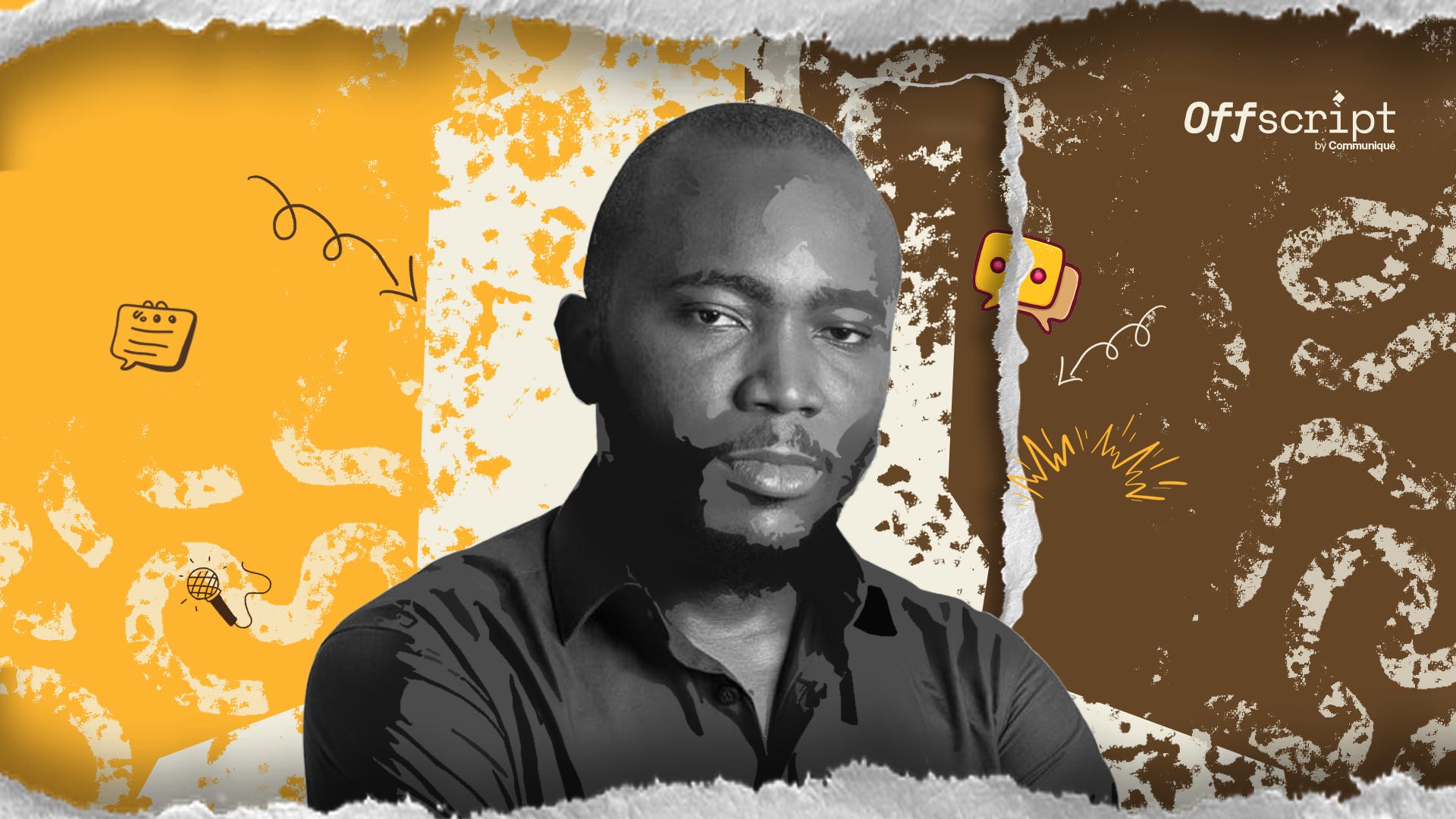
“I really believe in the things I get involved in. That belief inspires a duty of care, a commitment to excellence, and the delusion that it can work. Because without belief, what are we doing here, man?”
For Joey Akan, belief is not a vague idea or a motivational slogan. It is a working principle. It has made him leave well-paying jobs and stay with projects that demanded more than they gave him. For him, the distinction is whether he can still see a reason to keep doing the work. If he stops believing in something, he leaves. “It was fun to do it as long as I believed in it,” he says of his time at Pulse. “I believed in Pulse. I believed in the people around me. And the moment I stopped believing in that, I just walked away.”
That pattern has shaped his career. Akan has worked as a writer, editor, A&R executive, television producer, and media entrepreneur. He has written about African music for local and international publications such as the New York Times, worked at Universal Music, and founded Afrobeats Intelligence, a platform that has grown from a publication into a podcast, video project, and live experience. Now, he is expanding again with The Joey Akan Experience, a wider media project built around conversations with people working across culture and the creative industries.
Akan was born and grew up in Port Harcourt, southern Nigeria. He was orphaned early, and much of his childhood was marked by solitude. He spent much of his time alone, often with books. “I read and read until one day I decided, how about I just create words of my own or stories of my own?”
Books offered escape, but they also taught him how to think. He read mostly novels and was drawn to the way fiction could make a reader hold conflicting ideas at once. They were also accessible. He did not have much money growing up, but books were easier to find than many other forms of entertainment. People discarded them during house moves. They could be borrowed, passed around, and collected.
You’re reading Communiqué because someone in the Inner Circle paid for it. Pay it forward.
Akan studied biochemistry at the University of Uyo after coming through secondary school with a science background. But he never expected the degree to become his career. “I knew biochemistry was not what I wanted to do. Even though I did not know [what].”
He did know, though, that he wanted to write. In his second year, he saved up from his feeding money and bought a laptop. Then he bought an internet modem and went online. The internet opened up a new world. Writing had always carried prestige, especially in newspapers, but Akan was not interested in the traditional route. “The internet gave me blank canvases everywhere to write,” he says. “You can write on Facebook; you can write on WordPress.”
He began publishing essays on Facebook and blogging. He wrote about ideas, art, and the things around him. In his final year, while at a beach in Oron, he received a call from someone recruiting writers for Pulse. “I was having a bottle of Heineken, my phone rang, and some guy with a British accent was courting me for Pulse.” He went through the interview process and was hired while still in school. After graduating, he returned briefly to Port Harcourt before moving to Lagos.
At Pulse, he started as a writer covering general news. He didn’t take long to grow restless. He moved into music because it brought together two things he already loved: writing and art. But he was not satisfied with the kind of entertainment coverage he found around him. Much of it focused on celebrity possessions, scandals, and controversy. He wanted to take the music itself seriously. “When I started, entertainment journalism existed, but I didn’t find enough spaces where people were concerned about the art,” he says.
So he taught himself. He read publications such as The Fader, Complex and DJBooth. He studied music criticism, opinion writing, and long-form reporting. At Pulse, he learned how to distinguish high-traffic stories from high-impact ones, while building his own approach to music journalism. “A lot of the work I did there was self-taught,” he says. “I was teaching myself every day.”
By the time he left Pulse, Akan had established himself as one of Nigeria’s leading music writers. He had built relationships within the industry and earned recognition for his work. But instead of settling into the position he had created for himself, he began looking for the next challenge. Afrobeats was also beginning to travel internationally, and Akan could see a story developing around it. He wanted to help tell that story to a global audience. So he resigned and took a role at Universal Music, which was expanding its presence on the continent.
At Universal, he worked on projects involving artists such as WurlD and Tekno, among others. The attraction wasn’t simply the job itself, but the chance to understand how the machine worked. “What makes a lot of opportunities important for me is how much I could learn from them. So the potential to improve my knowledge base is bigger than anything else.” He learned how the industry operated from the inside, and the experience gave him a deeper understanding of the business he had spent years covering.
Your contribution funds: Original reporting, data licensing, and a small editorial team that actually answers your replies. No ads, no paywalls.
Once he felt he had learned what he needed to learn, however, he became less interested in staying. He had discovered that he did not particularly enjoy “looking under the hood” of the industry from the position he occupied there. Again, the decision was less about whether the opportunity was objectively good and more about whether it remained meaningful to him.
Before he left Pulse, Akan had started writing for international publications. After Universal, he leaned further into freelancing. Working with editors outside Nigeria improved his craft, but it could be exhausting. He pitched stories repeatedly, wrote for uncertain outcomes and waited to be paid. One rejection from Genius stayed with him. He had been commissioned to write a piece, but the publication rejected it twice. The larger problem was that he had grown tired of writing the same introduction to Afrobeats for international audiences. Too many stories began from the same place: African music as a discovery. “I discovered that I’d introduced Afrobeats for way too long,” he says. “It felt like the narrative was stunted and I didn’t enjoy it.”
His friends urged him to launch a Substack publication. He called it Afrobeat Intelligence. It was initially a place to publish opinion pieces, which did reasonably well but didn’t get the response he hoped for. Then he returned to some of the interviews he had accumulated over the years. He published an interview with singer Asa, and the response shifted the project’s direction. “It went crazy. People loved it!” That response showed him what his audience wanted: thoughtful, detailed conversations with artists and cultural figures.
Akan followed that signal. And Afrobeat Intelligence became a space where he could apply the editorial standards he had developed internationally to stories much closer to home. The project expanded gradually. He bought podcast equipment, put them in his car, and began recording audio versions of the interviews he was already conducting for the publication. Eventually, the project expanded into video and a team formed around it.
“There was no grand plan to be this,” Akan says. “The live shows came as an if, as a natural order of things. You do things online, people love it, people identify with it. And you could put them in a room and do the same thing.”
There were other stops along the way. Akan joined News Central, a Lagos-based broadcaster, to run the entertainment desk when it started in 2019. He helped develop programmes for the station, but he soon left because television work didn’t suit him. He preferred depth and long-form storytelling, while television’s demands pushed him toward shorter, faster formats. He knew the arrangement was unlikely to last because the format didn’t fit the way he wanted to work. He also worked at The Conversation Africa, a role that put him at the intersection of academia and the public.
By the time he launched his Afrobeat Intelligence podcast, all these acts had to end, and he had to focus squarely on the work. At some point, the project had to stop because of creative differences with his partners. Akan could not find a version of the project he believed in. “If I don’t believe in this, then why am I doing it?” Untangling himself from the relationship took a year and significant resources. But he left.
Right now, Akan says he feels fortunate to be working from a position where he has access to people, resources and funding, and where others are willing to believe in what he is building. That creates another responsibility: to make that trust worthwhile by getting better and building more carefully.
The Joey Akan Experience is part of that effort. It extends the same curiosity that shaped his music journalism into a broader media project, letting him explore people, ideas, and culture beyond music. “The Joey Akan experience, it’s my gift to the media space.” He argues that music has benefited from dedicated media projects such as Afrobeat Intelligence, while other parts of the culture have yet to receive the same depth of attention. “I use the word gift because music has enjoyed too much. Think about it. Do we have an equivalent of Afrobeat intelligence for Nollywood? No, we don’t.”
The uncertainty doesn’t bother him as much as it might have earlier in his career. But he trusts his judgement, his team, and the market enough to keep moving. On a personal level, he doesn’t know exactly what comes next. He knows only that he believes in it. For Joey Akan, that has usually been enough.
