


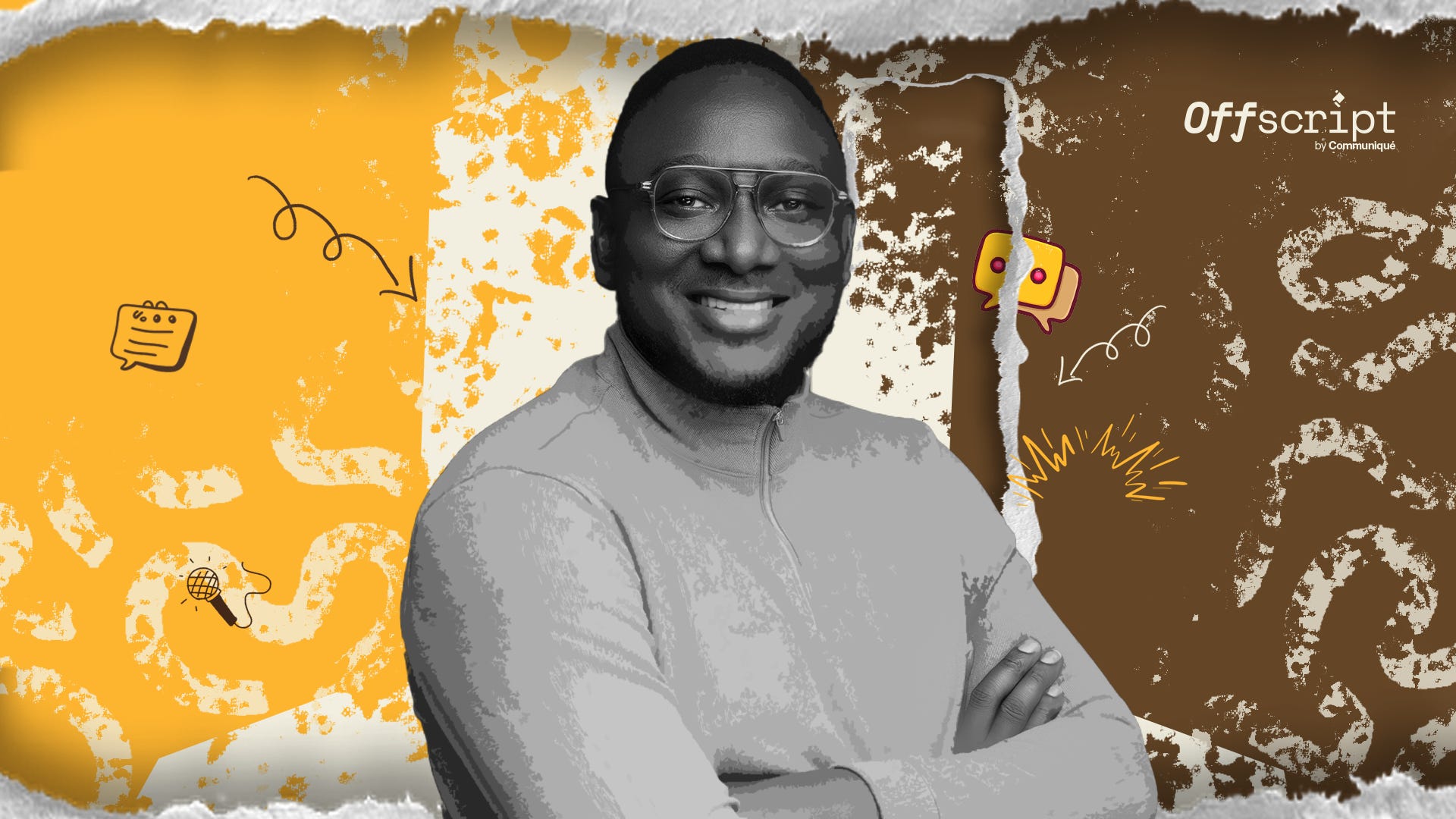
“When African stories are told well, I think the world might experience a new kind of civilisation, because that’s the only last frontier of cultural experience that the world hasn’t even touched or explored yet.”
Ferdy Adimefe is not a filmmaker in the traditional sense. He has never animated a single frame. He cannot draw. What he can do is see things before they exist. Stories, worlds, civilisations.
He saw them as a child in the southern Nigerian city of Port Harcourt, arranging pebbles on the floor and assigning each one a character. He saw them as a teenager, printing a four-page newsletter and distributing it to churches across the city. He sees them now as the founder of Magic Carpet Studios, one of Nigeria’s most ambitious animation companies, building what he calls an entertainment ecosystem, a machine for turning African mythology, folklore, and literature into globally scalable intellectual property.
The animation industry is worth $300 billion globally. Africa accounts for less than 4% of it. Adimefe wants to change that. But to see how, you have to start at the beginning
Adimefe grew up as the third child and first son of six in a household shaped by stories. His mother was a primary school teacher who named him Ferdinand after a character in Shakespeare’s The Tempest and kept African Writers Series titles around the house. In the evenings, his grandmother, who lived with them, kept the tradition of African folktales alive. “Most of the evenings we’d gather around the fire,” he recalls. “She would tell us stories from her growing-up years. We would sing with her.” It was an early education in the power of a well-told story.
It was also a childhood saturated with imagination. Adimefe read everything: his mother’s teacher manuals, his sisters’ Hints and Hearts magazines, fiction, science textbooks. By his teenage years, he had joined a Christian drama group called The Box, which was reimagining the Christmas story as a stage play. It was there, performing and building, that Adimefe first found his people, a community of creatives in Port Harcourt.
Despite all of this, he was a Science student. A very good one. When it came time to apply to university, he chose medicine, partly pushed by his mother and partly by the logic that good science grades pointed in that direction. He got into the University of Port Harcourt Medical School, studying human anatomy, with plans to transition into clinical medicine and eventually become a doctor. That plan ended in a cadaver room.
In his second year, standing over a body being dissected, Adimefe realised with sudden clarity that Medicine was not his calling. He had never liked the sight of blood. He had never questioned whether he actually wanted to be a doctor, only that he was good at the subjects that led to it. He considered switching to Psychology or Economics, but the school counsellor told him he could only move within the Faculty of Science. So he finished his Anatomy degree, and then he left.
The pivot to storytelling did not happen all at once. During a university strike that sent students home for a year, Adimefe was invited to speak to a group of teenagers at a Bible school his cousin attended. He had never given a talk before. He went anyway. Afterwards, a man in the audience told him he liked the way he spoke and asked him to write his speech up as an article. Someone else suggested he could turn the article into a newsletter. He did. He called it Hallmark, a printed, four-page bulletin focused on inspiring stories about people, and began distributing it to secondary schools across Port Harcourt.
The response surprised him. He gave a copy to his pastor, who made it the subject of his sermon that Sunday and asked Adimefe to stand up in front of the congregation. “I was embarrassed, I hated to be the centre of attention. I wanted so much for the ground to open for me to go in.” But the attention came anyway, and with it, momentum. When he returned to campus, Hallmark became a magazine. Most people who knew him at university knew him as an editor, not an Anatomy student.
After graduating, he worked briefly as a copywriter at an advertising agency. Before moving to Century Group, an oil and gas company, where he spent five years as a brand manager, earning well, growing bored, and feeling, as he puts it, that he had betrayed his creative side.
In 2015, he resigned to start Imaginarium, a creative technology and brand innovation agency, built on the belief that advertising had become stale and that brands needed new ways to tell stories. Everyone thought he had lost his mind, leaving a lucrative job to start an agency. But he wanted to be solely focused on Imaginarium. “I felt for the longest time that I’d betrayed my creative side,” he says. “And I wanted so much to get in touch with it. I felt that if I combined the oil company job and the agency, I wouldn’t give it my best.” Within a month of resigning, he had his first client, a governorship campaign in Delta State. It was proof enough. He kept going.
Imaginarium grew. They got a Value Added Service (VAS) license from the Nigerian Communications Commission (NCC) and began to distribute content for the federal government, working with telecoms companies like MTN and Etisalat. It was not glamorous work, but it was sustainable, and that sustainability was what allowed Adimefe to pursue what he actually wanted to build.


Magic Carpet Studios came out of a question he asked his team one afternoon: if we had to adapt a piece of African literature into a film, what would it be? His team voted for The Passport of Mallam Ilia, a 1960 novel by Cyprian Ekwensi about a Fulani cattle herder journeying across Northern Nigeria in search of the man who caused his wife’s death. Adimefe thought it was a great choice. “I remember reading The Passport of Mallam Ilia back then and falling in love with it,” he says. “It was very cinematic. It had this very pictorial way of telling the story.” They tracked down the author’s daughter, who lived in Atlanta, secured the rights, and announced the project. That was 2018.
What followed was a masterclass in the gap between ambition and infrastructure. When they began recruiting animators, they discovered that Nigeria essentially had none, at least not at the quality the project required. The handful of people who showed up to audition were passionate but undertrained. A co-production opportunity with a South African company emerged, but it came with an $8 million budget requirement, half of which Magic Carpet would need to raise. The highest-grossing Nollywood film at the time, The Wedding Party, had made roughly ₦452 million ($1.72 million) at the box office. Raising $4 million in that environment was not realistic. By 2020, the South African partners had pulled out. Then COVID arrived.
Rather than abandon the project, Adimefe did something that would define Magic Carpet’s identity: he built the talent that didn’t exist. In 2021, the studio launched a training school. For two years, they taught animation to young Nigerians, slowly assembling the team that would eventually work on the film. “It took us about two years to deepen the quality of talent,” he says. “For two years, our pace was very slow because we had only the core hands working on it while we were training.” Today, 90% of the people working on The Passport of Mallam Ilia are locally trained graduates of that programme. Production fully resumed in 2024, after a successful raise on Wefunder. The film is now expected to be released before the end of this year.
While The Passport of Mallam Ilia was in development, Magic Carpet built a second IP: Meet the Igwes, a 13-part animated family series, think The Simpsons, but rooted in Nigerian family life, exploring the love and friction between siblings and parents, and the texture of growing up in this part of the world.
Adimefe is also building what he calls Magic Carpet Venture Studio, a $10 million IP-focused fund, structured like a Y Combinator for African creators. The model is simple in theory: identify promising IPs, incubate the creators behind them, help them build communities around their work, and then license or sell to international streamers from a position of ownership rather than desperation. The fund is expected to launch by August 2026.


The urgency behind all of this is not abstract. Adimefe points to a statistic from the Director General of the African Continental Free Trade Area: of the roughly $100 billion generated annually by Nigerian music, only 2% returns to the country. The rest flows to the platforms, labels, and distributors that own the infrastructure. Iwaju, the Disney+ animated series set in a futuristic Lagos, is a Nigerian story, but the IP belongs to Disney. Iyanu, the HBO animated series drawn from Yoruba mythology, is a Nigerian story, but the IP belongs to Lionforge and Warner Bros.
“What we want to do in Magic Carpet,” Adimefe says, “is to let our people own a piece of the pie.”
There is a version of this story that is simply about one man’s persistence, the pebbles on the floor, the newsletter, the cadaver room, the oil and gas job he left, the animation talent that didn’t exist, the co-production that fell apart, the pandemic, and then, finally, the film. That story is true, and it is worth telling.
But the larger story is about what would happen when a continent with the world’s richest untapped mythology—Sango, Queen Amina, the empires, the folktales and the cosmologies—finally builds the infrastructure to tell its own stories on its own terms. Adimefe believes that moment is arriving. He has spent the better part of a decade making sure Magic Carpet is there when it does.
Editor’s note: The essay has been updated to accurately reflect the plot of The Passport of Mallam Ilia and the IP ownership of Iyanu.
I’ve always loved African stories, and deep down I’ve always believed the world still hasn’t fully experienced the depth of Africa’s imagination, mythology, and culture. Africa needs its own animation identity, storytelling voice, and creative ecosystem that feels truly ours.
What you’re building with Magic Carpet Studios is deeply inspiring because it proves that African stories can be told at a world-class level without losing their soul. You’re not just building a studio, you’re helping build the future of African storytelling.
One day, I believe I’ll have the opportunity to work with you in fulfilling this mission of creating globally respected African stories that our people can truly own and the world can genuinely connect with.