


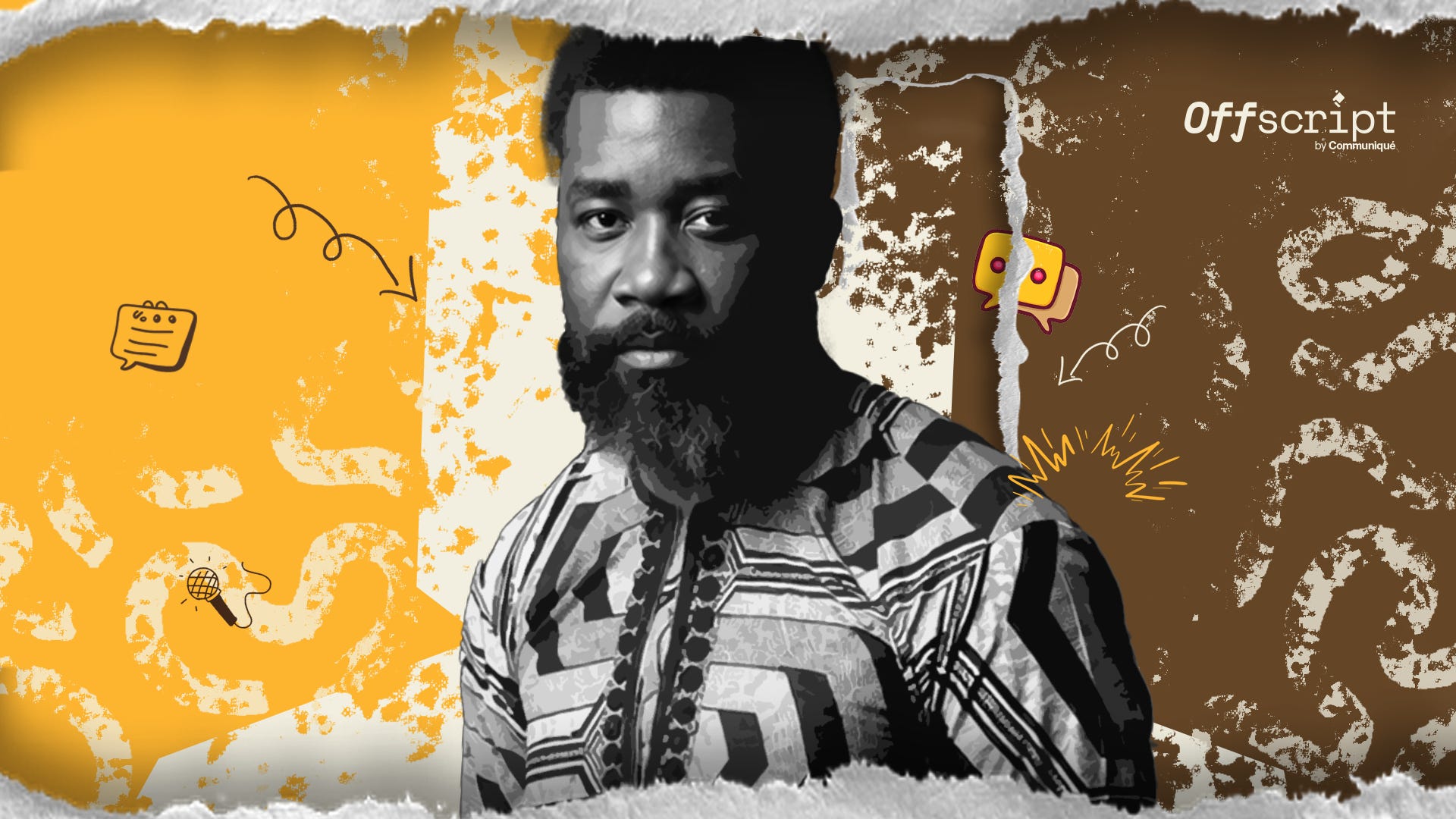
“Back in the day when red carpets were new things, there was a photographer I knew. If he ever took a picture of me, he would show me first because he knew I was always looking out to make sure nobody was taking my picture. He would always sneak a picture, then come up and say, ‘I got you.’ But he would never post it or use it.”
For most of his career, Enyi Omeruah has preferred to stay out of the frame. In an industry obsessed with visibility, he built a life around being useful instead. While artists chased audiences, producers chased financing, and executives chased influence, Omeruah quietly developed a different skill: connecting people to opportunities.
Over the last two decades, that skill has taken him through almost every corner of Nigeria’s creative industries. He has managed musicians, supervised film soundtracks, raised money for movies, represented actors, connected writers to international opportunities, facilitated book adaptations, advised producers, and built relationships across Africa and beyond.
If you’ve heard of him, chances are somebody pointed you in his direction. He rarely points at himself. “I’ve just always stayed away because I wanted the clients to receive the spotlight,” he says. “That’s why they were there. My job was always in the background.”
In many ways, that instinct started long before he ever worked in entertainment. Omeruah grew up moving around Nigeria. His father was in the military, which meant a childhood split between Lagos, Kaduna, Enugu, and back again. But the more important influence may have been his mother.
She worked at the Nigerian Television Authority, where she created and produced Kiddies Junction, a children’s television programme intended to be Nigeria’s answer to Sesame Street. After school, Omeruah and his siblings would often end up at the television station. They appeared on programmes, sat around production sets, watched puppeteers at work and spent time around cameras.
Most children would have been fascinated by what was happening in front of the camera. Omeruah was more interested in what was happening behind it. “I would always look into the control booth,” he recalls. “I was wondering what was happening there. What was happening behind the camera, not necessarily what was happening in front of it.” That curiosity never left him.
But curiosity and career are often two different things. Like many children raised in strict African homes, creative ambitions did not seem practical. By the time he left Nigeria for university in the United States, entertainment was not on the table. He enrolled in accounting instead. “I changed to accounting because I thought it was the easiest of all the options that I had.” He graduated, found work, and spent the next seven years in the profession. But he hated it.
What kept him going during those years was a growing fascination with the entertainment business itself. He spent hours in bookstores reading copies of Variety and The Hollywood Reporter, trying to understand how films were financed, how labels operated, how talent relationships worked, and who actually made the important decisions behind the scenes. At church, he spent time with the musicians. In recording studios, he watched producers work. Whenever he found himself among creative people, he was more interested in understanding the machinery behind them than in their performance.
If Communiqué has shaped how you see the industry, return the favour. Every contribution keeps us accountable to you.
In 2004, Omeruah returned to Nigeria for his compulsory national service. Being back in Lagos shifted something in him. Even after a brief return to the United States, he knew he wanted to move back permanently, which he eventually did in 2006. A month later, his father died suddenly from a heart attack. Grief, it turns out, is clarifying. “That sort of shifts things. That makes you ask yourself, ‘What is life? What are you doing?’ It can flip on its head.”
Around the same period, he was spending evenings moving through Lagos’ live music circuit. Places like Bogobiri had become gathering points for musicians, poets and artists. One performer in particular caught his attention. A guitarist named Bez Idakula. “I remember thinking the world was his.”
Soon he discovered that Bez worked closely with Cobhams Asuquo, whom Omeruah already knew through family connections. The introductions were easy. The relationship developed naturally. What came next became a pattern that would define much of Omeruah’s career. He simply started connecting dots. That meant looking for more places and people to speak to who could help platform the musician. One of the people Omeruah reached out to was Tokini Peterside-Schwebig, the founder and convener of ArtX; at the time, she was working at Hennessy and trying to put together musical programming for the drink manufacturer’s music platform, Hennessy Artistry. That opportunity proved massive for Bez; it introduced him to the mainstream conversation.
As Bez’s profile grew, Omeruah found himself doing more than making introductions. He was helping coordinate opportunities and manage relationships. Only later did he realise there was a name for what he was doing. “I realised, oh, I was doing a role called talent management.” The work expanded organically. He started managing aspects of Asuquo’s affairs and supporting younger musicians in the producer’s orbit who had not yet broken into the mainstream. He was doing all of this while simultaneously managing family responsibilities after his father’s death and trying to sustain other ventures, including a catfish farm.
Then another opportunity emerged much closer to home. His younger sister, Chioma Omeruah, better known today as Chigul, had started sending funny voice notes to friends on BlackBerry Messenger. Omeruah paid little attention at first. “I felt too good for it. She was my sister, and I was like she should shut up and go away.” But the recordings spread quickly, and before long brands were trying to reach her. Since she was based in Abuja while much of the entertainment industry remained concentrated in Lagos, Omeruah gradually stepped in to help manage those relationships. And that’s how he found himself managing comic talent alongside musicians.
By now Omeruah was beginning to understand his real talent was helping artists navigate systems. Film entered his life almost by accident.
He watched a trailer for Before 30 and immediately became annoyed. The visuals were distinctly Nigerian. The music underneath them was not. “I was like, you can’t tell me they couldn’t find Nigerian music.” Through a childhood friend in the cast, he contacted the producers and offered to help for free. That introduction led to a relationship with the founders of Nemsia Studios, BB Sasore and Derin Adeyokunnu. He became a music supervisor, helping source music for projects like God Calling and Banana Island Ghost, often persuading artists to license songs without charging fees.
But another lesson was beginning to emerge. Talent needed opportunity, and to create opportunity, one needed money, and having money changed certain conversations. “I realised I would have more sway if I could raise money for these projects. I could raise a quarter of the budget and then softly insist that they use my [talent] Zainab Balogun for God Calling or somebody else for something else.”
Using the same relationship-driven approach that had shaped his work in music, he raised funding from friends, family and acquaintances. Some of the projects he worked on in this capacity include Ajuwaya. Even when projects did not generate strong financial returns, he maintained communication with investors and prioritised transparency. “The investor must be respected. The investor must be communicated with. Sometimes they’re not only there to make money. They’re there to be aligned with a great product.” That philosophy became central to how he approached business. Creative industries often celebrate vision and talent. Omeruah became equally interested in trust.
Over time, his world expanded beyond Nigeria. Film festivals, markets, and conferences took him to cities across Europe, North America, and Africa. He attended Cannes, the American Film Market, Berlin and Content London. Everywhere he went, he did the same thing he had done in Lagos; build relationships.
One of those relationships proved particularly important. At Content London, he connected with Odiri Iwuji, the commercial director of B2B media company C21 Media. In 2020, both men founded ChudorMMC, a management company specifically for African screenwriters. The idea was to connect writers and foreign producers seeking authentic African voices. They were successful at it, inking deals with global streamers like HBO and Apple TV.
Around this time, Omeruah also became quietly obsessed with the business of optioning books. “I believe our best stories are being told in prose. We can take those books and adapt them. And then fire up the sales of the books with great film and TV. It’s a whole ecosystem that could work together.” Essentially, he applied his expertise in connecting the right people in that part of the sector, linking publishers like Othuke Ominiabohs at Masobe Books with international producers, and introducing novelists like Adesuwa O’man to people who could turn their work into something more people could see.
Today, Omeruah is chairman of the board of the Realness Institute, a non-profit organisation that develops African screenwriters, producers, and creative executives. Writers come in with an idea, leave with a pilot script and a pitch deck, and are taken to Series Mania to pitch to network executives. He followed the organisation for years before getting the invitation to join the board. It is the kind of role that suits him: influential, connective, and largely invisible to the public.
He still avoids the spotlight when he can. But after nearly two decades spent helping creatives find audiences, funding, collaborators, and opportunity, Omeruah still measures success differently. “I have no money. I have people. And people trump money every time in the balance sheet of my life.”

Editor's Note: This article has been updated. The previous version incorrectly stated that Enyi Omeruah worked on Lara and the Beat. He did not.