


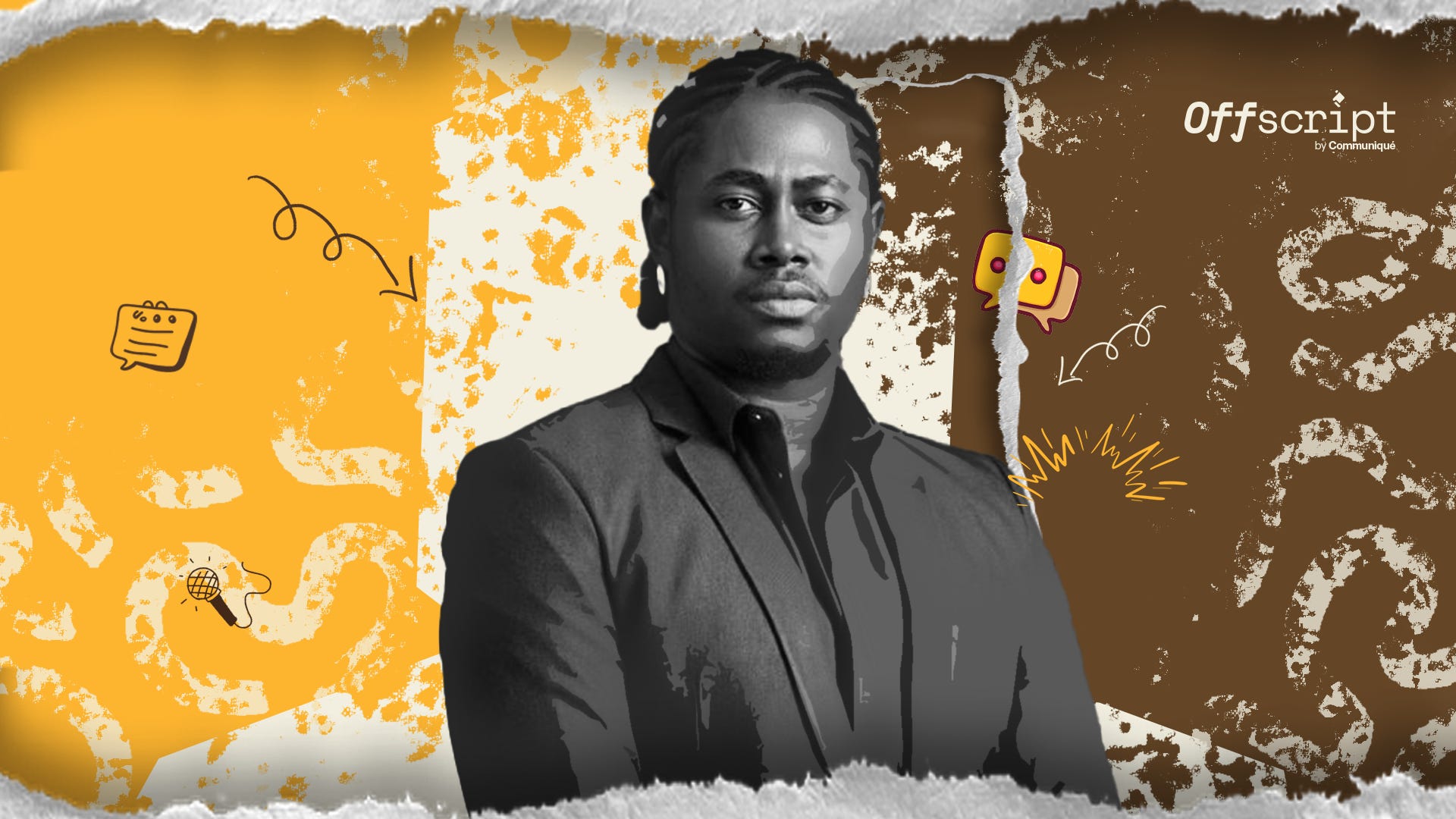
“I think I’ve had multiple opportunities, not because I was necessarily chasing them, I was just doing things I liked.”
Edwin Madu—better known by his stage name Dwin, the Stoic—says this like it’s an afterthought. Like he’s talking about picking a meal, not designing a life that has stretched across writing, tech, music, media, and now building a record label. But that one sentence explains almost everything about how he moves through the world.
For Madu, there is no master plan. There’s no moment where he decided, I will be this kind of person. What he describes instead is a series of “side quests.” Things he followed because they felt interesting, or necessary, or simply fun. Over time, those side quests started to look like a system.
To understand that system, we must first go back in time to his childhood home in Lagos. Born to two parents who he describes as basically teachers, Madu’s education began early and subconsciously. His mother, a fine arts teacher, filled the house with sculptures, paintings, and other half-finished art projects. His father, a travelling consultant, returned with books and records from all the places he had visited. He began reading those books and exploring the worlds they offered. “I think that something about reading literature in general is that it will always open your eyes to what life could be like in other places.”
Madu’s elder sister was a writer, and soon he began to follow in her steps. “I’d seen some of the stuff she was doing, and I just felt like, hey, I’m just going to try and express some of my thoughts.” An edition of Nigerian Idol got him hooked on songwriting, and he began to scribble lyrics in the back of his school notebooks. But he never put out anything until he lost his sister in his second year at university. His grief found an outlet in writing. And like many aspiring writers in the early 2010s, he started a blog.
But writing or music was never meant to be a career path. He was already a computer science student at Covenant University and would go on to graduate with a first class. Still, writing had taken root, and even though it was just a side quest, it kept pulling him in. “I wrote to just express the ideas I thought I had. But then, as I wrote, I was getting more people interested. And then I started doing short stories, and people liked them.”
It was around this time that he wrote and released his first song on SoundCloud. “I wasn’t trying to be a musician. In fact, I hid it from my parents because I got one low grade that semester. And the grade had nothing to do with the music, but I didn’t want them to make it a thing.” In 2015, he got into Chimamanda Adichie’s popular writing workshop. It was the first validation he received for his writing.
But Madu still did what was expected of him. After graduation, he followed the sensible path: first into advertising, then to tech consulting firm Inlaks, where he worked as a consultant helping banks and financial institutions across West Africa digitise their systems. On paper, it was a clean, respectable life. The kind that reassures parents and keeps family group chats quiet.
In the background, though, music never really left. After his first SoundCloud release, he kept dabbling with the craft. In 2017, he decided to take it seriously. This time, he didn’t hide it from his parents.
“At this point, I’m earning a salary. I’ve done the smart thing as a young man to get a job. So I sat them down and said, I’m working on an album. It’s not going to change anything. Monday to Friday, I go to work. Saturday and Sunday, I will go and work on the album.”
Madu released the album independently, without a record label’s support, and that freedom shaped everything that followed.
“I dropped an album that I don’t think anyone in the industry would have advised me to drop,” he says. “There were many genres. It was me writing songs how I would like to write stories. Some of them are slow. Some of them fast. I just thought music should sound like the music I grew up on.”
But freedom came with its own responsibility. There was no team to lean on. “I was keeping track of everything I was doing. I was talking to the press, making sure my publishing was registered,” he says. “I was doing all the things you read on those websites about what indie artists should do.”
But the album didn’t take off. There was no viral moment, no sudden spike that changed his life overnight. “All I got was just a lot of encouragement. People just going, ‘Oh, these songs are really good.’ And then that was it.”
For Madu, that was enough. The album proved what he was capable of. And once people saw that, doors began to open in small, unexpected ways. Songwriting work followed, including sessions with artists like Adekunle Gold. In 2018, Ndani TV reached out to license some of his songs for their popular web series, Skinny Girl in Transit. Around the same time, he found a creative partner in Rhaffy, a producer who would become a frequent collaborator. Together, they started a band, Ignis Brothers.
Then writing pulled him back again, this time to Big Cabal Media as an editor with TechCabal. “I was very much focused on the culture of tech. I wanted to talk about the people, the stories, and what it really means to be in this industry.” When the editor-in-chief role at sister publication Zikoko opened, Madu got the job, allowing him to do the culture storytelling he loved on a larger scale.
Madu’s music career kept growing, and before long, running a major media platform and building a life in music began to feel like running two startups at once. In 2022, he resigned from Zikoko to focus on music.
He initially did not plan to start a record label.
“I’m not a fan of the entrepreneurial life,” he says. “But life can be funny. It will take the thing you really love and make it so important to you that now you must start a business around it to sustain it.”
What he saw instead was a gap. Years of managing himself as Dwin, the Stoic and working with Ignis Brothers had taught him the workings of the industry, and he wanted to turn that hard-won knowledge into a platform for other independent artists.
In 2023, he started St Claire Records, named after his late sister. The first two artists were himself and Raffy. Together, they released Love Lane in 2023 and Master of Ballads in 2024.

The work, he admits, has been intense and relentless. “A lot of this is like running a startup. You’re everything,” he says. “At some point, I’m designing flyers for a tour, but I also need to get to rehearsal. I need to do this, and then I need to do that.” Still, the label kept growing. In 2025, St Claire signed indie artist Celeste Ojatula.
Now, when Madu talks about music, he doesn’t just talk about songs. He talks about structure. About governance. About education. He sounds less like someone curating a playlist and more like someone sketching out an industry.
And maybe that’s what the side quests were always leading to. Writing taught him how to tell a story. Tech taught him how to build systems. Media taught him how to find and hold an audience. And now, music has given him a reason to bring it all together.
I totally loved reading this.