


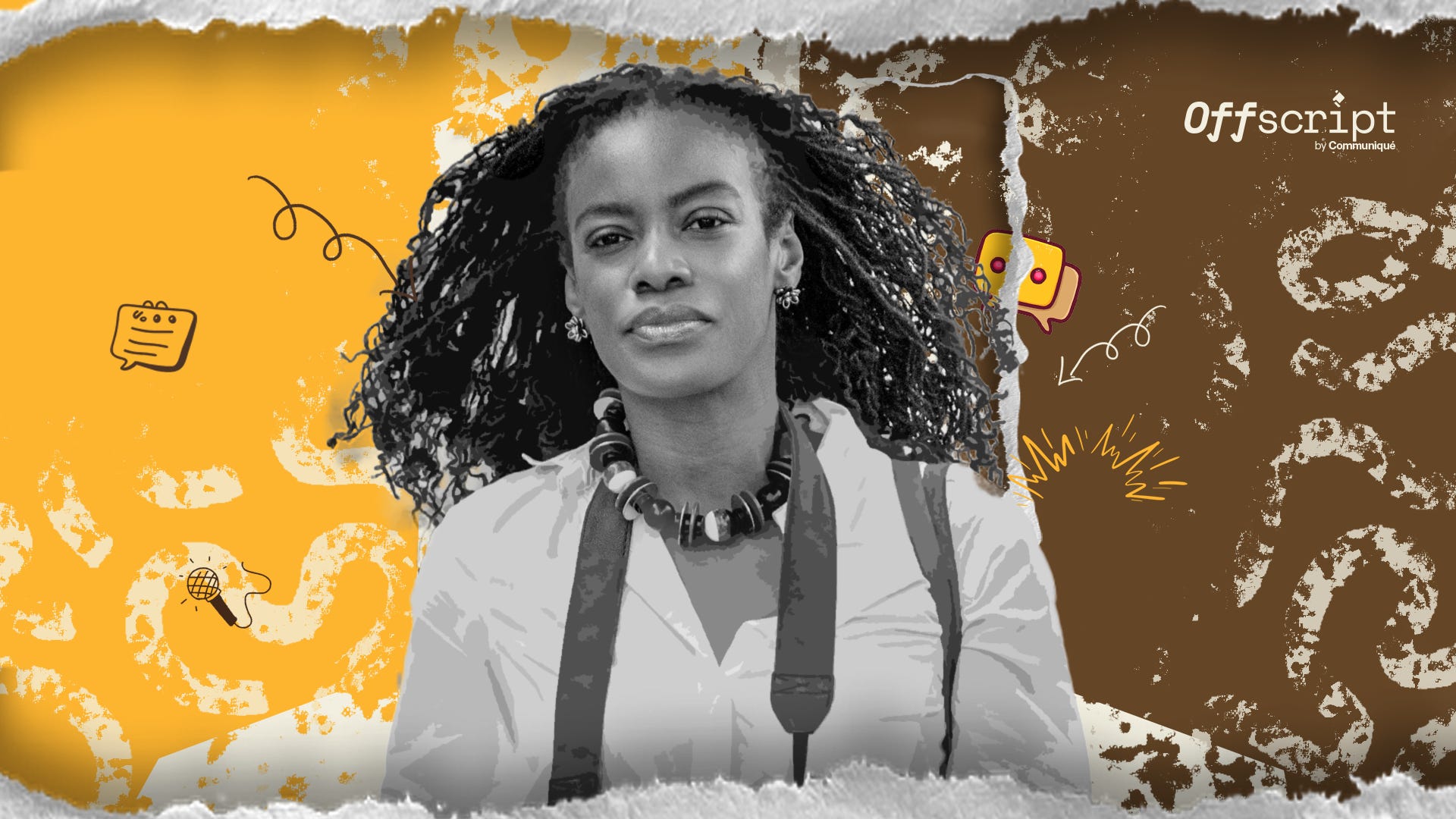
“The way I practice my journalism is to go as close as possible to the source. It’s an influence of my anthropological training, where we go into the field.”
In April 2014, that instinct took Chika Oduah to Chibok, a northeastern town in Nigeria.
Boko Haram had just kidnapped 276 schoolgirls from the Government Secondary School, and most articles being published about it were being filed from Abuja, Lagos, London, New York, or Washington. At the time, no journalists had actually gone to Chibok. An editor at The Guardian reached out to Oduah and asked if she could write something. She looked at the coverage and immediately saw the gap.
She had been attending the Bring Back Our Girls rallies in Abuja and had connected with a man from Chibok who had not been back to his hometown in years. He became her guide. They hired a car and drove fourteen hours north, through increasingly remote and deserted terrain, until they arrived. When they did, she crossed paths with Adam Nossiter, the New York Times correspondent, who had come the same day with politicians and a large entourage. Oduah had come differently. “I like to travel low-key,” she says. “Wear a hijab, speak my small Hausa, and just go.” A local businessman offered her a bed for the night. Before he left her to sleep, he pointed to a machete by the wall and told her to use it if she heard anything. She did not sleep easily. But she got the story.
It was not a one-off. The story of terrorism and its aftermath became a major thread running through her career, one she would return to again and again. But more than any single assignment, Chibok captures something essential about how Oduah works, and why she has spent years building a journalism practice that many of her peers in international media have never attempted.


For most foreign correspondents covering Nigeria and Africa, the job is done at a distance. Stories about the continent are filed from comfortable newsrooms, stitched together from wire copy and phone calls. Oduah has never seen the point of this. She has spent her career working with international media organisations while insisting on doing the reporting on the ground, where the story actually happens. That conviction made her turn her back on a career in the United States and move to Nigeria. It is what now guides her as she builds her own platform, ZIKORA Media & Arts African Cultural Heritage Organisation. To understand where it comes from, you have to go back to a small village on the banks of the River Niger.
Oduah was born in Ogbaru, a rustic community sitting on those banks, as the first daughter of her parents. Life in the village was busy and full of nature.
At two years old, she relocated with her family to the United States, settling in Georgia — a state that, with its sprawling greenery and slower pace, carried some of the same rural texture as the village she had left behind. As the first female child, she was expected to be many things at once. That sense of doing several things at the same time stayed with her. “I was raised to be a multitasker. It is why I wear many hats.”
But Georgia was not Ogbaru, and America was not home. Even as a child, Oduah felt the dissonance acutely. “I felt like a fish out of water,” she says. “The US was not for me. It was a country of corporate slavery and capitalism stripped of humanity. I saw all of this when I was about eight years old and told my parents I was not going to stay.”
Growing up, she was an inquisitive, creative child. She read, drew, danced, and wrote poetry. By her teenage years, she had started writing articles on current affairs. She had so many interests it was difficult to choose: fashion design, anthropology, fiction writing, activism. Her parents nudged her toward journalism. Her mother first suggested it, and her father convinced her she did not need to be on television to do it. She could write. That was all she needed.
At sixteen, Oduah walked into her first newsroom, The Atlanta Journal-Constitution, one of the most prestigious papers in the American Southeast. It was there that she began to understand what the craft demanded. She went on to study Journalism and Anthropology at Georgia State University, embracing the multimedia approach that was being pushed hard at the time — learning to write, shoot, edit video, record audio, and produce. It helped that CNN’s headquarters sat a few minutes from her campus. Inspiration was always within walking distance.
In those early years, the stories she wrote were almost always about immigrants and marginalised voices. After graduating, she got a spot in NBC News’s training program for early-career journalists. But before that, she had spent time in Kenya, working at K24: the country’s first twenty-four-hour news station, drifting from place to place doing documentary and feature work. It was her first real taste of on-the-ground journalism on the continent, and she loved every moment of it.
Back in New York, she joined Sahara Reporters as a creative director, helping build what was then an ambitious attempt at a pan-African television broadcast station. In 2012, she was accepted into Chimamanda Ngozi Adichie’s Farafina Trust Creative Writing Workshop, a recognition of the literary ambitions she had never fully set aside.
After she left Sahara Reporters, she decided to return to Nigeria. Her mother cried when she announced she was leaving the US, but her father was supportive. “He was like, that’s my girl. He always loved my go-getter spirit.”
In 2013, she moved to Abuja. The choice was deliberate; Al Jazeera had a permanent West Africa bureau in the city. She had been applying from the United States, but the emails and calls had not been taken seriously. When she showed up in person at the Abuja office, they finally understood she was serious and offered her a job as a producer for the West African region.
As producer, Oduah was responsible for everything: pitching stories to Doha, organising news teams, arranging fixers, conducting risk assessments, going into the field, helping to write scripts and edit the final product. The role of TV news producer, along with writing news stories for Al Jazeera’s website, took her across Nigeria and into neighbouring countries. She covered the farmer-herder conflict in the Middle Belt, the Benue massacres, and communities in the northeast living under the shadow of Boko Haram. “I have been able to travel across Nigeria more than people who have lived there their whole life.”


After leaving Al Jazeera, she worked as a freelance journalist covering West Africa for several international media organizations including Vice, Voice of America and France 24. It was during this period she found her way to Chibok.
In 2017, she moved to Senegal. The reasons were layered. The first was safety; her reporting on Boko Haram had made certain people unhappy, and she needed distance. The second was language; most West African countries are francophone, and she needed French to cover the region properly. The third was art. Senegal has a deep, living tradition of artistic practice, and she wanted to immerse herself in it.
But it was her frustrations with the international media industry that eventually pushed her to build something of her own. There was the outlet that planned to cover a Nigerian election without telling the only Nigerian on the team. There were the organisations that did not like her dreadlocks and wanted her to look a certain way on camera. And then there was a YouTube video of a Burkinabé mystic and spiritual philosopher named Patrice Malidoma, a man who had spent his life bridging African spiritual traditions and the Western world. In the middle of the video, Malidoma stopped and said, seemingly out of nowhere, that someone was listening who had not been brought to Africa to report on bad news, but to find solutions. Oduah got chills. Shortly after, she learned that Malidoma had died.
If Communiqué has shaped how you see the industry, return the favour. Every contribution keeps us accountable to you.
She started ZIKORA Media and Arts African Cultural Heritage Organization in 2023. The name means “show the world” in Igbo. “Africans still apologise for being African,” she says. ZIKORA is her attempt to change that, through journalism, literature, performance, and events.
Looking ahead, Oduah talks about ZIKORA the way a young reporter talks about her first big story: as something whose full shape she cannot yet see, but whose direction she is sure of. There is more of the continent to cover, more voices to find, but she wants those voices to speak for themselves.
It is the same instinct that put her in a car for fourteen hours to Chibok, that walked her into the Al Jazeera office in person. The instinct to go close, to go in person, and to show the world whatever she finds there.
Editor’s Note: This article has been updated to reflect corrections to names, titles, and contextual details.
My first time coming across this woman and her story. I am really touched and inspired ✨
POWERFUL