


1. A boom masking a quiet bust
By most measures, 2025 was a great year for Lagos-based publisher, Masobe Books. Sanya, a mythology fantasy novel by author Oyin Olugbile, won the prestigious NLNG Nigeria Prize for Literature, taking home its $100,000 prize. Of the 11 books longlisted for the prize last year, five were written by Masobe authors, reinforcing the publisher’s position as one of the most influential players in Nigeria’s resurgent literary scene. It was the kind of momentum that typically signals a publishing house in ascent: critical acclaim, industry recognition, and growing commercial returns. But when Othuke Ominiaboh, Masobe’s founder and CEO, sat down to review the company’s numbers for the year, they told a more complicated story.
Sales volumes were slipping. Masobe sold roughly 40,000 copies of its titles in 2025, down from nearly 60,000 the year before. Yet, paradoxically, revenue had reached an all-time high. On paper, the business looked healthier than ever. In reality, the foundation it depended on, an active, growing base of readers, was beginning to erode. “It looks like we are making more money right now,” Ominiaboh said to Communiqué. “But what do you think it will be in the next five years? Because that pool is going to keep shrinking, especially with our economic realities.”
That contradiction between rising revenues and a shrinking readership captures a deeper structural tension within Nigeria’s book industry. As inflation climbs and disposable income tightens, books are increasingly treated as discretionary spending, pushed further down the list of everyday priorities. For publishers, this creates a fragile equilibrium: higher prices may sustain revenue in the short term, but they risk accelerating the long-term decline in readership.
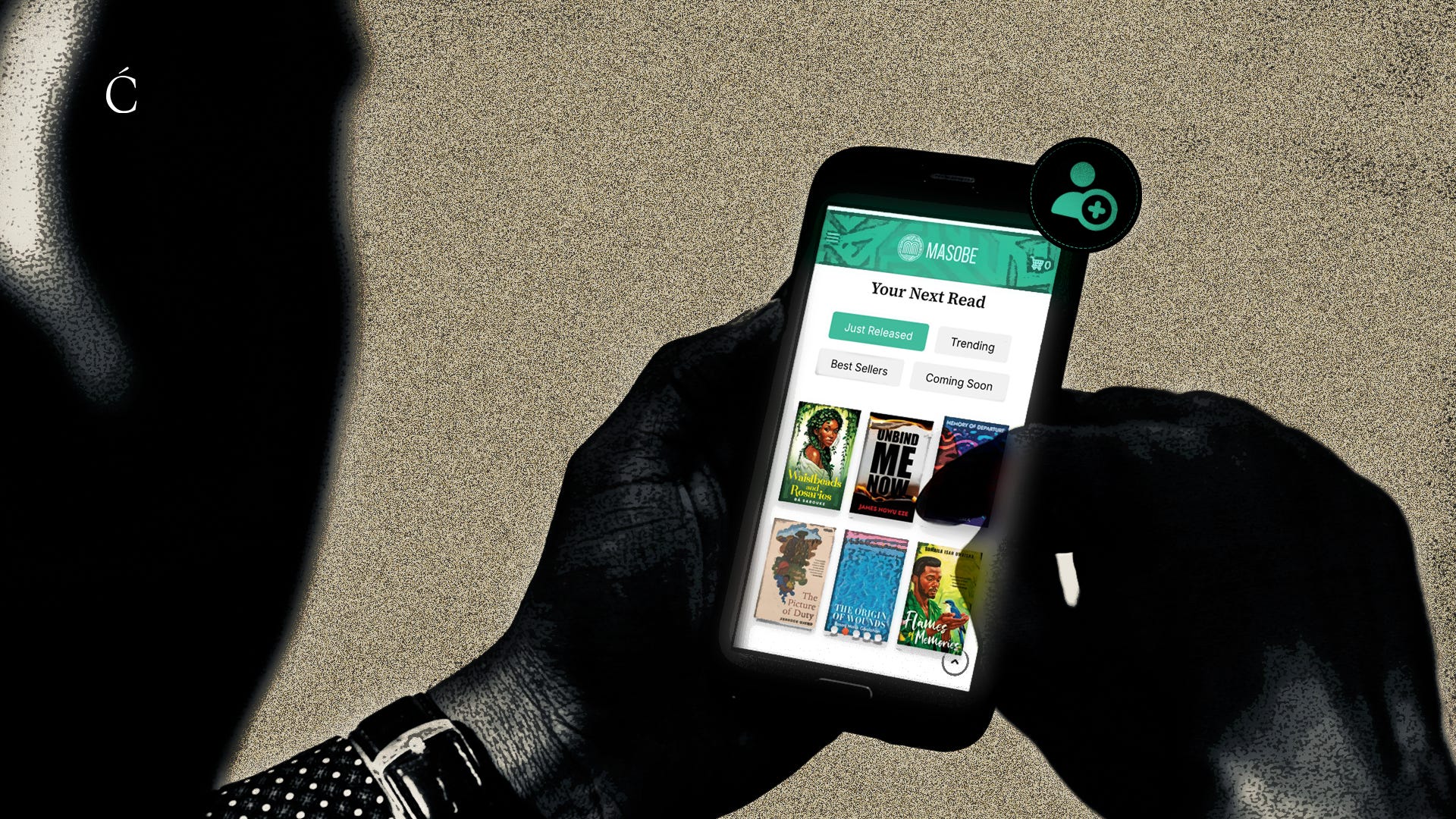
It is this tension that has pushed Masobe to experiment beyond traditional publishing. In late March, the company launched a subscription-based mobile app, offering readers access to its book catalogue, with audiobooks expected to follow. More than a new product, the app represents Masobe’s attempt to answer a question that has long haunted the Nigerian literary ecosystem: how do you build a sustainable reading culture and a viable business in an economy where books are increasingly becoming a luxury?
2. The making of Masobe
Masobe Books was built on the promise of expanding access to Nigerian stories. For Othuke Ominiaboh, that idea was deeply personal. Filled with a new zest for life after surviving a kidney transplant, he decided to self-publish his novels. But printing books was only half the problem; getting them into readers’ hands was the other half. Ominiaboh took matters into his own hands. He embarked on a cross-country road trip, physically distributing his books across Nigeria. Along the way, he encountered a pipeline of writers just like him, talented but unpublished. “I came across some very solid manuscripts, and it dawned on me there was a gap in the market,” he told The Guardian in 2025. Established publishers, he argued, “were looking outwards, not inwards”, focusing on reprinting titles already successful in Western markets while local writers struggled to get their voices heard.
That realisation became the foundation for Masobe. With a $7,000 loan from his sister, Ominiaboh set up the company, positioning it as a home for contemporary Nigerian fiction. In its early years, affordability was central to the model. Books were priced between ₦3,000 and ₦4,000, within reach for a growing base of urban readers. But the economics that made that model possible would not hold.
The cause of Masobe’s predicament is one shared by nearly every consumer-facing business in Nigeria. When the company launched, the naira traded at roughly ₦300 to the dollar. Today, it hovers around ₦1,400. For a business dependent on imported paper, ink, and printing equipment, the impact has been severe. Titles that once retailed for ₦3,000 now sell for ₦13,000 to ₦15,000. In a country where the national minimum wage is ₦70,000 a month, a single hardcover novel can cost nearly a fifth of a worker’s income.
The effect on readership has been predictable. Core audiences, such as students, have been priced out. In the vacuum, an informal market has flourished. On Telegram and other messaging platforms, pirated PDFs of Masobe titles are sold for ₦300 to ₦500, a fraction of the official price. Efforts to shut them down have proven largely ineffective. Yet, for Ominiaboh, piracy has also revealed something important: the demand for books has not disappeared but has shifted to where they can be afforded. The new Masobe app is his attempt to meet his audience where they are.
3. Middleground
The idea for the Masobe app had been gestating for nearly three years before it became a product. Initially, Masobe wanted a rental model, where users could pay to access a particular book for a limited period, but it eventually set that aside in favour of a subscription model. Ominiaboh is careful to frame the app not as a strategic pivot but as an additional distribution channel. “It’s like what we have with our books stocked at Roving Heights and other bookstores. The Masobe app is just another store.” However, this store is designed for a different customer; one who cannot afford to go to a Roving Heights store and who, without a cheaper alternative, might resort to illegal means to read books or simply not read at all.
The app launched with three subscription tiers. The entry-level tier costs approximately ₦1,999 and unlocks two books. The mid-tier, at around ₦3,999, gives access to four to five titles. The top tier, priced at roughly ₦5,999, opens the full catalogue, subject to a cap of 15 titles in a user’s library at any one time. The prices are not yet set in stone, as the publisher is still monitoring what the market can bear.
Author compensation is designed to mirror traditional sales. Each time a subscriber adds a book to their library, a fixed amount, between ₦500 and ₦1,000, depending on the title, is credited to the author’s account as a royalty-generating transaction. Masobe’s existing contracts with authors already included e-book and audiobook rights, so there was no need to renegotiate rights before the launch.
If you like what you’re reading and find it useful, consider supporting Communiqué with a donation.
4. Beating the ghost of OkadaBooks
Any discussion of digital reading in Nigeria must eventually reckon with OkadaBooks, the platform that came closest to cracking the market before shutting down in November 2023, citing rough economic conditions. At its peak, OkadaBooks had approximately 400,000 active readers and a catalogue of around 40,000 original books. Its closure has since hardened into a cautionary tale, cited as evidence that subscription models cannot work in Nigeria and Africa at large, that consumers, as the conventional wisdom goes, will not pay for digital content. Subscription streaming platforms have also struggled to survive on the continent, with Canal+-owned Showmax becoming the latest casualty in March this year, further reinforcing the narrative.
But Masobe is not trying to be the Netflix for African books. It is attempting something more pragmatic: an online bookstore for underserved readers priced out of physical books. Its internal benchmark reflects that restraint. Ominiaboh says the business can break even at around 15,000 subscribers, a fraction of Okada Books’ peak. Yet the ambition is still expansive. In a best-case scenario, Masobe aims to reach the 400,000-user ceiling. The gap between those two numbers—survival at 15,000, and scale at 400,000—is where the model will be tested.
For Masobe’s subscription app to be sustainable, three things have to hold. First is pricing discipline. The app works because it collapses the cost barrier that has pushed readers towards piracy. At roughly ₦1,000 to ₦6,000 per month, it reframes books from a high-ticket, one-off purchase into a recurring, lower-stakes expense. But that balance is delicate. Price too high, and it replicates the exclusion of print. Price too low, and it struggles to cover author payouts and platform costs.
Second is catalogue strength. Unlike streaming platforms that rely on sheer volume, Masobe’s advantage lies in curation. Literary prizes and critical acclaim have already validated its catalogue, but that alone will not be enough to sustain a subscription product. A closed catalogue limits choice, and choice is central to how users perceive value in subscription models. Also, to compete with piracy, where readers can access a wide range of titles across publishers, Masobe needs breadth as much as depth. That means bringing other publishing houses onto the platform, expanding beyond its own imprint to offer a more comprehensive digital bookshelf. The company is already in talks with local publishers to make this possible. If it can pair its curatorial strength with a broader catalogue to offer books that readers feel compelled to seek out, it can create a pull strong enough to convert even reluctant subscribers.
Third is distribution behaviour. The app’s success depends less on converting existing bookstore customers and more on capturing the shadow market currently served by piracy. This is where its model diverges from OkadaBooks. Rather than betting on discovering new readers at scale, Masobe is targeting existing readers who transact informally. If the app can offer convenience and reliability, it stands a better chance of shifting that behaviour.
Masobe is not the only platform exploring new distribution models for African literature. Storipod, a microblogging platform that serialises stories in the form of social media stories, is also rethinking how literature is consumed and monetised. Its model seeks to expand access to African literature by allowing readers to unlock books chapter by chapter. Once accessed, chapters remain in a user’s digital library. On Monday, Storipod announced a deal with Narrative Landscape Press to publish books by Chimamanda Ngozi Adichie on its platform, alongside works by Chude Jideonwo, Adorah Nworah, Pede Hollist, Suyi Davies Okungbowa, and Nikki May.
Taken together, these experiments point to a broader shift in how African literature is being packaged, priced, and distributed, less as a static product, and more as a flexible, mobile-first experience shaped by the economics of attention and affordability.
The Masobe app recorded 5,000 downloads in its first week, an early signal that it may be tapping into a real, if underserved, demand. The challenge now is retention: turning those downloads into paying, repeat users. Masobe is attempting both a product experiment and a bet on behaviour change. If it succeeds, it could begin to redraw the economics of publishing in Nigeria.
Really hope that Masobe becomes a success - much needed for ecosystem of unpublished authors and hungry readers. They should consider partnering with universities, since one of their main audiences are students.
Really informative piece, this. Bravo!