


1. Dave sets the stage
Over the weekend, British-Nigerian rapper Dave ended his The Boy Who Played the Harp tour with two shows in Lagos. The concerts, held on October 16 and 17 at the Wole Soyinka Centre for Arts and Culture, also featured appearances from Burna Boy, Zaylevelten, and Oxlade. The tour made 39 stops across Europe, North America, and Australia before arriving in Africa, where Dave first performed in Pretoria and Cape Town before wrapping up in Lagos. Live Nation presented the African leg of the tour alongside Nigerian concert promoter MASSIVE Dynamics, offering a useful glimpse into Live Nation’s approach to the African market.
Live Nation has operated on the continent for years. Its strongest presence is in South Africa, where its subsidiary Big Concerts has spent decades promoting international tours. The company has also produced global tours for African artists including Burna Boy, Wizkid, and Davido. But over the past few years, its activity on the continent has become more structured.
In June, Live Nation appointed Daniel Noake as Vice President of Market Development for Sub-Saharan Africa, giving the company dedicated leadership for the region. “We’ve been working in Africa for a while now,” Noake told Communiqué. “The only change is that we’ve just put dedicated leadership now around venues, sponsorship, ticketing, and touring.”
The appointment suggests that Live Nation is thinking beyond individual concerts. It is trying to build the infrastructure and relationships that could make more African cities regular stops on global tours, while using the same network to help African artists reach audiences elsewhere. The question is whether it can build that kind of business across African markets that remain very different in their infrastructure, economics, and readiness for large-scale touring. The company has faced this challenge elsewhere. Across Latin America and Asia, Live Nation expanded gradually, working with local promoters, investing in ticketing and venues, and building country-level operations over time. Africa is much earlier in that process, but Live Nation is beginning to lay the groundwork.
You’re reading Communiqué because someone in the Inner Circle paid for it. Pay it forward. Your contribution funds: Original reporting, data licensing, and a small editorial team that actually answers your replies. No ads, no paywalls.
2. A familiar playbook
By the mid-2010s, Live Nation had begun a more visible push into markets beyond its established businesses in the United States and Europe. Africa was part of that expansion. In 2016, the company acquired a controlling stake in South African promoter Big Concerts. The deal followed the same pattern Live Nation has used elsewhere. Rather than enter a market and immediately build a new operation from scratch, it often starts by working with an existing local promoter, then increases its involvement over time.
The reason is practical. Concert promotion depends heavily on local knowledge. Promoters need to know which venues work, which artists can sell tickets, what audiences will pay, which suppliers to trust, and how to navigate relationships with regulators, sponsors, and security providers. Live Nation’s role is to provide relationships with international artists, access to capital, and experience moving shows across markets, while the local operator brings on-the-ground knowledge of how the business works.
In several countries, Live Nation has started with a partnership before moving to deeper ownership. In Japan, it formed a joint venture with promoter Creativeman in 2012 and bought out its partner two years later. In Thailand, it formed a joint venture with BEC-Tero in 2015 before acquiring its concerts and entertainment division in 2022. In the Philippines, it worked with promoter MMI for years before acquiring the company in 2022. In each case, existing management remained important to the business.
Latin America shows the same pattern, but on a larger scale. In 2014, Live Nation acquired a controlling stake in C3, the American promoter that owned the popular Latam music festival Lollapalooza. In Mexico, Live Nation bought a 51% stake in OCESA in 2021 and increased it to 75% in 2025. In Argentina, it acquired a majority stake in DF Entertainment, the promoter of Lollapalooza Argentina, in 2018, but it didn’t move into venue ownership until years later, taking a majority stake in Movistar Arena Buenos Aires in 2026.
That sequence is important. Live Nation does not always enter a market with ticketing, venues, sponsorship, and promotion already in place. Those parts often come in at different stages. In Asia, for instance, Live Nation had already spent years building concert operations before Ticketmaster made a bigger push into the region in 2020. Venues have tended to come later, once the company has enough evidence that a market can support a regular flow of events.
The same structure can also help move local artists outward. In Japan and Thailand, Live Nation’s local operations eventually became useful not only for bringing in foreign acts, but for taking local acts into other markets. More recently, it has used a similar approach in Latin America, acquiring a majority stake in Dale Play Live to strengthen its ability to promote local and regional artists.
$10 covers a reader. $100 covers a story. $1,000 covers a month. Communiqué is built on direct support from people who believe Africa’s creative economy deserves serious coverage.
3. Replicating the playbook in Africa
Big Concerts gave Live Nation its first substantial base in Africa. Since the 2016 acquisition, the South African promoter has continued to bring major international acts to the country, including J. Cole, Ed Sheeran, Imagine Dragons, and Doja Cat. Live Nation has since begun adding other parts of the live entertainment business around that base.
Ticketing is one example. In 2024, Ticketmaster acquired Cape Town-based Quicket, which already operated in Nigeria, Uganda, Kenya, Zambia, and Botswana. Quicket remained a standalone business after the deal, giving Live Nation a ticketing foothold in markets where its concert promotion business was much less developed.
But Noake says the company does not expect the South African model to transfer neatly elsewhere. Instead, it is assessing countries individually and deciding which part of the business makes sense in each one. “It’s very much a deep market assessment of where we can add real value and support existing local businesses and the live economy through some of the skills and experience and resources that we have internally,” Noake told Communiqué. “And how is that going to create a long-term platform for not just us, but for the entire live music economy within a country?”
That has meant working with different partners for different purposes. In 2021, Live Nation launched a joint venture with Nigerian promoter Duke Concept, which had already built a business touring African artists including Burna Boy, Wizkid, and Davido in North America. Under the arrangement, Duke Concept promotes independently and handles production and logistics, while Live Nation provides operational support and access to its venue network.
Live Nation is also beginning to add venues to its African blueprint. In 2025, it opened the 10,500-capacity Dome in Johannesburg in partnership with Stadium Management South Africa and Gearhouse South Africa. As part of the partnership, Live Nation brought in international experts to train the venue’s staff. “It’s pointless having a fantastic piece of infrastructure if you don’t have a top-end venue operations team,” Noake told Communiqué. “So we brought some of our global experts to provide training around crowd management, security, and production.” In Lagos, Live Nation is also one of several partners, alongside Persianas Group, the Nigeria Sovereign Investment Authority, and Oak View Group, developing a 12,000-capacity arena that is expected to become operational in Q4 2028.
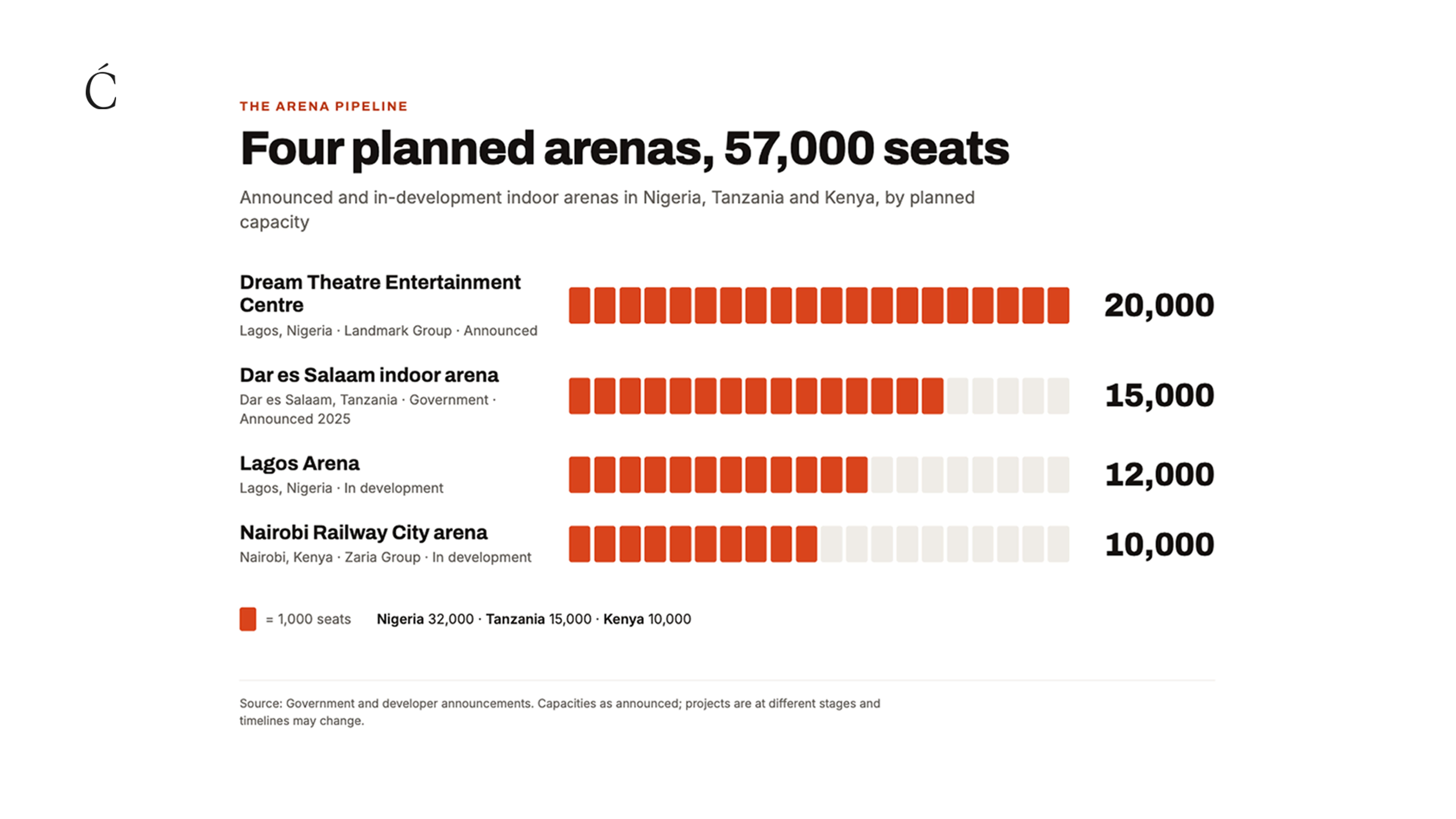
The live entertainment sector is heating up across the continent. Governments and private investors are investing in new arenas designed to attract concerts, sports, and other large events. In Tanzania, President Samia Suluhu Hassan announced plans in 2025 for a 15,000-capacity indoor arena in Dar es Salaam. In Kenya, Zaria Group is developing a 10,000-capacity arena as part of the Nairobi Railway City project. Nigeria has its own growing pipeline. Alongside the 12,000-capacity Lagos Arena, Landmark Group has announced plans for a 20,000-capacity Dream Theatre Entertainment Centre in Lagos.
As more of these projects come onstream, Africa could have considerably more capacity to host large international tours and sporting events. More promoters, venue operators, and investors will also look for events capable of filling those rooms. But large arenas solve only one part of the problem.
For a live entertainment market to develop sustainably, artists also need places to perform before they can sell 10,000 or 20,000 tickets. That means clubs, theatres, and mid-sized venues where local acts can build audiences and promoters can take smaller risks. “We want to grow local artists from a thousand-cap venues, club venues, maybe even smaller, into 5,000-cap venues, then 10 to 12,000-seater arenas and then onwards,” Noake told Communiqué.
That may ultimately be the harder part of Live Nation’s African expansion. The company has already found a base in South Africa, added ticketing, begun working with promoters across different markets and joined new venue projects. But building a touring circuit goes beyond a handful of large arenas. It will require enough venues, promoters, and audiences at different levels and in different cities to allow artists to move from one stage to the next, and enough African cities where tours can stop repeatedly. For Live Nation, the long game in Africa will depend on whether those individual markets can eventually connect.
