


1. Flipping the year-end playbook
At the end of every year, most media platforms begin a familiar dance. They publish lists: best this of the year, most popular that of the year. These lists are editorial rituals designed to celebrate achievement, measure impact, and, in some cases, shape legacy. The format is predictable, almost ceremonial: a neat packaging of the past twelve months into digestible rankings of success.
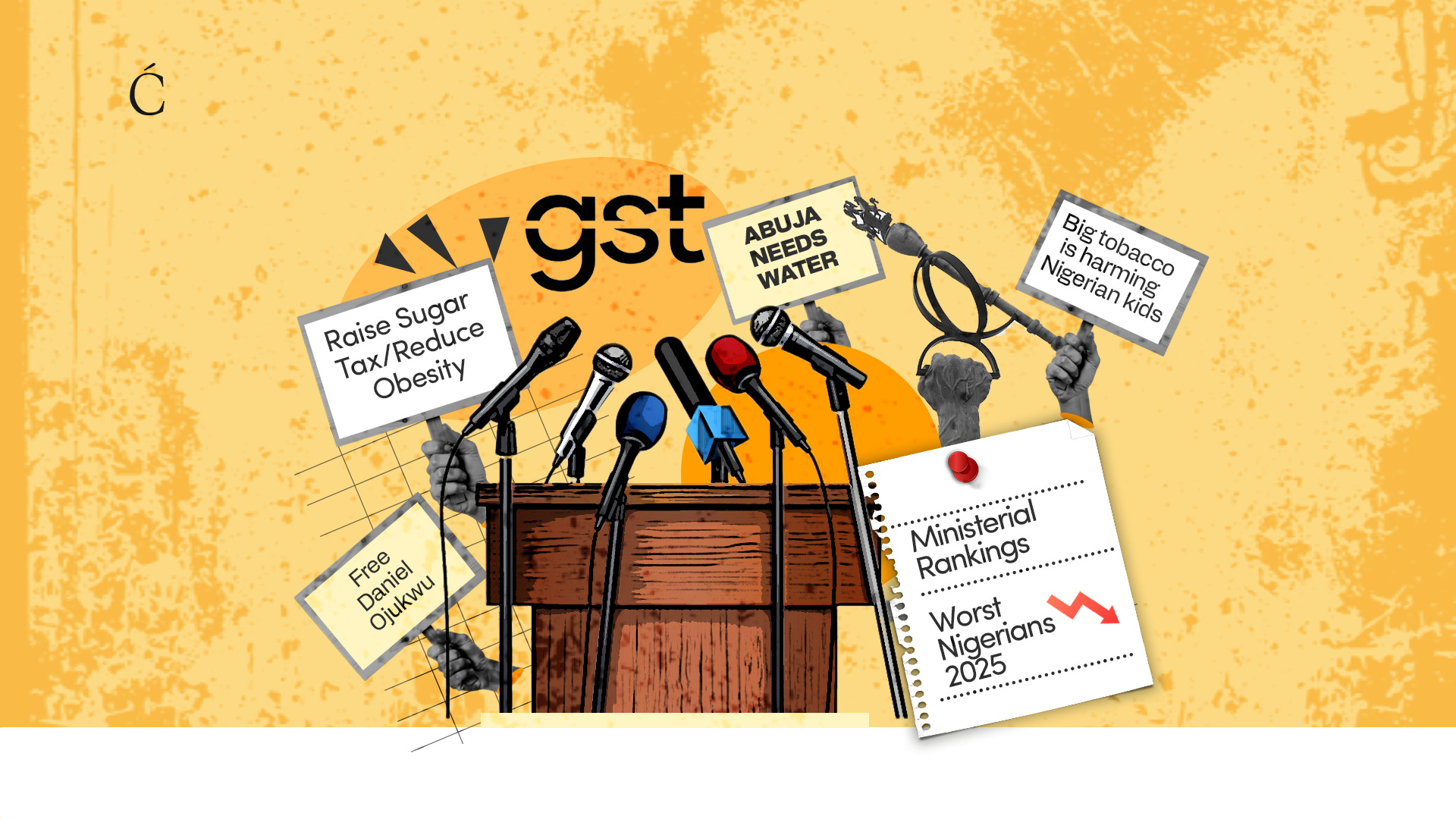
But GST (pronounced ‘gist’) decided to do something different. At the end of 2025, the politics and civic engagement media platform released its “Worst Nigerians of the Year” ranking, an unflattering roll call that has become an annual tradition since its 2024 debut. The first edition focused largely on politicians and public office holders, including President Bola Ahmed Tinubu and former Inspector General of Police Kayode Egbetokun, reflecting the platform’s emphasis on governance and accountability.
But in 2025, the list evolved. It became broader, more culturally attuned, and arguably more provocative. Alongside political figures were names drawn from Nigeria’s entertainment and digital public sphere, among them Grammy Award-winning artist Burna Boy, cited for “assaulting a fan”, and social commentator Martins Vincent Otse, popularly known as VeryDarkMan, criticised for his style of activism that “thrives on drama, visibility and opportunism rather than principle”. The Worst Nigerians list was controversial by design. But more importantly, it was instructive. And this is the essence of GST: an attempt to reimagine what media can do for young Nigerians, not just to inform or entertain, but to call out, mobilise, drive policy change, and shape public behaviour in real time.
2. Making politics cool again
If GST feels like a response to something broken, it is because it is. The 2015 general elections marked a turning point in Nigeria’s civic life. For perhaps the first time in decades, a large base of young Nigerians became politically engaged, mobilised by the promise of change and the possibility of unseating an incumbent government. The eventual victory of the opposition felt like proof that civic participation could translate into real outcomes. But the years that followed told a different story.
As the promised transformation failed to materialise, that early enthusiasm gave way to disillusionment. By 2017, a growing sense of apathy had set in, particularly among young people who had once been at the forefront of political conversations. Organisations like Yiaga Africa, trying to fix the problem, launched campaigns such as Not Too Young To Run, pushing for structural reforms to lower the age barrier to political participation and encourage younger candidates to contest for office. But Adewunmi Emoruwa, CEO and founder of Gatefield, approached the problem from a different angle. He asked: “What would it take to get young people to care again?” His answer was a media platform.
“We were going to try and make sure that the news is delivered in a very clear way using content creator approaches, tools from advertising and marketing, and behavioural science, to make politics really cool for people to follow,” Emoruwa said to Communiqué.
In 2017, GST began as Gatefield TV, a pop culture-focused YouTube channel with a sprinkle of politics. Its thesis was that politics could be made more engaging if embedded in the language of pop culture. The format leaned heavily on creator-style content: conversations, lifestyle segments, and social commentary. It worked, just not in the way they expected. Audiences came for the culture, but not necessarily for the politics. Over time, it became clear that the model risked drifting into the very thing it was trying to avoid: another lifestyle media brand competing for attention in an already crowded space. So Gatefield pulled back.
At the same time, the Nigerian media space was growing more repressive. Newsrooms were increasingly entangled with corporate and political interests, shaping not just what was reported, but how it was framed. For journalists who resisted, the consequences could be severe, ranging from imprisonment to harassment.
Gatefield had, up until that point, maintained an investigative journalism fund to support reporters carrying out accountability-driven work. But in 2020, during the End SARS protests, the Federal Government froze the fund. It was a pivotal moment. What had been a structural challenge became an existential one. For Emoruwa and his team at Gatefield, the implication was clear: if independent journalism could be constrained so directly, then relying solely on existing media institutions was no longer viable. They would have to build something they could control, both in philosophy and in execution.
“We said if every other organisation will be controlled, then we probably need to invest in the ecosystem of independent journalism, and then, secondly, we need to invest in something that we have control over; this platform will not be for sale to private or government actors,” Emoruwa said.
As a result, GST does not accept advertisements; its funding has come primarily from a grant by the National Endowment for Democracy, but in recent months, it has launched a crowdfunding campaign.
3. Building an advocacy media platform
The new GST was launched in 2022. This time, it returned to its politics and civic engagement roots. Instead of building around a central website as a distribution channel, GST was designed as a social-first media platform—native to the spaces where young Nigerians already spend their time. Its presence was built across platforms like X, Instagram, and YouTube, with no real dependence on a traditional website. GST recognised a structural shift in how content was being consumed. “One of the theses we had with GST is that people are not going to websites anymore,” Chiamaka Dike, GST’s former editor, said to Communiqué. “You’re getting less traction on your stories on websites. So instead of wasting time building a website, why don’t we just put everything on social media?”
But more important than where GST showed up was how it showed up. From the outset, the platform rejected one of journalism’s most enduring norms: strict neutrality. Instead of simply reporting events as they happened, GST made a deliberate decision to editorialise, to interpret, contextualise, and take positions. “We are not going to be strictly bound by the entire idea of objectivity. So we are going to editorialise from the start. We’re going to give people the truth,” Emoruwa said.
In practice, this means connecting policy decisions to lived realities, for example, showing how inflation figures translate into the cost of living, or how monopolies shape everyday consumption. It also means choosing not to “platform” political actors in ways that could enable misinformation or manipulation.
The result sits uneasily within traditional media definitions. GST operates like a media platform in its distribution, but like a movement in its intent, a hybrid model that blends journalism, advocacy, and community into a single system. Or, as Emoruwa puts it: “We think of ourselves as a news movement of sorts, but really, it is a sort of social justice community.”
Beyond just storytelling, the engine of the “GST news movement” is campaigning. Every piece of content is a potential trigger for action. Where a traditional newsroom might stop at publishing a headline, say, a proposed tax increase, GST goes further, interrogating the underlying implications, particularly where they intersect with rights, policy, or everyday life. Those insights are then translated into coordinated campaigns.
One example is the “Reject Tax Scam” campaign, where GST’s deeper reporting on tax provisions surfaced concerns that had previously gone unnoticed. What followed was not just coverage, but mobilisation, petitions, public debate, and direct government responses.
The pattern is consistent: story → campaign → pressure → response.
In this model, journalism is the starting point of a process designed to convert attention into action, and, ultimately, into change.
What Gatefield has built with GST is an attempt to redesign the relationship between information and participation. In a landscape where attention is fragmented and trust in institutions is low, GST is betting that the future of civic engagement will not be driven by access to information alone but by the ability to translate that information into coordinated action.
That model, however, comes with trade-offs. By choosing to editorialise, to campaign, and to take positions, GST departs from the conventions of traditional journalism and steps into a more contested space, one where influence, advocacy, and accountability intersect. But this is precisely where GST’s advantage lies. In a media system which largely focuses on documenting events, its decision to take positions enables it to convert attention into pressure, and pressure into outcomes.
In the end, GST is asking a different question of the media in Nigeria: not just what people need to know, but what can they be moved to do?
Last paragraph. I’ve found their penchant for taking the sensational and campaign route interesting. There’s a tendency to misrepresent facts and get things wrong for the purpose of painting a narrative when a media organisation takes that route. Now if we can’t wholly trust journalism in this political clime and AI times. What then is the end goal ?
I love GST's approach. Defying conventions and norma is important due to the way the nation is being run. I am rooting for them, and hope that they don't go off the track.