


1. When two elephants fight
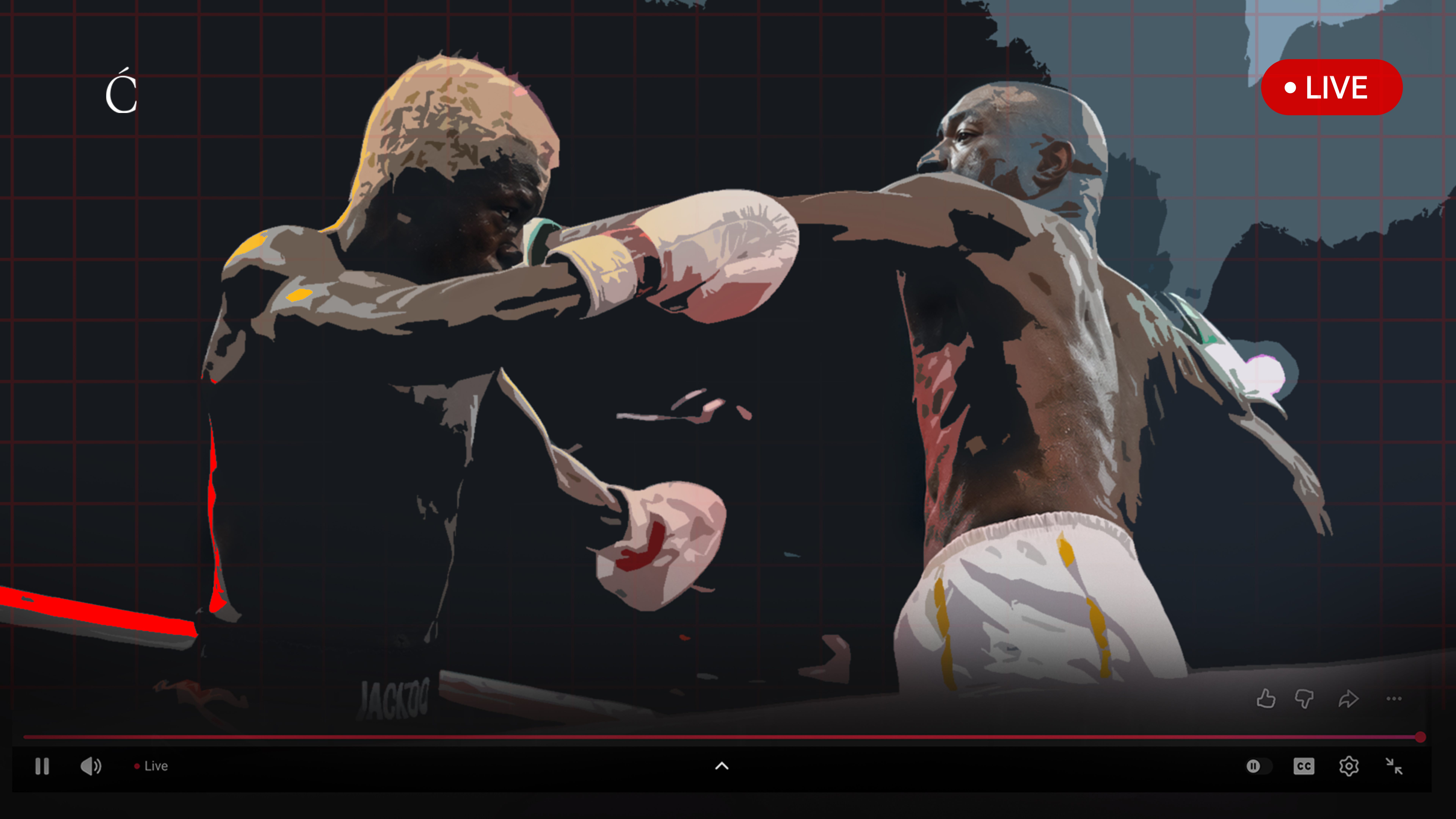
On May 1, Nigerians were treated to an unlikely sporting spectacle: a boxing match between content creator Oderhohwo Joseph Efe, popularly known as Carter Efe and musician Habeeb Badmus (stage name: Portable). After three rounds of comical chaos, Carter Efe emerged victorious with a 30–27 decision.
The bout was the centrepiece of a larger fight card featuring local and international fighters competing in the cruiserweight division. Organised by Balmoral Productions in partnership with Amir Khan Productions, the event carried many of the trappings of a professional boxing night: weigh-ins, promotional tours, celebrity appearances, and a paying audience eager for spectacle. Sports streaming platform DAZN streamed the match live, highlighting how combat sports are becoming part of the company’s broader push into Africa. In 2025, DAZN signed a global broadcasting agreement with traditional wrestling promoter African Warriors Fighting Championship to stream Dambe, a centuries-old combat sport popular across northern Nigeria, as part of efforts to deepen its footprint on the continent.
According to Ezekiel Adamu, chief executive of Balmoral Productions, the fight night cost roughly ₦1.3 billion ($935,000) to organise and generated nearly one billion views globally across streaming and social media platforms. Yet the significance of the event extended beyond the ring itself. Clips from the fight quickly spread across TikTok, Instagram, and X, dominating online conversations long after the fight ended. For many viewers, the appeal was not technical boxing ability but the collision of two internet personalities whose brands ride on controversy, humour, and spectacle.
The Carter Efe–Portable fight reflects a broader shift occurring across global sports and entertainment. Increasingly, creators, influencers, and internet-native celebrities are moving into sports not merely as commentators or sponsors, but as athletes. What began as novelty entertainment has evolved into a commercial strategy aimed at capturing one of the few things still scarce in the digital economy: live audience attention.
2. The fight that changed sports
The modern creator-athlete era arguably began in 2018 with a boxing match between British YouTuber Olajide Olatunji, better known as KSI, and his American counterpart, Logan Paul, in the UK. Initially dismissed as internet gimmickry, the match went on to become one of the most-watched boxing events that year, with 1.8 million viewers watching live and more than 38 million replay views across both creators’ YouTube channels. But beyond the numbers, the event revealed something more profound: creators could generate sports-level audiences without relying on traditional sporting institutions.
At the same time, traditional sports viewership among younger audiences had been steadily declining. Across major markets, younger fans were increasingly abandoning cable television and conventional sports broadcasting in favour of digital platforms built around creators, livestreams, and short-form content. Creator-led sports events succeeded because they adapted naturally to these changing consumption habits. Unlike traditional sports broadcasts, which often rely on institutional loyalty built over decades, creator sports are personality-driven, interactive, and internet-native. Audiences are not merely watching a match; they are following an ongoing storyline shaped by online rivalries, memes, fan communities, and parasocial relationships built over years of content creation.
Combat sports proved especially suited to the creator economy because they already relied heavily on spectacle, personal narrative, and rivalries. All these, coupled with an engaged fan base and the promise of live drama, were often enough to generate commercial interest. Also, with boxing and wrestling, creators could independently participate without the structure of a team. Following the success of KSI vs Logan Paul, other creators, including Jake Paul, Deji Olatunji and Tommy Fury, followed suit.
But the trend has not remained limited to individual combat sports. Team sports such as football and basketball have increasingly begun adapting to the creator-athlete era by building alternative leagues and entertainment formats designed specifically for digital-native audiences. One of the most prominent examples is the Kings League, launched in Spain in 2022 by former Barcelona defender Gerard Piqué alongside popular streamers, including Ibai Llanos. Combining seven-a-side football with livestreaming, fan voting, creator-owned teams, and unconventional rules, the league quickly attracted millions of online viewers and younger audiences largely disconnected from traditional football broadcasting. In late 2024, the league raised $63 million to expand into the UK and the US, bringing the total investment to $163 million.
A similar model emerged in Germany with the Baller League, founded in 2023 by entrepreneur Felix Starck and former footballers Mats Hummels and Lukas Podolski. The six-a-side indoor football competition blends professional players, retired athletes, and creators into short, high-intensity matches optimised for social media and livestream consumption. The Baller League has raised $25 million, with investors including Apex Capital, EQT Ventures, 885 Capital* and footballers Diogo Dalot and Mason Mount.
Upstart creator leagues are not the only ones embracing this shift. Traditional sports institutions have also begun adapting to the creator-athlete era to reach younger digital audiences. In 2021, the NBA launched the NBA Creator Cup, a basketball event featuring popular content creators and influencers competing during All-Star Weekend.
3. A league ahead of its time
Long before Nigerian creators began dabbling in primetime sports, a group of friends saw an opportunity to build a football league primarily on the back of social media relationships and interactions. That competition, now defunct, was called the Twitter Premier League (TPL).
Founded in 2014 by Efe Ori-Jesu, the TPL began as a challenge to Nigerian Twitter users who constantly debated football matches on Twitter, now known as X. Instead of arguing online, popular social media personalities were invited to prove themselves on the pitch. The league quickly gained momentum online, with matches drawing large crowds and regularly trending on Nigerian Twitter. Teams cultivated strong online identities, organised photo shoots, engaged fans on social media, and secured sponsorships from brands including Samsung and Smile Nigeria. Matches evolved into entertainment events featuring DJs, livestreams, and food vendors.
In many ways, the TPL anticipated the logic behind today’s creator-led sports leagues, building audience loyalty through community ownership and participation. Although the league generated significant buzz at its peak, the organisers struggled to sustain the operational demands to keep the project long-term. By the late 2010s, the TPL had ceased to exist, but it provided one of the earliest examples of an internet native sports community, foreshadowing many of the creator-led sports models now emerging globally.
If Communiqué has shaped how you see the industry, return the favour. Every contribution keeps us accountable to you.
4. A new playbook for Nigerian sports
Once again, the creator-athlete trend is emerging in Nigeria and, in line with global patterns, is beginning with combat sports. The fight with Carter Efe was the third creator-boxing event involving Portable, who previously defeated Nollywood actor Charles Okocha and musician Speed Darlington in earlier bouts. But as seen internationally, creator involvement in sports is unlikely to remain confined to boxing and wrestling. Over time, the trend could expand into football, Nigeria’s most popular sport, potentially creating a new framework for engaging with local sports culture.
In Nigeria, football fandom and attention remain overwhelmingly oriented towards European leagues such as the English Premier League, La Liga, and the UEFA Champions League. While local clubs struggle to command sustained national interest, the Super Eagles, Nigeria’s national team, remain one of the few sporting institutions capable of generating nationwide emotional investment. This imbalance has long reflected broader issues around marketing, media visibility, and audience engagement within domestic sports.
In a version of the future, creator-led sporting events could offer an alternative pathway. Rather than attempting to replicate traditional league structures, creators could build internet-native sports ecosystems tailored to younger Nigerian audiences who already consume sports through social media, livestreams, and creator-driven content.
Should this shift happen, what will emerge is an internet-native ecosystem fundamentally different from the structures that currently define Nigerian sports. Rather than relying on traditional federations, television broadcasters, or legacy systems, creator-led sports will be built primarily for digital consumption: livestream-first competitions, short-form highlights engineered for TikTok and Instagram, interactive fan communities on WhatsApp and X, and personalities functioning as the central drivers of audience loyalty.
In practice, this will mean creator-owned football teams competing in short-format tournaments streamed on YouTube, celebrity five-a-side leagues sponsored by betting and fintech companies, or combat sports cards where the promotional narratives unfold online weeks before the event itself. The matches will then become one part of a broader entertainment cycle that includes podcasts, training content, livestreams, online feuds, fan voting, and creator collaborations. Attention, rather than athletic pedigree alone, will increasingly determine commercial value.
The model is already visible globally. The Kings League transformed football into an internet-native entertainment product by combining creators and unconventional rules with livestream distribution. Similar experiments are now emerging across basketball, motorsport, and combat sports, where digital engagement often matters as much as broadcast reach.
Over time, the distinction between creators and professional athletes will begin to erode. Traditional athletes are increasingly recognising that creator-led sports properties offer access to younger audiences. In December last year, Nigerian-British heavyweight boxer Anthony Joshua knocked out Jake Paul in the second most-watched boxing match that year.
Nigeria’s sports economy will ultimately follow the same trajectory. What currently appears experimental or comedic will evolve into a parallel sports economy, one where creators function not just as entertainers, but as promoters, broadcasters, and sporting institutions in their own right.
*Disclosure: 885 Capital is a client of Communiqué Advisory, Communiqué’s strategy and consulting arm.
Editor’s note: The article has been updated to accurately indicate Anthony Joshua’s opponent.
I love boxing, but when Jake Paul fought Anthony Joshua, it made no sense. I struggled to understand how Paul, a powder-puff fighter, could challenge Joshua, a hard-hitting former heavyweight champion. After they fought, I knew things were changing. I saw Joshua/Paul thing happening with Efe and Portable, celebrity matchups. Your article made sense of this trend. The fact that your write-up extended the phenomenon into football makes it a very valuable piece. Thanks for broadening our mind on the creator economy.