


1. The dawn of a new era
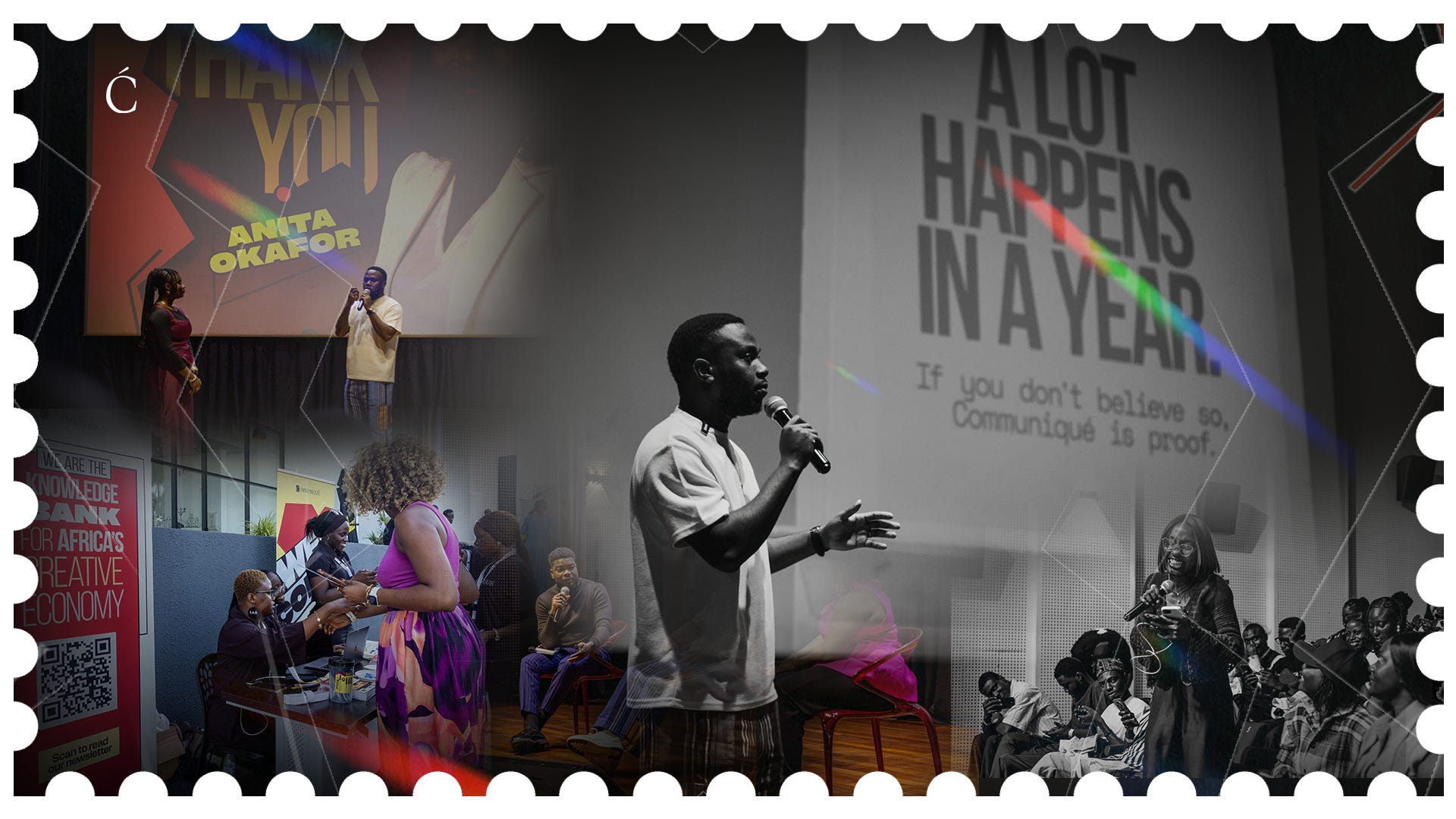
On Friday, March 20, we hosted our most important event yet. Over a hundred people joined us at the Mike Adenuga Centre, Ikoyi, for the second edition of Communiqué IRL Lagos.
We kicked things off with a rundown of all we’ve been up to in the last year—expanding our media products, taking our events to Nairobi and Johannesburg, and formally launching our advisory and intelligence business that has seen us work with Expertise France, Sporty Group, the National Council of Arts and Culture, and 885 Capital, among others.
That presentation was followed by a special moment of recognition, where we surprised one of our most active community members, Anita Okafor, with a gift.
Then we had a panel discussion, which I participated in with Fisayo Fosudo, one of Africa’s most influential YouTubers. Gloria Edukere, our chief of staff and advisory business lead, moderated the conversation, which revolved around “The Creator’s Lifecycle.” It was full of gems and practical insights for creators looking to build businesses and careers that last longer than fleeting virality. Ask anyone who attended, and they’ll say the same thing.
Among all these amazing moments, however, we announced something that we had been working on for the last year. We’d hinted at it a few times in the past, but never fully articulated it until now. It completely changes our company’s trajectory and signals our entry into a new phase. We are confident it will have a massive impact on the future of Africa’s media and creative industries. It will change how creators and creative entrepreneurs build their businesses, how investors think about capital deployment, and how policymakers approach regulatory work.
2. Hello world, meet Communiqué OS
In the nearly six years that we’ve been publishing this newsletter and covering the media and creative industries, we have dealt with the “data question” far too many times to ignore. We agreed with the diagnosis that there isn’t enough data in Africa’s creative economy for founders, investors, and policymakers to work with. But we also knew that we needed a sustainable solution—one that wasn’t merely project-based, that didn’t depend exclusively on grants and foreign actors, and that was tailored to fixing real problems rather than succumbing to wishful thinking. To get to that point, we first needed to know what the landscape looked like. The creative economy database we launched in March 2025 did that.
Over several months before launch, we gathered information on 1,000+ organisations, investors, and events shaping the industry across Africa. We then categorised this by sector: film and TV, media, creator economy, music, fashion, gaming, creative arts, and cultural heritage. Our goal was to make it easier for anyone to find the right people, companies, and resources to unlock opportunities across the continent. But we also made it clear that the database was the first step in a long journey. It was, for all intents and purposes, an MVP.
Now, we are taking the next step: housing that data on a platform that is perpetually useful to the people we are building for. This is where Communiqué OS comes in.
Speak to enough media founders, and you get the sense that many of us think we can replicate Bloomberg’s success in our market contexts. I have alluded to this multiple times. Yes, I know that Bloomberg is successful because it is first a data and intelligence company before it is a media platform. But I have also argued that this doesn’t mean it is impossible to take some elements of that success and assess their relevance in different scenarios.
In Communiqué’s context, this means we must develop an intelligence + media play that is both true to our reality and strategically viable, and this requires us to first understand what kind of information people need (not just want). Then we must figure out how to efficiently and affordably collect that information without compromising the quality. Finally, we must design a monetisation model that aligns with our audience’s spending habits.
So, what does this OS look like?
3. The anatomy of our intelligence layer
Think of Communiqué OS as an autonomous guide built on verified, structured profiles of the companies, investors, events, and organisations shaping the creative economy across Africa. Over a thousand of them, across 54 markets, organised by sector and geography. This is the foundation on which everything else sits.
The next layer is intelligence. Raw data, on its own, doesn’t tell you what to do. It only gives you an idea of what exists. The intelligence layer tells you what it means. In our case, that is a Health Index that scores markets across revenue density, capital inflows, export reach, and the policy environment; a capital flow tracker that follows money and traction; and a policy monitor that keeps watch on the frameworks shaping the industry in real time.
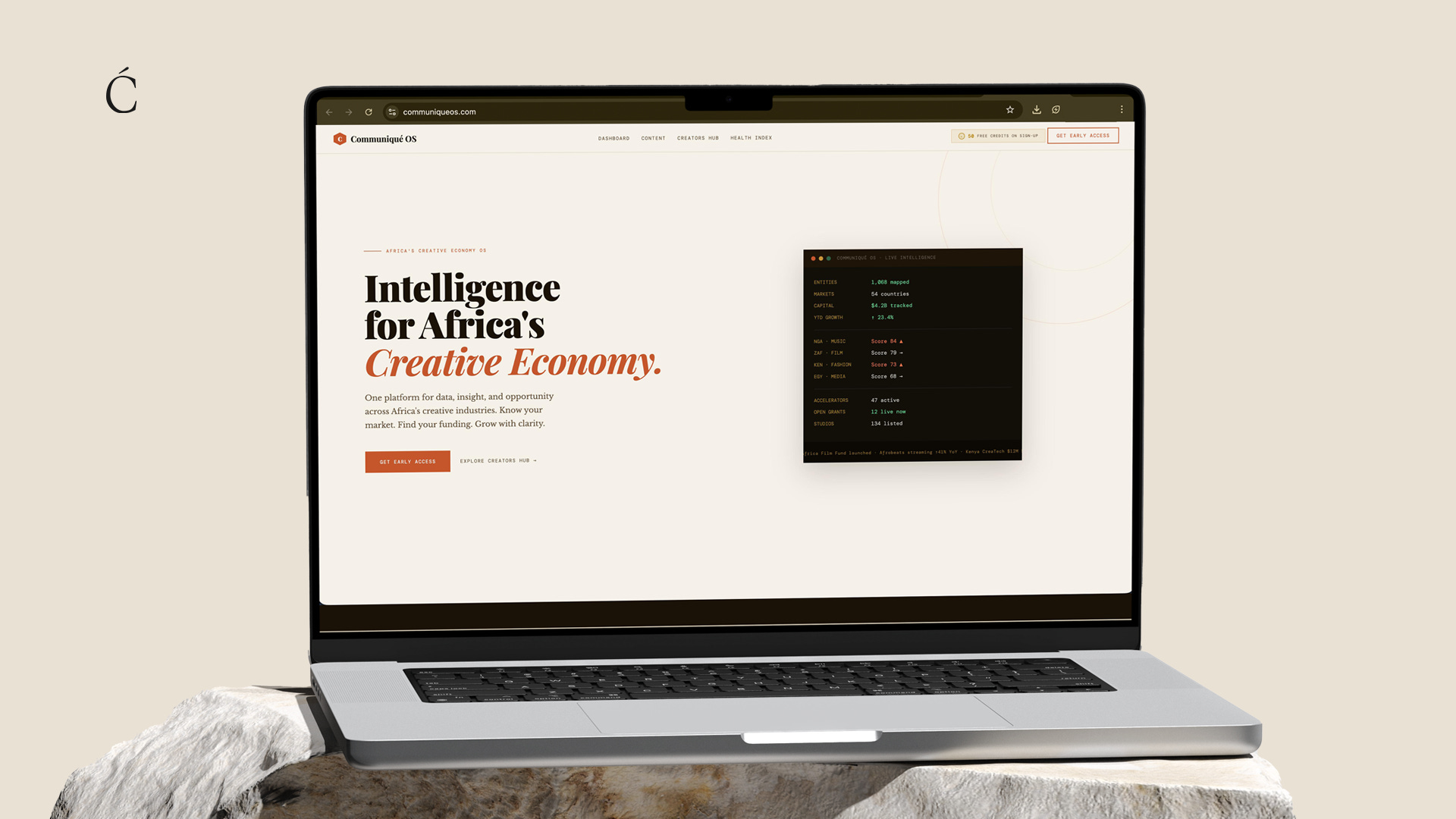
Above that sits the Creators Hub: a resource centre built specifically for Africa’s creative professionals. The tools that have always existed but never in the same place — accelerator listings, studio directories, legal contract templates built for the realities of this continent, a funding database that covers everything from the Afreximbank’s billion-dollar Africa Film Fund to smaller, sector-specific grants. The kind of information that, until now, required knowing the right person in the right room.
And holding all of it together is content and matchmaking: the connective tissue. The sector reports, playbooks, and interviews that help you understand where the industry is headed, paired with a routing engine that connects the right founders with the right investors.
None of these layers works in isolation. The data feeds the intelligence. The intelligence informs the resources. The content contextualises all of it. And the matchmaking engine brings it to life. The point is that an operating system is not a feature. It is the environment in which everything else runs.
4. Why do this?
We want to make the creative economy easier to navigate, build within, and invest in—a natural extension of the work we’ve been doing for the last six years. Communiqué OS brings together the insights, resources, and playbooks from our essays under one roof. It is for the founders, creators, investors, policymakers, researchers, and media professionals who want to build businesses, invest in companies and ideas, understand where things are headed, and how to prepare for the future.
For a long time, the problem has not just been access to information, but access to structured and unified information. The kind that helps make high-quality decisions and gives clarity.
Of course, none of this works without a sustainable business model. From the beginning, we knew this could not be just a grant-funded experiment (we won’t say no to the right grants, though) or a one-off research initiative. It has to be a product people are willing to pay for because it delivers clear, consistent value. Our approach to monetisation reflects that.
Communiqué OS will not be a pure subscription platform. Instead, users will purchase credits and expend them only when needed. We believe this approach better aligns with our market reality and puts the onus of trust and utility on us.
5. And how do we get there?
Building the platform is one part of the challenge; gathering the data is the other. For years, the dominant narrative has been that Africa’s creative economy lacks data. But we have found that the issue is not always the absence of data. It is the absence of systems capable of consistently capturing, structuring, and updating it.
Much of the most valuable information in this industry does not reside in the public domain. It lives in people’s experiences, the decisions they make, and the patterns they notice before other people. That kind of insight is often difficult to capture with traditional methods.
We’ve seen that reports help, but they are static. By the time we publish them, parts of the story have already changed. Instead, we need something more dynamic, something that evolves as quickly as the industry itself.
This is why we are introducing the Communiqué Intelligence Panel, a curated group of professionals and consumers across the creative economy who will contribute to a continuous stream of insight about what is really happening on the ground.
Instead of waiting months to compile a report, we can now ask focused questions in real time. Instead of relying solely on external datasets, we can capture lived experience directly from the people who shape the industry and consume its products. Instead of publishing isolated snapshots, we can begin to track patterns over time.
The process is intentionally simple. People register their interest, tell us a bit about who they are and what parts of the ecosystem they understand best, and if selected, become part of the private research community. This way, we ensure that we are not just building Communiqué OS for the ecosystem, but alongside it.
One year ago, we launched a primitive database. One year later, that database has grown into something much bigger and more audacious. Who knows what it’ll be another year from today?
For now, however, we invite you to take the next step with us. Join the Communiqué OS waitlist and register your interest to be a part of our Intelligence Panel.