


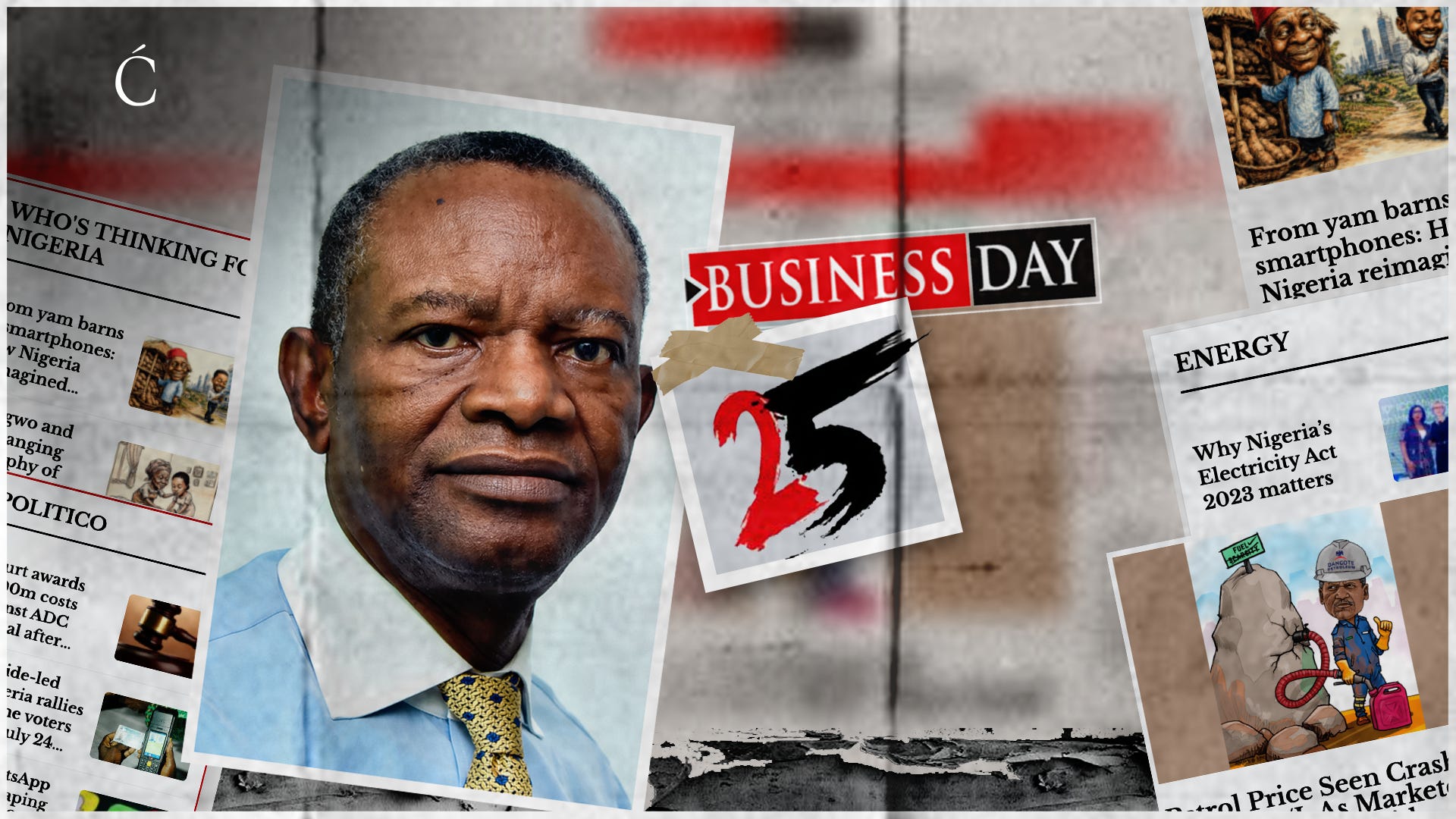
1. 25 years in the making
Frank Aigbogun did not set out to build Nigeria’s leading business publication. After 14 years at Vanguard, rising from pioneer news editor to general editor across all titles, he wanted out. The plan was plastic manufacturing. But investors would not back that venture. What they wanted to fund was journalism, which he knew how to do. So he picked up his pen again.
In 2001, he launched BusinessDay with a clear ambition: to become Nigeria’s top provider of business and financial intelligence. The market already had business publications at the time, but most of them were published weekly. Aigbogun believed that there was a fundamental misunderstanding of the market’s rhythm. Deals close, policy shifts, companies report, capital moves, and executives decide every working day, not just on Mondays. If BusinessDay was going to serve that audience properly, it had to show up every business day.
But it started as a weekly publication, even though the ambition was always to publish daily. The transition was brutal. BusinessDay had to teach the market that a daily business newspaper was necessary. That meant printing copies of papers they were unsure would sell out, only to watch many of them go unsold. By Aigbogun’s own account, the company burned roughly ₦200 million getting there.
What made the bet bearable was capitalisation. BusinessDay was never a sole proprietorship. Aigbogun brought in investors from the start. In 2002, Dick Kramer — founder of Arthur Andersen Nigeria and co-founder of the Nigerian Economic Summit Group and Lagos Business School — took a 40% stake through his private equity firm, African Capital Alliance. Two years later, that stake grew to roughly 60%, when ACA formed Johnnic West Africa Limited as a joint venture with Johnnic Communications of South Africa, then owner of Business Day South Africa.
That structure gave BusinessDay something most Nigerian media companies don’t have: patient capital and institutional discipline. Equity, not debt, funded the transition to daily publishing. Had the company leveraged bank debt to fund that move, it likely wouldn’t have survived it. Instead, its early investors gave the paper room to fight for market share without a repayment clock ticking.
Capital wasn’t the whole story. BusinessDay also built governance around itself. Its founding board was chaired by the economist Pat Utomi and stocked with people willing to ask management hard questions. Alongside it, an editorial advisory board led by Dick Kramer met regularly for more than a decade: testing story ideas, questioning editors, keeping the publication honest about its purpose.
You’re reading Communiqué because someone in the Inner Circle paid for it. Pay it forward.
2. The editor’s pipeline
Business reporting demands a different skill set from political or general-interest journalism: fluency in monetary policy and market behaviour, the ability to read a company’s annual report and balance sheet, and the discipline to write about both authoritatively for a high-level audience. BusinessDay’s institutional structure also gave its reporters something rarer: access. Company executives, regulators, and investors spoke to BusinessDay journalists with a candour they rarely extended to general-interest reporters, precisely because the paper had built a reputation for treating that information seriously. Those two things — technical fluency and institutional access — are exactly what international publications look for when covering emerging markets. It’s no accident that BusinessDay alumni, including Anthony Osae-Brown and Tayo Fagbule, went on to senior roles at Bloomberg and CNBC.
That movement is a function of how the newsroom was built. The macro factor is Nigeria’s business journalism market itself. Before BusinessDay, there was no daily training ground for reporters who wanted to cover markets, companies, and policy with the rigour that international outlets expect. Weekly titles produce generalists; a daily business desk produces specialists, because the volume forces reporters to develop a real understanding of specific sectors — banking, energy, capital markets — rather than covering business as one beat among many.
The micro factor is the editorial board that Aigbogun built early on. A board that meets for a decade, testing editors’ judgment and pushing back on weak stories, does something specific: it trains editors to defend their calls under scrutiny before they ever have to do it in front of a Bloomberg or CNBC assignment desk. That’s a skill international newsrooms hire for directly. BusinessDay’s editorial discipline wasn’t just a governance mechanism; it was, functionally, a training curriculum.
The result is that BusinessDay hasn’t just retained talent; it has also exported it to global business outlets. That, in itself, is a strong signal of credibility.
3. Teaching a market to pay
BusinessDay has also refused to treat the newspaper as a fixed product. It was built around print, but it did not stay there.
In 2015, it became the first Nigerian publication to launch a digital subscription product. At the time, paywalls were a hard sell in Nigerian media. Readers expected news for free online, and advertising still drove most of the digital business logic. BusinessDay made a different argument that if the journalism was useful enough for executives, investors, policymakers, and professionals to act on, it was valuable enough to pay for.
“If we practise good journalism, then it should be worth paying for,” Aigbogun said in an interview marking the paper’s 25th anniversary. “We have a mantra that, going forward, our focus will be journalism for a paying audience. We have no apologies about that. We would rather do that than ask people to donate to us.”
That strategy fit the audience like a glove. Unlike general-interest papers chasing individual readers, BusinessDay built a B2B subscription base comprising banks and financial services firms buying bulk access for their staff, executives, and high-net-worth clients.
Even the subscription model has evolved. In 2023, BusinessDay took down its paywall to re-strategise. During that period, readership quadrupled, and the newsroom used the data to study what readers actually liked and what they would pay for. By 2025, it had restored the paywall, with a sharper understanding of audience behaviour than before.
Your contribution funds: Original reporting, data licensing, and a small editorial team that actually answers your replies. No ads, no paywalls.
4. The events engine
BusinessDay’s other major pillar is events. In 2009, it launched the CEO Forum, now one of Nigeria’s leading executive gatherings. From there, it built out sector-specific conferences across agriculture, finance, luxury, entertainment, pensions, real estate, and technology. In 2024, it hosted 38 events, generating about 32% of annual revenue.
That growth follows a pattern we now see across global media, where platforms use their journalism to reach influential audiences, and then they bring those audiences into physical spaces. Semafor offers a useful comparison. The American media startup grew its events portfolio from 12 events in 2022 to 80 in 2025, with events generating more than half of its reported $80 million annual revenue.
BusinessDay has built a healthy revenue mix that now includes paper sales, advertisements, subscriptions and events. Its twelfth event this year was the Creative Entertainment Summit, focused on Afrobeats monetisation, IP ownership, and royalty structures. That a business publication, not a culture outlet, is the one asking those questions is itself informative: it signals that BusinessDay defines “business” wide enough to include the creative economy’s commercial infrastructure.
The same instinct to meet the audience where it actually is has pushed BusinessDay into video. It now operates BusinessDay TV, launched in 2023 as a digital-first channel, streamed online and across social platforms. It is designed to bring the paper’s reporting and analysis to readers who now consume business information first on their phones and social feeds.
That’s the actual genius of BusinessDay after 25 years. Its survival hasn’t come from nostalgia for print but from rebuilding around its audience’s needs at every step: first, daily publishing; then subscriptions; then events; now, video. As Aigbogun puts it: “I think it’s important for journalism to continue to recreate itself, to continue to create a connection with society, to continue to create something that is local and of interest to the people. But more importantly, to be sure that whatever it does resonates with the people.”

Founders Connect Live Show is back! It is happening on July 18, 2026, in Lagos, and this year, the interview is the entire event.
One stage. One host. Honest conversations with some of Africa’s most interesting builders, live and unscripted, with you in the room.
For years, my generation of Nigerian journalists wondered how Aigbogun was able to break through with Business Day. This is the first time we're reading an indepth report of the breakthrough. Great article!